












Solubility of Nd2O3 in LiF and LiF–NdF3 molten salts
Literature Information
Publication Date
2024-01-02
DOI
10.1039/D3NJ04179D
Impact Factor
3.591
Authors
View Original
Abstract
Accurately measuring the solubility of Nd2O3 in the LiF–NdF3 molten salt system is of great significance for establishing a reasonable feeding system for the electrolytic production of the rare earth metal neodymium and its alloys. Based on the isothermal saturation method, this article developed a membrane method for accurately measuring the solubility of rare earth oxides in molten salts, which solves the problem that the solubility values obtained by traditional isothermal saturation methods are too high due to the presence of undissolved Nd2O3 or NdOF in the molten salt supernatant. This method also has reference value for studying the solubility of other substances in molten salts. Simultaneously, the experimental process uses NdOF instead of Nd2O3 to indirectly study the solubility of Nd2O3 in LiF–NdF3 molten salt, solving the problem of analysis errors caused by chemical reactions between Nd2O3 and NdF3 in the molten salt system. The effects of dissolution time, dissolution temperature, and NdF3 concentration on the solubility of Nd2O3 were studied in detail. The experimental results show that, under the conditions of 1373 K and 9 h dissolution time in LiF molten salt, the maximum solubility of Nd2O3 is 0.32% (wt%). In the LiF–NdF3 binary molten salt system, when the concentration of NdF3 is 23 mol%, the maximum solubility of Nd2O3 is 2.77% (wt%) in the temperature range of 1173 K to 1373 K. At 1273 K, when the concentration of NdF3 is in the range of 16 mol% to 45.5 mol%, the maximum solubility is 3.37% (wt%), which provides basic data for the formulation of an accurate feeding system for electrolytic neodymium production. Using EPMA, the analysis of the quenched sample of the LiF–23 mol% NdF3–3.5 wt% Nd2O3 molten salt system at 1473 K revealed the presence of the Nd3O2F5 compound in the system.
Related Literature
Synthesis of microporous polymers by Friedel–Crafts reaction of 1-bromoadamantane with aromatic compounds and their surface modification
Ho Lim, Min Chul Cha, Ji Young Chang
2012-02-16
Communication
DOI: 10.1039/C2PY00511E
Synthesis of novel cylindrical bottlebrush polypseudorotaxane via inclusion complexation of high density poly(ε-caprolactone) bottlebrush polymer and α-cyclodextrins
Qiang Fu, Jing. M. Ren, Greg. G. Qiao
2011-11-11
Paper
DOI: 10.1039/C1PY00362C
Synthesis of low-temperature benzocyclobutene cross-linker and utilization
Julia N. Dobish, Sharon K. Hamilton, Eva Harth
2012-01-30
Communication
DOI: 10.1039/C2PY00606E
High relaxivity MRI imaging reagents from bimodal star polymers
Chinessa T. Adkins, Julia N. Dobish, Clifford S. Brown, Brian Mayrsohn, Sharon K. Hamilton, Felicia Udoji, Kelly Radford, Thomas E. Yankeelov, John C. Gore, Eva Harth
2011-11-29
Paper
DOI: 10.1039/C1PY00474C
Temperature-sensitive nanogels: poly(N-vinylcaprolactam) versus poly(N-isopropylacrylamide)
Jose Ramos, Ainara Imaz, Jacqueline Forcada
2011-12-16
Minireview
DOI: 10.1039/C2PY00485B
From a benzodiazaborole-based compound to donor–acceptor polymervia electropolymerization
Shotaro Hayashi, Toshio Koizumi
2012-01-16
Communication
DOI: 10.1039/C2PY00563H
High molecular weight acrylonitrile–butadiene architectures via a combination of RAFT polymerization and orthogonal copper mediated azide–alkyne cycloaddition
Christoph J. Dürr, Sebastian G. J. Emmerling, Paul Lederhose, Andreas Kaiser, Sven Brandau, Michael Klimpel, Christopher Barner-Kowollik
2012-02-07
Paper
DOI: 10.1039/C2PY00547F
Controlled biomimetic silica formation using star-shaped poly(l-lysine)
Qinrong Wang, Jun Yu, Yunsong Yan, Shaoqiang Xu, Fangfang Wang, Qingnan Li, Jinzhi Wang, Xin Zhang, Daojun Liu
2012-03-21
Paper
DOI: 10.1039/C2PY20070H
Two dimensional size controlled confinement of poly(vinyl pyrrolidone) in the interlayer space of swelling clay mineral
Minoru Sohmiya, Shingo Omata
2012-02-10
Paper
DOI: 10.1039/C2PY00465H
Simple efficient one-pot synthesis of 5-hydroxymethylfurfural and 2,5-diformylfuran from carbohydrates
Boris Estrine, Norbert Hoffmann, Jean Le Bras, Siniša Marinković, Jacques Muzart
2015-11-04
Paper
DOI: 10.1039/C5RE00004A
You might also like
Compound Q&A
What industries use 4-(4-tert-Butylphenyl)-1H-pyrazol-3-amine (CAS: 1015845-73-4)?
4-(4-tert-Butylphenyl)-1H-pyrazol-3-amine finds applications in various industri...
1015845-73-44-(4-tert-Butylpheny...
Compound Q&A
What industries use H3TATAB (CAS: 63557-10-8)?
H3TATAB is used in the pharmaceutical industry for the synthesis of certain orga...
63557-10-8H3TATAB
Compound Q&A
What are the main uses of 1-Ethyl-3-fluorobenzene (CAS: 696-39-9)?
1-Ethyl-3-fluorobenzene (CAS: 696-39-9) is primarily used as a precursor in the ...
696-39-91-Ethyl-3-fluorobenz...
Compound Q&A
What are the main uses of 1-(tert-Butoxycarbonyl)-4-(4-methoxyphenyl)pyrrolidine-3-carboxylic acid (CAS: 851484-94-1)?
1-(tert-Butoxycarbonyl)-4-(4-methoxyphenyl)pyrrolidine-3-carboxylic acid is prim...
851484-94-11-(tert-Butoxycarbon...
Compound Q&A
What are the physical and chemical properties of 1-Cyclobutyl-4-piperidinone (CAS: 359880-05-0)?
1-Cyclobutyl-4-piperidinone (CAS: 359880-05-0) is a colorless or white crystalli...
359880-05-01-Cyclobutyl-4-piper...
Compound Q&A
What is Pyridine-2,6-dicarboxylic acid mono-tert-butyl ester (CAS: 575433-76-0)?
Pyridine-2,6-dicarboxylic acid mono-tert-butyl ester (CAS: 575433-76-0) is a che...
575433-76-0Pyridine-2,6-dicarbo...
Compound Q&A
What is the market or research trend for 2,3-Difluorophenylalanine (CAS: 236754-62-4)?
The market for 2,3-Difluorophenylalanine (CAS: 236754-62-4) is growing with incr...
236754-62-42,3-Difluorophenylal...
Compound Q&A
How is (2-Hydroxy-1-naphthyl)boronic acid (CAS: 898257-48-2) typically synthesized?
(2-Hydroxy-1-naphthyl)boronic acid can be synthesized through the reduction of 2...
898257-48-2(2-Hydroxy-1-naphthy...
Compound Q&A
What are the physical and chemical properties of tert-Butyl (5-bromo-6-methyl-3-(4,4,5,5-tetramethyl-1,3,2-dioxaborolan-2-yl)pyridin-2-yl)carbamate (CAS: 1315351-28-0)?
This compound is a crystalline solid with a molecular weight of approximately 52...
1315351-28-0tert-Butyl (5-bromo-...
Compound Q&A
Are there alternatives to 5,7-Dihydroxy-4-oxo-2-(3,4,5-trihydroxyphenyl)-4H-chromen-3-yl beta-D-glucopyranoside (CAS: 19833-12-6) in synthesis?
While 5,7-Dihydroxy-4-oxo-2-(3,4,5-trihydroxyphenyl)-4H-chromen-3-yl beta-D-gluc...
19833-12-65,7-Dihydroxy-4-oxo-...
Source Journal
New Journal of Chemistry

CiteScore:
5.3
Self-citation Rate:
3.7%
Articles per Year:
2153
NJC (New Journal of Chemistry) is a broad-based primary journal encompassing all branches of chemistry and its sub-disciplines. It contains full research articles, communications, perspectives and focus articles. This well-established journal, owned by the Centre National de la Recherche Scientifique (CNRS) of France, has been co-published with the Royal Society of Chemistry since January 1998. NJC is the forum for the publication of high-quality, original and significant work that opens new directions in chemistry or other scientific disciplines. In addition to having a significant chemical component, work published in NJC must demonstrate that it will have an impact on areas of research other than that of the reported work.
Recommended Compounds
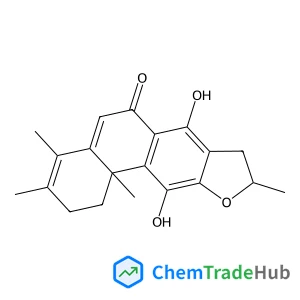
Phenanthro(3,2-b)furan-6(2H)-one, 1,8,9,11b-tetrahydro-7,11-dihydroxy-3,4,9,11b-tetramethyl-, cis-
CAS Number:
99624-92-7
Molecular Formula:
C20H22O4
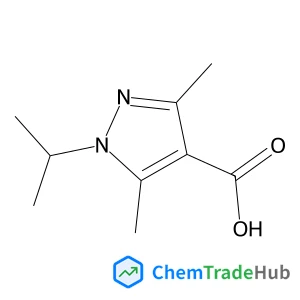
1-isopropyl-3,5-dimethyl-1H-pyrazole-4-carboxylic acid
CAS Number:
1007542-01-9
Molecular Formula:
C9H14N2O2
![Ethyl 2-[(3-bromo-4-pyridinyl)sulfanyl]-2-methylpropanoate structure](https://static.chemtradehub.com/structs/135/1352794-86-5-a8aa.webp "Ethyl 2-[(3-bromo-4-pyridinyl)sulfanyl]-2-methylpropanoate structure")
Ethyl 2-[(3-bromo-4-pyridinyl)sulfanyl]-2-methylpropanoate
CAS Number:
1352794-86-5
Molecular Formula:
C11H14BrNO2S
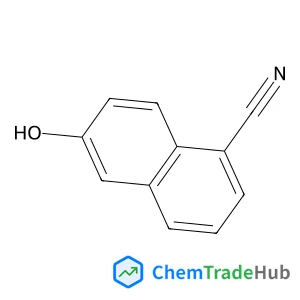
Recommended Suppliers




Disclaimer
This page provides academic journal information for reference and research purposes only. We are not affiliated with any journal publishers and do not handle publication submissions. For publication-related inquiries, please contact the respective journal publishers directly.
If you notice any inaccuracies in the information displayed, please contact us at support@chemtradehub.com. We will promptly review and address your concerns.