












A new Cu(ii) complex derived from the reaction between tris(2-aminoethyl)amine and Cu(i)-activated acetonitrile with potent anticancer activity against some cell lines and high affinity for the essential proteins of SARS-CoV-2
Literature Information
Publication Date
2024-01-12
DOI
10.1039/D3NJ04142E
Impact Factor
3.591
Authors
Farshid Hajibabaei, Sadegh Salehzadeh, Robert William Gable
View Original
Abstract
In this project a water-soluble Cu(II) complex, [CuL]Cl·H2O (L = N){(CH2CH2NC(CH3)NH2)2(CH2CH2NC(CH3)NHCOO−)}, was synthesized through an amidation–oxidation reaction between Cu(I) ions, tris(2-aminoethyl)amine (tren), CH3CN and CO2 molecules in acetonitrile–methanol solution. The above complex was characterized using FT-IR, CHN analysis and by single crystal X-ray structure determination. The structural analysis shows that the tertiary nitrogen atom, three imine nitrogen atoms of the amidine groups and one oxygen atom of the anionic terminal carbamate group of the ligand are all coordinated to the central Cu(II) ion. The DNA interaction studies of the complex with calf thymus DNA (ct-DNA) were carried out using viscosity measurements, UV-Vis and competitive fluorescence spectroscopies and molecular docking simulations. All the above experimental measurements in solution as well as the docking simulations showed that the above complex binds to DNA via a minor groove binding mode. Also, the anticancer activity of the complex against MCF-7, CT-26 and normal HEK-293 cell lines were evaluated and compared with cisplatin (CP) as a reference anticancer drug. The results showed that the toxicity caused by the complex in all of cells is comparable to CP. Furthermore, the affinity of the complex for the essential proteins of the SARS-CoV-2 virus was also simulated. The obtained binding affinity values by Vina indicated that the complex has favorable binding affinity when compared to favipiravir, hydroxychloroquine and remdesivir, all potent anti-COVID-19 agents.
Recommended Journals
Related Literature
Hyperbranched glycoconjugated polymer from natural small molecule kanamycin as a safe and efficient gene vector
Jieli Wu, Linzhu Zhou, Chengyu Jin, Chunlai Tu, Bangshang Zhu, Qi Zhu, Deyue Yan
2011-09-19
Paper
DOI: 10.1039/C1PY00333J
Synthesis of DNA intercalator–immobilized cyclodextrin and interaction with double-stranded DNA: Utilization of DNA–cyclodextrin conjugated material as an environmental remediation material
Masanori Yamada, Masamitsu Inoue, Tetsuya Yamada
2012-03-23
Paper
DOI: 10.1039/C2PY00007E
High relaxivity MRI imaging reagents from bimodal star polymers
Chinessa T. Adkins, Julia N. Dobish, Clifford S. Brown, Brian Mayrsohn, Sharon K. Hamilton, Felicia Udoji, Kelly Radford, Thomas E. Yankeelov, John C. Gore, Eva Harth
2011-11-29
Paper
DOI: 10.1039/C1PY00474C
Recognition of polymer side chains by cyclodextrins
Akihito Hashidzume
2011-06-07
Review Article
DOI: 10.1039/C1PY00162K
Recent progress on phosphonate vinyl monomers and polymers therefore obtained by radical (co)polymerization
G. David, C. Negrell-Guirao, F. Iftene, B. Boutevin, K. Chougrani
2011-09-23
Review Article
DOI: 10.1039/C1PY00276G
Supramolecular design for polymer/titanium oxo-cluster hybrids: an open door to new organic–inorganic dynamers
Costantino Creton
2011-10-03
Communication
DOI: 10.1039/C1PY00341K
Synthesis of biodegradable polymers from renewable resources
Mathieu J.-L. Tschan, Emilie Brulé, Pierre Haquette, Christophe M. Thomas
2011-12-19
Review Article
DOI: 10.1039/C2PY00452F
Novel optically active helical poly(N-propargylthiourea)s: synthesis, characterization and complexing ability toward Fe(iii) ions
Ci Song, Lei Li, Fangjie Wang, Jianping Deng, Wantai Yang
2011-10-21
Paper
DOI: 10.1039/C1PY00457C
Hierarchical self-assembly and secondary structures of linear polypeptides graft onto POSS in the side chain through click chemistry
Yung-Chih Lin, Shiao-Wei Kuo
2011-11-15
Paper
DOI: 10.1039/C1PY00381J
You might also like
Compound Q&A
What industries use 4-(4-tert-Butylphenyl)-1H-pyrazol-3-amine (CAS: 1015845-73-4)?
4-(4-tert-Butylphenyl)-1H-pyrazol-3-amine finds applications in various industri...
1015845-73-44-(4-tert-Butylpheny...
Compound Q&A
What industries use H3TATAB (CAS: 63557-10-8)?
H3TATAB is used in the pharmaceutical industry for the synthesis of certain orga...
63557-10-8H3TATAB
Compound Q&A
What are the main uses of 1-Ethyl-3-fluorobenzene (CAS: 696-39-9)?
1-Ethyl-3-fluorobenzene (CAS: 696-39-9) is primarily used as a precursor in the ...
696-39-91-Ethyl-3-fluorobenz...
Compound Q&A
What are the main uses of 1-(tert-Butoxycarbonyl)-4-(4-methoxyphenyl)pyrrolidine-3-carboxylic acid (CAS: 851484-94-1)?
1-(tert-Butoxycarbonyl)-4-(4-methoxyphenyl)pyrrolidine-3-carboxylic acid is prim...
851484-94-11-(tert-Butoxycarbon...
Compound Q&A
What are the physical and chemical properties of 1-Cyclobutyl-4-piperidinone (CAS: 359880-05-0)?
1-Cyclobutyl-4-piperidinone (CAS: 359880-05-0) is a colorless or white crystalli...
359880-05-01-Cyclobutyl-4-piper...
Compound Q&A
What is Pyridine-2,6-dicarboxylic acid mono-tert-butyl ester (CAS: 575433-76-0)?
Pyridine-2,6-dicarboxylic acid mono-tert-butyl ester (CAS: 575433-76-0) is a che...
575433-76-0Pyridine-2,6-dicarbo...
Compound Q&A
What is the market or research trend for 2,3-Difluorophenylalanine (CAS: 236754-62-4)?
The market for 2,3-Difluorophenylalanine (CAS: 236754-62-4) is growing with incr...
236754-62-42,3-Difluorophenylal...
Compound Q&A
How is (2-Hydroxy-1-naphthyl)boronic acid (CAS: 898257-48-2) typically synthesized?
(2-Hydroxy-1-naphthyl)boronic acid can be synthesized through the reduction of 2...
898257-48-2(2-Hydroxy-1-naphthy...
Compound Q&A
What are the physical and chemical properties of tert-Butyl (5-bromo-6-methyl-3-(4,4,5,5-tetramethyl-1,3,2-dioxaborolan-2-yl)pyridin-2-yl)carbamate (CAS: 1315351-28-0)?
This compound is a crystalline solid with a molecular weight of approximately 52...
1315351-28-0tert-Butyl (5-bromo-...
Compound Q&A
Are there alternatives to 5,7-Dihydroxy-4-oxo-2-(3,4,5-trihydroxyphenyl)-4H-chromen-3-yl beta-D-glucopyranoside (CAS: 19833-12-6) in synthesis?
While 5,7-Dihydroxy-4-oxo-2-(3,4,5-trihydroxyphenyl)-4H-chromen-3-yl beta-D-gluc...
19833-12-65,7-Dihydroxy-4-oxo-...
Source Journal
New Journal of Chemistry

CiteScore:
5.3
Self-citation Rate:
3.7%
Articles per Year:
2153
NJC (New Journal of Chemistry) is a broad-based primary journal encompassing all branches of chemistry and its sub-disciplines. It contains full research articles, communications, perspectives and focus articles. This well-established journal, owned by the Centre National de la Recherche Scientifique (CNRS) of France, has been co-published with the Royal Society of Chemistry since January 1998. NJC is the forum for the publication of high-quality, original and significant work that opens new directions in chemistry or other scientific disciplines. In addition to having a significant chemical component, work published in NJC must demonstrate that it will have an impact on areas of research other than that of the reported work.
Recommended Compounds
![(3aR,7R,7aR)-2,2-Diethyl-3a,6,7,7a-tetrahydro-7-[(methylsulfonyl)oxy]-1,3-benzodioxole-5-carboxylic Acid Ethyl Ester structure](https://static.chemtradehub.com/structs/204/204254-90-0-7172.webp "(3aR,7R,7aR)-2,2-Diethyl-3a,6,7,7a-tetrahydro-7-[(methylsulfonyl)oxy]-1,3-benzodioxole-5-carboxylic Acid Ethyl Ester structure")
(3aR,7R,7aR)-2,2-Diethyl-3a,6,7,7a-tetrahydro-7-[(methylsulfonyl)oxy]-1,3-benzodioxole-5-carboxylic Acid Ethyl Ester
CAS Number:
204254-90-0
Molecular Formula:
C15H24O7S
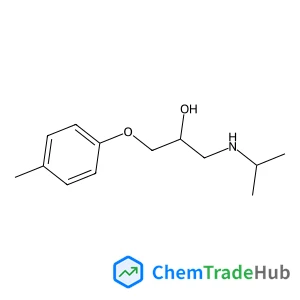
1-(4-Methylphenoxy)-3-(propan-2-ylamino)propan-2-ol
CAS Number:
5790-46-5
Molecular Formula:
C13H21NO2
Recommended Suppliers






Disclaimer
This page provides academic journal information for reference and research purposes only. We are not affiliated with any journal publishers and do not handle publication submissions. For publication-related inquiries, please contact the respective journal publishers directly.
If you notice any inaccuracies in the information displayed, please contact us at support@chemtradehub.com. We will promptly review and address your concerns.