













Novel optically active helical poly(N-propargylthiourea)s: synthesis, characterization and complexing ability toward Fe(iii) ions
Literature Information
Publication Date
2011-10-21
DOI
10.1039/C1PY00457C
Impact Factor
5.582
Authors
Ci Song, Lei Li, Fangjie Wang, Jianping Deng, Wantai Yang
View Original
Abstract
An enantiomeric pair of novel chiral N-propargylthiourea monomers (monomers 1 and 2) and their racemate (monomer 3) were synthesized and polymerized in the presence of (nbd)Rh+B−(C6H5)4 as a catalyst. The resulting poly(1) and poly(2) could adopt stable helices and demonstrate optical activity in solvents of low polarity (e.g.CHCl3), according to circular dichroism and optical rotation measurements. But for poly(3), no considerable CD signal was observed at 320 nm and above. Poly(1) and poly(2) kept stable helical structures in a temperature range from 0–60 °C, while failed to maintain helix in polar solvents. Helical poly(1) and poly(2) exhibited strong complexing ability towards Fe(III) ions, based on which novel sensors may be developed next.
Related Literature
Performance and durability of Pt/C cathode catalysts with different kinds of carbons for polymer electrolyte fuel cells characterized by electrochemical and in situ XAFS techniques
Kensaku Nagasawa, Shinobu Takao, Kotaro Higashi, Shin-ichi Nagamatsu, Gabor Samjeské, Yoshiaki Imaizumi, Oki Sekizawa, Takashi Yamamoto
2013-12-18
Paper
DOI: 10.1039/C3CP54457E
CO dissociation on magnetic Fen clusters
Alexis Markovits, Christian Minot, Manef Abderrabba, Michel A. Van Hove
2014-08-07
Paper
DOI: 10.1039/C4CP01527D
Retracted Article: Two-dimensional nanosheets associated with one-dimensional single-crystalline nanorods self-assembled into three-dimensional flower-like Mn3O4 hierarchical architectures
Mei Wang, Liming Cheng, Quanbao Li, Zhiwen Chen, Shilong Wang
2014-08-28
Paper
DOI: 10.1039/C4CP03407D
Towards the ionic limit of two-dimensional materials: monolayer alkaline earth and transition metal halides
Shi-Hsin Lin, Jer-Lai Kuo
2014-08-12
Paper
DOI: 10.1039/C4CP02048K
Excited states of protonated DNA/RNA bases
Matias Berdakin, Géraldine Féraud, Claude Dedonder-Lardeux, Christophe Jouvet, Gustavo A. Pino
2014-03-28
Paper
DOI: 10.1039/C4CP00742E
Resonant Raman spectra of molecules with diradical character: multiconfigurational wavefunction investigation of neutral viologens
Julia Romanova, Vincent Liégeois, Benoît Champagne
2014-08-28
Paper
DOI: 10.1039/C4CP02977A
Ultrafast resonance energy transfer in the umbelliferone–alizarin bichromophore
Pierangelo Fabbrizzi, Luisa Lascialfari, Stefano Cicchi, Malgorzata Biczysko, Fabrizio Santoro
2014-01-23
Paper
DOI: 10.1039/C3CP54609H
One-pot fabrication of novel cuboctahedral Cu2O crystals enclosed by anisotropic surfaces with enhancing catalytic performance
Shaodong Sun, Hongjia Zhang, LinLi Tang, Xiaozhe Zhang, Zhimao Yang
2014-08-20
Communication
DOI: 10.1039/C4CP03381G
Structural instabilities and wrinkles at the grain boundaries in 2-D h-BN: a first-principles analysis
Anjali Singh, Umesh V. Waghmare
2014-08-19
Paper
DOI: 10.1039/C4CP02267J
Photocatalytic generation of solar fuels from the reduction of H2O and CO2: a look at the patent literature
Stefano Protti, Angelo Albini, Nick Serpone
2014-07-28
Perspective
DOI: 10.1039/C4CP02828G
You might also like
Compound Q&A
What industries use 4-(4-tert-Butylphenyl)-1H-pyrazol-3-amine (CAS: 1015845-73-4)?
4-(4-tert-Butylphenyl)-1H-pyrazol-3-amine finds applications in various industri...
1015845-73-44-(4-tert-Butylpheny...
Compound Q&A
What industries use H3TATAB (CAS: 63557-10-8)?
H3TATAB is used in the pharmaceutical industry for the synthesis of certain orga...
63557-10-8H3TATAB
Compound Q&A
What are the main uses of 1-Ethyl-3-fluorobenzene (CAS: 696-39-9)?
1-Ethyl-3-fluorobenzene (CAS: 696-39-9) is primarily used as a precursor in the ...
696-39-91-Ethyl-3-fluorobenz...
Compound Q&A
What are the main uses of 1-(tert-Butoxycarbonyl)-4-(4-methoxyphenyl)pyrrolidine-3-carboxylic acid (CAS: 851484-94-1)?
1-(tert-Butoxycarbonyl)-4-(4-methoxyphenyl)pyrrolidine-3-carboxylic acid is prim...
851484-94-11-(tert-Butoxycarbon...
Compound Q&A
What are the physical and chemical properties of 1-Cyclobutyl-4-piperidinone (CAS: 359880-05-0)?
1-Cyclobutyl-4-piperidinone (CAS: 359880-05-0) is a colorless or white crystalli...
359880-05-01-Cyclobutyl-4-piper...
Compound Q&A
What is Pyridine-2,6-dicarboxylic acid mono-tert-butyl ester (CAS: 575433-76-0)?
Pyridine-2,6-dicarboxylic acid mono-tert-butyl ester (CAS: 575433-76-0) is a che...
575433-76-0Pyridine-2,6-dicarbo...
Compound Q&A
What is the market or research trend for 2,3-Difluorophenylalanine (CAS: 236754-62-4)?
The market for 2,3-Difluorophenylalanine (CAS: 236754-62-4) is growing with incr...
236754-62-42,3-Difluorophenylal...
Compound Q&A
How is (2-Hydroxy-1-naphthyl)boronic acid (CAS: 898257-48-2) typically synthesized?
(2-Hydroxy-1-naphthyl)boronic acid can be synthesized through the reduction of 2...
898257-48-2(2-Hydroxy-1-naphthy...
Compound Q&A
What are the physical and chemical properties of tert-Butyl (5-bromo-6-methyl-3-(4,4,5,5-tetramethyl-1,3,2-dioxaborolan-2-yl)pyridin-2-yl)carbamate (CAS: 1315351-28-0)?
This compound is a crystalline solid with a molecular weight of approximately 52...
1315351-28-0tert-Butyl (5-bromo-...
Compound Q&A
Are there alternatives to 5,7-Dihydroxy-4-oxo-2-(3,4,5-trihydroxyphenyl)-4H-chromen-3-yl beta-D-glucopyranoside (CAS: 19833-12-6) in synthesis?
While 5,7-Dihydroxy-4-oxo-2-(3,4,5-trihydroxyphenyl)-4H-chromen-3-yl beta-D-gluc...
19833-12-65,7-Dihydroxy-4-oxo-...
Source Journal
Polymer Chemistry

CiteScore:
8.6
Self-citation Rate:
7.3%
Articles per Year:
457
Polymer Chemistry welcomes submissions in all areas of polymer science that have a strong focus on macromolecular chemistry. Manuscripts may cover a broad range of fields, yet no direct application focus is required.
Recommended Compounds


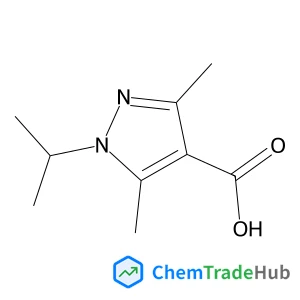
1-isopropyl-3,5-dimethyl-1H-pyrazole-4-carboxylic acid
CAS Number:
1007542-01-9
Molecular Formula:
C9H14N2O2
Recommended Suppliers






Disclaimer
This page provides academic journal information for reference and research purposes only. We are not affiliated with any journal publishers and do not handle publication submissions. For publication-related inquiries, please contact the respective journal publishers directly.
If you notice any inaccuracies in the information displayed, please contact us at support@chemtradehub.com. We will promptly review and address your concerns.