


Synthesis of DNA intercalator–immobilized cyclodextrin and interaction with double-stranded DNA: Utilization of DNA–cyclodextrin conjugated material as an environmental remediation material
Literature Information
Publication Date
2012-03-23
DOI
10.1039/C2PY00007E
Impact Factor
5.582
Authors
Masanori Yamada, Masamitsu Inoue, Tetsuya Yamada
View Original
Abstract
Intercalator–immobilized cyclodextrin (PβCD) was synthesized by the linking of various methylene chains between psoralen, one of the DNA intercalators found in nature, and β-cyclodextrin, a cyclic oligosaccharide. The psoralen part of the PβCD was intercalated into the double-stranded DNA and formed the stable DNA–PβCD conjugated material with UV irradiation at 365 nm. The DNA–PβCD conjugated material possessed both the functions of double-stranded DNA, such as intercalation, and cyclodextrin, such as encapsulation into the intramolecular cavity. As a result, planar structure-containing harmful compounds, such as dioxin and polychlorobiphenyl (PCB) derivatives, were accumulated by the intercalation of double-stranded DNA. Non-planar structure-containing compounds, such as bisphenol A and diethylstilbestrol, were accumulated by the encapsulation of cyclodextrin. Additionally, DNA–PβCD conjugated material can accumulate various harmful compounds from an aqueous multi-component solution, which contains the model endocrine disruptors. Furthermore, the accumulative amount of harmful compounds increased with the length of the methylene linker. Therefore, the DNA–PβCD conjugated material may have the potential for use in environmental remediation, such as the accumulation of harmful compounds from factory effluent.
Recommended Journals

Colloid Journal

Critical Reviews in Solid State and Materials Sciences

Bioorganic & Medicinal Chemistry Letters

Acta Metallurgica Sinica-English Letters

Chinese Journal of Chemistry

Electroanalysis

Medicinal Chemistry Research

Journal of Chemical Sciences

Journal of the Indian Institute of Science

Atomization and Sprays
Related Literature
The adsorption behaviour of CH4 on microporous carbons: effects of surface heterogeneity
Dongliang Jin, Xiaoqing Lu, Mingmin Zhang, Shuxian Wei, Qing Zhu, Xiaofan Shi, Yang Shao, Weili Wang, Wenyue Guo
2014-04-03
Paper
DOI: 10.1039/C3CP55107E
Resonant Raman spectra of molecules with diradical character: multiconfigurational wavefunction investigation of neutral viologens
Julia Romanova, Vincent Liégeois, Benoît Champagne
2014-08-28
Paper
DOI: 10.1039/C4CP02977A
Migration of Mn cations in delithiated lithium manganese oxides
Yuan Hu, Chi-Kai Lin, Yang Ren, Yang-Kook Sun, Zonghai Chen
2014-08-04
Paper
DOI: 10.1039/C4CP02795G
Measuring the Brønsted acid strength of zeolites – does it correlate with the O–H frequency shift probed by a weak base?
Carlos O. Arean, Montserrat R. Delgado, Petr Nachtigall, Ho Viet Thang, Miroslav Rubeš, Roman Bulánek, Pavla Chlubná-Eliášová
2014-01-30
Paper
DOI: 10.1039/C3CP54738H
Heterogeneous dynamics of ionic liquids in confined films with varied film thickness
Yong-Lei Wang, Zhong-Yuan Lu
2014-08-14
Paper
DOI: 10.1039/C4CP02843K
Specific ion effects on membrane potential and the permselectivity of ion exchange membranes
Harrison J. Cassady, Donald R. Paul
2014-08-26
Paper
DOI: 10.1039/C4CP03076A
The conjugated oligoelectrolyte DSSN+ enables exceptional coulombic efficiency via direct electron transfer for anode-respiring Shewanella oneidensis MR-1—a mechanistic study
Nathan D. Kirchhofer, Xiaofen Chen, Enrico Marsili, James J. Sumner, Frederick W. Dahlquist
2014-07-25
Communication
DOI: 10.1039/C4CP03197K
Theoretical investigation on structural and electronic properties of organic dye C258 on TiO2(101) surface in dye-sensitized solar cells
Ping-Ping Sun, Quan-Song Li, Li-Na Yang, Zhu-Zhu Sun, Ze-Sheng Li
2014-08-26
Paper
DOI: 10.1039/C4CP02951H
Stability and binding interaction of bilirubin on a gold nano-surface: steady state fluorescence and FT-IR investigation
Mritunjoy Maity, Supriya Das, Nakul C. Maiti
2014-08-01
Paper
DOI: 10.1039/C4CP02649G
Complex refractive indices in the near-ultraviolet spectral region of biogenic secondary organic aerosol aged with ammonia
J. M. Flores, G. Adler, H. J. Lee, L. Segev, J. Laskin, A. Laskin, S. A. Nizkorodov, S. S. Brown, Y. Rudich
2014-04-10
Paper
DOI: 10.1039/C4CP01009D
You might also like
Compound Q&A
What industries use 4-(4-tert-Butylphenyl)-1H-pyrazol-3-amine (CAS: 1015845-73-4)?
4-(4-tert-Butylphenyl)-1H-pyrazol-3-amine finds applications in various industri...
1015845-73-44-(4-tert-Butylpheny...
Compound Q&A
What industries use H3TATAB (CAS: 63557-10-8)?
H3TATAB is used in the pharmaceutical industry for the synthesis of certain orga...
63557-10-8H3TATAB
Compound Q&A
What are the main uses of 1-Ethyl-3-fluorobenzene (CAS: 696-39-9)?
1-Ethyl-3-fluorobenzene (CAS: 696-39-9) is primarily used as a precursor in the ...
696-39-91-Ethyl-3-fluorobenz...
Compound Q&A
What are the main uses of 1-(tert-Butoxycarbonyl)-4-(4-methoxyphenyl)pyrrolidine-3-carboxylic acid (CAS: 851484-94-1)?
1-(tert-Butoxycarbonyl)-4-(4-methoxyphenyl)pyrrolidine-3-carboxylic acid is prim...
851484-94-11-(tert-Butoxycarbon...
Compound Q&A
What are the physical and chemical properties of 1-Cyclobutyl-4-piperidinone (CAS: 359880-05-0)?
1-Cyclobutyl-4-piperidinone (CAS: 359880-05-0) is a colorless or white crystalli...
359880-05-01-Cyclobutyl-4-piper...
Compound Q&A
What is Pyridine-2,6-dicarboxylic acid mono-tert-butyl ester (CAS: 575433-76-0)?
Pyridine-2,6-dicarboxylic acid mono-tert-butyl ester (CAS: 575433-76-0) is a che...
575433-76-0Pyridine-2,6-dicarbo...
Compound Q&A
What is the market or research trend for 2,3-Difluorophenylalanine (CAS: 236754-62-4)?
The market for 2,3-Difluorophenylalanine (CAS: 236754-62-4) is growing with incr...
236754-62-42,3-Difluorophenylal...
Compound Q&A
How is (2-Hydroxy-1-naphthyl)boronic acid (CAS: 898257-48-2) typically synthesized?
(2-Hydroxy-1-naphthyl)boronic acid can be synthesized through the reduction of 2...
898257-48-2(2-Hydroxy-1-naphthy...
Compound Q&A
What are the physical and chemical properties of tert-Butyl (5-bromo-6-methyl-3-(4,4,5,5-tetramethyl-1,3,2-dioxaborolan-2-yl)pyridin-2-yl)carbamate (CAS: 1315351-28-0)?
This compound is a crystalline solid with a molecular weight of approximately 52...
1315351-28-0tert-Butyl (5-bromo-...
Compound Q&A
Are there alternatives to 5,7-Dihydroxy-4-oxo-2-(3,4,5-trihydroxyphenyl)-4H-chromen-3-yl beta-D-glucopyranoside (CAS: 19833-12-6) in synthesis?
While 5,7-Dihydroxy-4-oxo-2-(3,4,5-trihydroxyphenyl)-4H-chromen-3-yl beta-D-gluc...
19833-12-65,7-Dihydroxy-4-oxo-...
Source Journal
Polymer Chemistry

CiteScore:
8.6
Self-citation Rate:
7.3%
Articles per Year:
457
Polymer Chemistry welcomes submissions in all areas of polymer science that have a strong focus on macromolecular chemistry. Manuscripts may cover a broad range of fields, yet no direct application focus is required.
Recommended Compounds
![4-[2-(3,4-Dihydro-2H-chromen-6-yl)-1,3-oxazol-5-yl]-1-(3-{[(2,5-dioxo-1-pyrrolidinyl)oxy]carbonyl}benzyl)pyridinium bromide structure](https://static.chemtradehub.com/structs/155/155863-03-9-8183.webp "4-[2-(3,4-Dihydro-2H-chromen-6-yl)-1,3-oxazol-5-yl]-1-(3-{[(2,5-dioxo-1-pyrrolidinyl)oxy]carbonyl}benzyl)pyridinium bromide structure")
4-[2-(3,4-Dihydro-2H-chromen-6-yl)-1,3-oxazol-5-yl]-1-(3-{[(2,5-dioxo-1-pyrrolidinyl)oxy]carbonyl}benzyl)pyridinium bromide
CAS Number:
155863-03-9
Molecular Formula:
C29H24BrN3O6
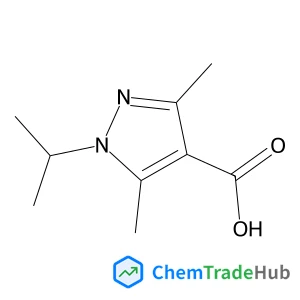
1-isopropyl-3,5-dimethyl-1H-pyrazole-4-carboxylic acid
CAS Number:
1007542-01-9
Molecular Formula:
C9H14N2O2
Recommended Suppliers






Disclaimer
This page provides academic journal information for reference and research purposes only. We are not affiliated with any journal publishers and do not handle publication submissions. For publication-related inquiries, please contact the respective journal publishers directly.
If you notice any inaccuracies in the information displayed, please contact us at support@chemtradehub.com. We will promptly review and address your concerns.