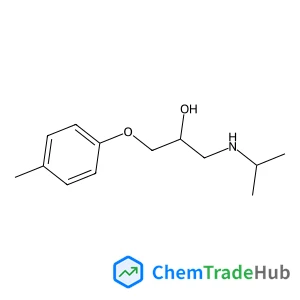
1-(4-Methylphenoxy)-3-(propan-2-ylamino)propan-2-ol
CAS Number:
5790-46-5
Molecular Formula:
C13H21NO2
Shengjie Liu, Xingyu Heng, Wenjin Wang, He Yang, Wei Sun, Zhaoqiang Wu, Hong Chen
Although cell transplantation has achieved great success in the treatment of many intractable diseases, due to the effect of an instant blood-mediated inflammatory reaction (IBMIR), blood clots usually form on the surface of transplanted cells, resulting in a significant reduction in the survival of transplanted cells. Inspired by the fibrinolytic mechanism in human blood, this paper constructs lysine ligand-containing copolymer-functionalized cell surfaces for fibrinolytic activity. First, a copolymer (POLF) of oligoethylene glycol methacrylate (OEGMA), 6-amino-2-(2-methacylamido)-hexanoic acid (Lys) and fluorescein O-methacrylate (FluMA) was synthesized by reversible addition–fragmentation chain transfer (RAFT) copolymerization. Then, the copolymer POLF was modified onto the HeLa cell surface by codeposition with dopamine. An in vitro study showed that compared to unmodified HeLa cells, modified cells not only have good cell viability but can also resist fibrinogen adsorption and selectively bind plasminogen from plasma. More importantly, upon activation of plasminogen adsorbed to plasmin, the modified cells were able to rapidly lyse fibrin formed on their surface. This study offers a novel proof-of-concept for constructing transplanted cells with fibrinolytic activity.

Bioorganic & Medicinal Chemistry

Herald of the Russian Academy of Sciences

Journal of Chemical Sciences

Electroanalysis

Chinese Journal of Chemistry

Colloid Journal

Medicinal Chemistry Research

Bioorganic & Medicinal Chemistry Letters

Journal of the Indian Institute of Science

Biocatalysis and Biotransformation
Matúš Dubecký, René Derian, Petr Jurečka, Lubos Mitas, Michal Otyepka
DOI: 10.1039/C4CP02093F
Mritunjoy Maity, Supriya Das, Nakul C. Maiti
DOI: 10.1039/C4CP02649G
Ravindra Shinde, Alok Shukla
DOI: 10.1039/C4CP02232G
Valeria Tagliazucca, Matteo Leoni, Claudia Weidenthaler
DOI: 10.1039/C4CP90131B
J. Pionteck, J. Jacquemin
DOI: 10.1039/C4CP02253J
Dariusz W. Szczepanik, Marcin Andrzejak, Karol Dyduch, Emil Żak, Marcin Makowski, Grzegorz Mazur, Janusz Mrozek
DOI: 10.1039/C4CP02932A
Julian Few, Gus Hancock
DOI: 10.1039/C4CP00740A
Deya Das, Sang Soo Han, Kwang-Ryeol Lee, Abhishek K. Singh
DOI: 10.1039/C4CP03251A
Yang Gao, Haoran Xu, Zhengqiang Li
DOI: 10.1039/C4CP03205E
Alexis Markovits, Christian Minot, Manef Abderrabba, Michel A. Van Hove
DOI: 10.1039/C4CP01527D
4-(4-tert-Butylphenyl)-1H-pyrazol-3-amine finds applications in various industri...
H3TATAB is used in the pharmaceutical industry for the synthesis of certain orga...
1-Ethyl-3-fluorobenzene (CAS: 696-39-9) is primarily used as a precursor in the ...
1-(tert-Butoxycarbonyl)-4-(4-methoxyphenyl)pyrrolidine-3-carboxylic acid is prim...
1-Cyclobutyl-4-piperidinone (CAS: 359880-05-0) is a colorless or white crystalli...
Pyridine-2,6-dicarboxylic acid mono-tert-butyl ester (CAS: 575433-76-0) is a che...
The market for 2,3-Difluorophenylalanine (CAS: 236754-62-4) is growing with incr...
(2-Hydroxy-1-naphthyl)boronic acid can be synthesized through the reduction of 2...
This compound is a crystalline solid with a molecular weight of approximately 52...
While 5,7-Dihydroxy-4-oxo-2-(3,4,5-trihydroxyphenyl)-4H-chromen-3-yl beta-D-gluc...
![6-Nitro-2-(4-nitrophenyl)imidazo[1,2-a]pyridine structure](https://static.chemtradehub.com/structs/118/118000-57-0-cb82.webp "6-Nitro-2-(4-nitrophenyl)imidazo[1,2-a]pyridine structure")
![(3aR,7R,7aR)-2,2-Diethyl-3a,6,7,7a-tetrahydro-7-[(methylsulfonyl)oxy]-1,3-benzodioxole-5-carboxylic Acid Ethyl Ester structure](https://static.chemtradehub.com/structs/204/204254-90-0-7172.webp "(3aR,7R,7aR)-2,2-Diethyl-3a,6,7,7a-tetrahydro-7-[(methylsulfonyl)oxy]-1,3-benzodioxole-5-carboxylic Acid Ethyl Ester structure")