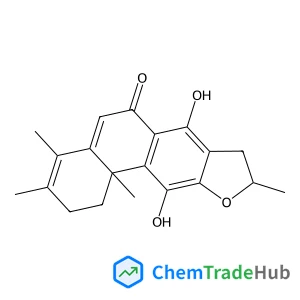
Phenanthro(3,2-b)furan-6(2H)-one, 1,8,9,11b-tetrahydro-7,11-dihydroxy-3,4,9,11b-tetramethyl-, cis-
CAS Number:
99624-92-7
Molecular Formula:
C20H22O4
Yang Gao, Haoran Xu, Zhengqiang Li
Binary coinage metal clusters can show a significantly different enhancement in surface-enhanced Raman scattering (SERS) from that of pure element clusters, owing to their tunable surface plasmon resonance energies affected by the composition and atomic ordering. Yet, the tunability by composition requires a deep understanding in order to further optimize the SERS-based detection technique. Here, to fill this deficiency, we conducted detailed analyses of the SERS of pyridine adsorbed through N–Ag bonding on the homonuclear diatomic metal cluster Ag2 and heteronuclear diatomic metal clusters of AuAg and CuAg, as well as the involved charge transfer under an intracluster excitation, based on calculations using time-dependent density functional theory with a short-time approximation for the Raman cross-section. We find that although the SERS enhancements for all complexes can reach the order of 103–104, the corresponding wavelengths used for SERS excitation are significantly different. Our molecular orbital analysis reveals that the complexes based on heteronuclear metal clusters can produce varied electronic transitions owing to the polarization between different metal atoms, which tune the SERS enhancements with altered optical properties. Our analyses are expected to provide a theoretical basis for exploring the multi-composition SERS substrates applicable for single molecular detection, nanostructure characterization, and biological molecular identification.
Kanako Sekimoto, Motoshi Sakakura, Takatomo Kawamukai, Hiroshi Hike, Teruhisa Shiota, Fumihiko Usui, Yasuhiko Bando, Mitsuo Takayama
DOI: 10.1039/C6AN00779A
Claudia Conti, Alessandra Botteon, Chiara Colombo, Marco Realini, Pavel Matousek
DOI: 10.1039/C6AN00852F
Julie Docherty, Samuel Mabbott, Ewen Smith, Karen Faulds, Christine Davidson, John Reglinski, Duncan Graham
DOI: 10.1039/C6AN01584K
Yichu Shan, Zhigang Sui, Qi Wu, Lihua Zhang, Zhen Liang, Yukui Zhang
DOI: 10.1039/C6AN00388E
Christina R. Ferreira, Karen E. Yannell, Brit Mollenhauer, Ryan D. Espy, Fernanda B. Cordeiro, Z. Ouyang, R. G. Cooks
DOI: 10.1039/C6AN01618A
Bin Yang, Jianping Li, Lianming Zhang
DOI: 10.1039/C6AN00926C
Grace Lu, Tori Z. Forbes, Amanda J. Haes
DOI: 10.1039/C6AN00891G
Yih Hong Lee, Jonathan Yong Chew Ho, Yijie Yang, Xing Yi Ling
DOI: 10.1039/C6AN01239F
When handling 2-Chloro-1,2-bis(4-methylphenyl)ethanone (CAS: 71193-32-3), it is ...
4-Ethoxy-3-(5-methyl-4-oxo-7-propyl-1,4-dihydroimidazo[5,1-f][1,2,4]triazin-2-yl...
Methyl 3-Oxo-4-Androsten-17-Carboxylate (CAS: 2681-55-2) should be stored in a c...
(R)-3-Amino-4-(3-hexylphenylamino)-4-oxobutylphosphonic acid is primarily used i...
2-Methyl-2-propanyl 3-amino-3-carbamoyl-1-azetidinecarboxylate (CAS: 1254120-14-...
There are alternative reagents that can be used in synthesis instead of (E)-4-(t...
[2-(3-Chlorophenyl)-1,3-thiazol-4-yl]methanol (CAS: 121202-20-8) is a crystallin...
The market and research trends for Methyl (2S)-[(4S)-2,2-dimethyl-1,3-dioxolan-4...
The market for 1-Bromo-2-isocyanatoethane (CAS: 42865-19-0) is driven by its use...
4-Nitro-D-phenylalanine hydrochloride (CAS: 147065-06-3) is primarily used in re...

Physical Chemistry Chemical Physics (PCCP) is an international journal co-owned by 19 physical chemistry and physics societies from around the world. This journal publishes original, cutting-edge research in physical chemistry, chemical physics and biophysical chemistry. To be suitable for publication in PCCP, articles must include significant innovation and/or insight into physical chemistry; this is the most important criterion that reviewers and Editors will judge against when evaluating submissions. The journal has a broad scope and welcomes contributions spanning experiment, theory, computation and data science. Topical coverage includes spectroscopy, dynamics, kinetics, statistical mechanics, thermodynamics, electrochemistry, catalysis, surface science, quantum mechanics, quantum computing and machine learning. Interdisciplinary research areas such as polymers and soft matter, materials, nanoscience, energy, surfaces/interfaces, and biophysical chemistry are welcomed if they demonstrate significant innovation and/or insight into physical chemistry. Joined experimental/theoretical studies are particularly appreciated when complementary and based on up-to-date approaches.
![7-Amino-5-methyl-5,7-dihydro-6H-dibenzo[b,d]azepin-6-one hydrochloride (1:1) structure](https://static.chemtradehub.com/structs/209/209984-32-7-9912.webp "7-Amino-5-methyl-5,7-dihydro-6H-dibenzo[b,d]azepin-6-one hydrochloride (1:1) structure")