













Chitosan/metal organic frameworks for environmental, energy, and bio-medical applications: a review
Literature Information
Publication Date
2023-11-08
DOI
10.1039/D3MA00413A
Impact Factor
0
Authors
Akash Balakrishnan, Meenu Mariam Jacob, Nanditha Dayanandan, Mahendra Chinthala, Muthamilselvi Ponnuchamy, Dai-Viet N. Vo, Sowmya Appunni, Adaikala Selvan Gajendhran
View Original
Abstract
Chitosan/metal–organic frameworks (CS/MOFs) are versatile materials fabricated by conjugating the chitosan (CS) material with metal–organic frameworks (MOFs). The CS/MOFs demonstrated phenomenal features such as higher surface area, porosity, non-toxicity, environmental safety, and ability to form different structures, making them suitable for diverse applications in adsorption, catalysis, membrane separation, supercapacitors, batteries, fuel cells, sensing, food packaging, and biomedical applications, including drug delivery. The different preparation routes for fabricating CS/MOFs are elucidated in detail. The CS/MOFs mostly remove emerging pollutants via adsorption and membrane separation. However, CS/MOFs are less explored in supercapacitors, fuel cells, and food packaging. This review highlights the preparation, characteristics, and applications of CS/MOFs for energy, environmental and bio-medical applications. The advantages, disadvantages, and perspectives are also elaborated. The following review is expected to be a useful guide for scientists working on CS/MOFs.
Related Literature
Electrical mobilities of multiply charged ionic-liquid nanodrops in air and carbon dioxide over a wide temperature range: influence of ion-induced dipole interactions
Juan Fernández-García, Juan Fernández de la Mora
2014-08-04
Paper
DOI: 10.1039/C4CP02850C
Destabilization effect of transition metal fluorides on sodium borohydride
Georgios N. Kalantzopoulos, Matylda N. Guzik, Stefano Deledda, Jiri Muller, Bjørn C. Hauback
2014-08-12
Paper
DOI: 10.1039/C4CP02899F
Complex refractive indices in the near-ultraviolet spectral region of biogenic secondary organic aerosol aged with ammonia
J. M. Flores, G. Adler, H. J. Lee, L. Segev, J. Laskin, A. Laskin, S. A. Nizkorodov, S. S. Brown, Y. Rudich
2014-04-10
Paper
DOI: 10.1039/C4CP01009D
Boron-nitride nanotube triggered self-assembly of hexagonal boron-nitride nanostructure
2014-07-29
Paper
DOI: 10.1039/C4CP02578D
Non-radiative decay paths in rhodamines: new theoretical insights
Umberto Raucci, Paolo A. Netti, Ilaria Ciofini
2014-07-14
Paper
DOI: 10.1039/C4CP02622E
Morphology control and multicolor up-conversion luminescence of GdOF:Yb3+/Er3+, Tm3+, Ho3+ nano/submicrocrystals
Xiaojiao Kang, Zhiyao Hou, Jun Lin
2014-04-09
Paper
DOI: 10.1039/C4CP00817K
Charge separation energetics at organic heterojunctions: on the role of structural and electrostatic disorder
Gabriele D'Avino, Luca Muccioli, Jérôme Cornil, David Beljonne
2014-07-08
Perspective
DOI: 10.1039/C4CP01872A
Nanoporous molybdenum carbide wires as an active electrocatalyst towards the oxygen reduction reaction
Xiaojun Bian, Jingjing Xiao, Baohong Liu, Micheál D. Scanlon, Hubert H. Girault
2014-02-12
Paper
DOI: 10.1039/C3CP54754J
Optimization of thermoelectric efficiency in SnTe: the case for the light band
Zachary M. Gibbs, Heng Wang, Yemao Han, Caini Xin, Laifeng Li
2014-08-14
Paper
DOI: 10.1039/C4CP02091J
You might also like
Compound Q&A
What industries use 4-(4-tert-Butylphenyl)-1H-pyrazol-3-amine (CAS: 1015845-73-4)?
4-(4-tert-Butylphenyl)-1H-pyrazol-3-amine finds applications in various industri...
1015845-73-44-(4-tert-Butylpheny...
Compound Q&A
What industries use H3TATAB (CAS: 63557-10-8)?
H3TATAB is used in the pharmaceutical industry for the synthesis of certain orga...
63557-10-8H3TATAB
Compound Q&A
What are the main uses of 1-Ethyl-3-fluorobenzene (CAS: 696-39-9)?
1-Ethyl-3-fluorobenzene (CAS: 696-39-9) is primarily used as a precursor in the ...
696-39-91-Ethyl-3-fluorobenz...
Compound Q&A
What are the main uses of 1-(tert-Butoxycarbonyl)-4-(4-methoxyphenyl)pyrrolidine-3-carboxylic acid (CAS: 851484-94-1)?
1-(tert-Butoxycarbonyl)-4-(4-methoxyphenyl)pyrrolidine-3-carboxylic acid is prim...
851484-94-11-(tert-Butoxycarbon...
Compound Q&A
What are the physical and chemical properties of 1-Cyclobutyl-4-piperidinone (CAS: 359880-05-0)?
1-Cyclobutyl-4-piperidinone (CAS: 359880-05-0) is a colorless or white crystalli...
359880-05-01-Cyclobutyl-4-piper...
Compound Q&A
What is Pyridine-2,6-dicarboxylic acid mono-tert-butyl ester (CAS: 575433-76-0)?
Pyridine-2,6-dicarboxylic acid mono-tert-butyl ester (CAS: 575433-76-0) is a che...
575433-76-0Pyridine-2,6-dicarbo...
Compound Q&A
What is the market or research trend for 2,3-Difluorophenylalanine (CAS: 236754-62-4)?
The market for 2,3-Difluorophenylalanine (CAS: 236754-62-4) is growing with incr...
236754-62-42,3-Difluorophenylal...
Compound Q&A
How is (2-Hydroxy-1-naphthyl)boronic acid (CAS: 898257-48-2) typically synthesized?
(2-Hydroxy-1-naphthyl)boronic acid can be synthesized through the reduction of 2...
898257-48-2(2-Hydroxy-1-naphthy...
Compound Q&A
What are the physical and chemical properties of tert-Butyl (5-bromo-6-methyl-3-(4,4,5,5-tetramethyl-1,3,2-dioxaborolan-2-yl)pyridin-2-yl)carbamate (CAS: 1315351-28-0)?
This compound is a crystalline solid with a molecular weight of approximately 52...
1315351-28-0tert-Butyl (5-bromo-...
Compound Q&A
Are there alternatives to 5,7-Dihydroxy-4-oxo-2-(3,4,5-trihydroxyphenyl)-4H-chromen-3-yl beta-D-glucopyranoside (CAS: 19833-12-6) in synthesis?
While 5,7-Dihydroxy-4-oxo-2-(3,4,5-trihydroxyphenyl)-4H-chromen-3-yl beta-D-gluc...
19833-12-65,7-Dihydroxy-4-oxo-...
Source Journal
Recommended Compounds
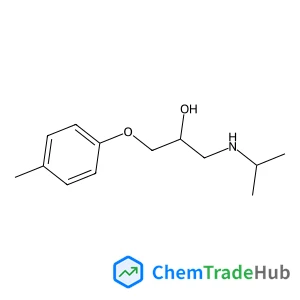
1-(4-Methylphenoxy)-3-(propan-2-ylamino)propan-2-ol
CAS Number:
5790-46-5
Molecular Formula:
C13H21NO2
Recommended Suppliers






Disclaimer
This page provides academic journal information for reference and research purposes only. We are not affiliated with any journal publishers and do not handle publication submissions. For publication-related inquiries, please contact the respective journal publishers directly.
If you notice any inaccuracies in the information displayed, please contact us at support@chemtradehub.com. We will promptly review and address your concerns.