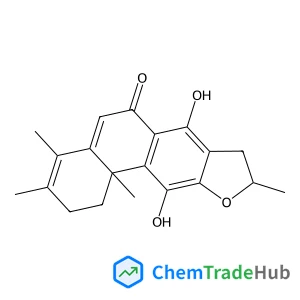
Phenanthro(3,2-b)furan-6(2H)-one, 1,8,9,11b-tetrahydro-7,11-dihydroxy-3,4,9,11b-tetramethyl-, cis-
CAS Number:
99624-92-7
Molecular Formula:
C20H22O4
Gabriele D'Avino, Luca Muccioli, Jérôme Cornil, David Beljonne
Improving the performance of organic photovoltaic cells requires the individuation of the specific factors limiting their efficiency, by rationalizing the relationship between the chemical nature of the materials, their morphology, and the electronic processes taking place at their interface. In this contribution, we present recent theoretical advances regarding the determination of the energetics and dynamics of charge carriers at organic–organic interfaces, highlighting the role of structural and electrostatic disorder in the separation of electron–hole pairs. The influence of interfacial electrostatic interactions on charge carrier energetics is first illustrated in model aggregates. Then, we review some of our recent theoretical studies in which we combined molecular dynamics, quantum-chemical and classical micro-electrostatic methods to evaluate the energy landscape explored by the mobile charges in the vicinity of donor–acceptor interfaces with realistic morphologies. Finally, we describe the theoretical challenges that still need to be overcome in order to gain a complete overview of the charge separation processes at the molecular level.

Organic Preparations and Procedures International

Kinetics and Catalysis

Israel Journal of Chemistry

Journal of Medicinal Chemistry

Pure and Applied Chemistry

Science Progress

Proceedings of the National Academy of Sciences of the United States of America

Journal of Heterocyclic Chemistry

Journal of Physics and Chemistry of Solids

European Journal of Wood and Wood Products
Vincenzo Aquilanti, Massimiliano Bartolomei, Fernando Pirani, David Cappelletti, Franco Vecchiocattivi, Toshio Kasai
DOI: 10.1039/B415212C
Weicheng Wu, Zili Wu, Zhaochi Feng, Pinliang Ying, Can Li
DOI: 10.1039/B414360B
S. J. Tinnemans, M. H. F. Kox, T. A. Nijhuis, T. Visser, B. M. Weckhuysen
DOI: 10.1039/B414427A
Minoru Yamaji, Michiyo Ogasawara, Kazuhiro Kikuchi, Satoru Nakajima, Shozo Tero-Kubota, Bronislaw Marciniak, Koichi Nozaki
DOI: 10.1039/B702598J
Gregory V. Hartland
DOI: 10.1039/B413368D
A. R. Allouche, M. Aubert-Frécon, D. Graveron-Demilly
DOI: 10.1039/B700631D
Simone Mazzucato, Ilaria Fortunati, Sara Scolaro, Michele Zerbetto, Camilla Ferrante, Raffaella Signorini, Danilo Pedron, Renato Bozio, Danika Locatelli, Stefania Righetto, Dominique Roberto, Renato Ugo, Alessandro Abbotto, Graziano Archetti, Luca Beverina, Sergio Ghezzi
DOI: 10.1039/B618709A
Peter I. Nagy, Krisztina Takács-Novák
DOI: 10.1039/B314924B
Laurence M. Peter
DOI: 10.1039/B617073K
Michael Wormit, Andreas Dreuw
DOI: 10.1039/B703028B
When handling 2-Chloro-1,2-bis(4-methylphenyl)ethanone (CAS: 71193-32-3), it is ...
4-Ethoxy-3-(5-methyl-4-oxo-7-propyl-1,4-dihydroimidazo[5,1-f][1,2,4]triazin-2-yl...
Methyl 3-Oxo-4-Androsten-17-Carboxylate (CAS: 2681-55-2) should be stored in a c...
(R)-3-Amino-4-(3-hexylphenylamino)-4-oxobutylphosphonic acid is primarily used i...
2-Methyl-2-propanyl 3-amino-3-carbamoyl-1-azetidinecarboxylate (CAS: 1254120-14-...
There are alternative reagents that can be used in synthesis instead of (E)-4-(t...
[2-(3-Chlorophenyl)-1,3-thiazol-4-yl]methanol (CAS: 121202-20-8) is a crystallin...
The market and research trends for Methyl (2S)-[(4S)-2,2-dimethyl-1,3-dioxolan-4...
The market for 1-Bromo-2-isocyanatoethane (CAS: 42865-19-0) is driven by its use...
4-Nitro-D-phenylalanine hydrochloride (CAS: 147065-06-3) is primarily used in re...

Physical Chemistry Chemical Physics (PCCP) is an international journal co-owned by 19 physical chemistry and physics societies from around the world. This journal publishes original, cutting-edge research in physical chemistry, chemical physics and biophysical chemistry. To be suitable for publication in PCCP, articles must include significant innovation and/or insight into physical chemistry; this is the most important criterion that reviewers and Editors will judge against when evaluating submissions. The journal has a broad scope and welcomes contributions spanning experiment, theory, computation and data science. Topical coverage includes spectroscopy, dynamics, kinetics, statistical mechanics, thermodynamics, electrochemistry, catalysis, surface science, quantum mechanics, quantum computing and machine learning. Interdisciplinary research areas such as polymers and soft matter, materials, nanoscience, energy, surfaces/interfaces, and biophysical chemistry are welcomed if they demonstrate significant innovation and/or insight into physical chemistry. Joined experimental/theoretical studies are particularly appreciated when complementary and based on up-to-date approaches.
![N-[2-Bromo-4-(trifluoromethoxy)phenyl]formamide structure](https://static.chemtradehub.com/structs/941/941294-53-7-f783.webp "N-[2-Bromo-4-(trifluoromethoxy)phenyl]formamide structure")
![Methyl 5-iodo-3-({[(2-methyl-2-propanyl)oxy]carbonyl}amino)-2-thiophenecarboxylate structure](https://static.chemtradehub.com/structs/100/1007171-35-8-177e.webp "Methyl 5-iodo-3-({[(2-methyl-2-propanyl)oxy]carbonyl}amino)-2-thiophenecarboxylate structure")