


Optimization of thermoelectric efficiency in SnTe: the case for the light band
Literature Information
Publication Date
2014-08-14
DOI
10.1039/C4CP02091J
Impact Factor
3.676
Authors
Zachary M. Gibbs, Heng Wang, Yemao Han, Caini Xin, Laifeng Li
View Original
Abstract
p-Type PbTe is an outstanding high temperature thermoelectric material with zT of 2 at high temperatures due to its complex band structure which leads to high valley degeneracy. Lead-free SnTe has a similar electronic band structure, which suggests that it may also be a good thermoelectric material. However, stoichiometric SnTe is a strongly p-type semiconductor with a carrier concentration of about 1 × 1020 cm−3, which corresponds to a minimum Seebeck coefficient and zT. While in the case of p-PbTe (and n-type La3Te4) one would normally achieve higher zT by using high carrier density in order to populate the secondary band with higher valley degeneracy, SnTe behaves differently. It has a very light, upper valence band which is shown in this work to provide higher zT than doping towards the heavier second band. Therefore, decreasing the hole concentration to maximize the performance of the light band results in higher zT than doping into the high degeneracy heavy band. Here we tune the electrical transport properties of SnTe by decreasing the carrier concentration with iodine doping, and increasing the carrier concentration with Gd doping or by making the samples Te deficient. A peak zT value of 0.6 at 700 K was obtained for SnTe0.985I0.015 which optimizes the light, upper valence band, which is about 50% higher than the other peak zT value of 0.4 for GdzSn1−zTe and SnTe1+y which utilize the high valley degeneracy secondary valence band.
Recommended Journals

Journal of Asian Natural Products Research

Critical Reviews in Solid State and Materials Sciences

Herald of the Russian Academy of Sciences

Journal of Chemical Sciences

NDT & E International

Electroanalysis

Heteroatom Chemistry

Acta Metallurgica Sinica-English Letters

Main Group Chemistry

Topics in Catalysis
Related Literature
Determination of the sputtering yield of cholesterol using Arn+ and C60+(+) cluster ions
P. D. Rakowska, M. P. Seah, J.-L. Vorng, R. Havelund, I. S. Gilmore
2016-06-08
Paper
DOI: 10.1039/C6AN00791K
An aerodynamic assisted miniature mass spectrometer for enhanced volatile sample analysis
Yanbing Zhai, Ting Jiang, Guangyan Huang, Yongzheng Wei
2016-06-22
Paper
DOI: 10.1039/C6AN00956E
A silicon nitride ISFET based immunosensor for Ag85B detection of tuberculosis
Pawasuth Saengdee, Woraphan Chaisriratanakul, Win Bunjongpru, Witsaroot Sripumkhai, Awirut Srisuwan, Charndet Hruanun, Amporn Poyai, Ponrut Phunpae, Wutthinan Jeamsaksiri, Chamras Promptmas
2016-07-25
Paper
DOI: 10.1039/C6AN00568C
Pseudo isobaric peptide termini labelling for relative proteome quantification by SWATH MS acquisition
Yichu Shan, Zhigang Sui, Qi Wu, Lihua Zhang, Zhen Liang, Yukui Zhang
2016-06-09
Paper
DOI: 10.1039/C6AN00388E
Isotope-filtered nD NMR spectroscopy of complex mixtures to unravel the molecular structures of phenolic compounds in tagged soil organic matter
N. G. A. Bell, M. C. Graham, D. Uhrín
2016-06-01
Paper
DOI: 10.1039/C6AN00999A
Changes in the volume phase transition temperature of hydrogels for detection of the DNA hybridization process
Klaudia Kaniewska, Agata Kowalczyk, Marcin Karbarz, Anna M. Nowicka
2016-07-29
Paper
DOI: 10.1039/C6AN00523C
Fluorescence suppression using micro-scale spatially offset Raman spectroscopy
Claudia Conti, Alessandra Botteon, Chiara Colombo, Marco Realini, Pavel Matousek
2016-06-24
Paper
DOI: 10.1039/C6AN00852F
Whole-cell detection of live lactobacillus acidophilus on aptamer-decorated porous silicon biosensors
S. Arshavsky-Graham, J. G. Walter, T. Scheper, E. Segal
2016-06-28
Paper
DOI: 10.1039/C6AN00810K
Enzymatic conversion of magnetic nanoparticles to a non-magnetic precipitate: a new approach to magnetic sensing
Arati G. Kolhatkar, Andrew C. Jamison, Ivan Nekrashevich, Katerina Kourentzi, Audrius Brazdeikis, T. Randall Lee
2016-07-25
Communication
DOI: 10.1039/C6AN00709K
You might also like
Compound Q&A
What precautions should be taken when handling 2-Chloro-1,2-bis(4-methylphenyl)ethanone (CAS: 71193-32-3)?
When handling 2-Chloro-1,2-bis(4-methylphenyl)ethanone (CAS: 71193-32-3), it is ...
71193-32-32-Chloro-1,2-bis(4-m...
Compound Q&A
What industries use 4-Ethoxy-3-(5-methyl-4-oxo-7-propyl-1,4-dihydroimidazo[5,1-f][1,2,4]triazin-2-yl)benzenesulfonyl chloride (CAS: 224789-26-8)?
4-Ethoxy-3-(5-methyl-4-oxo-7-propyl-1,4-dihydroimidazo[5,1-f][1,2,4]triazin-2-yl...
224789-26-84-Ethoxy-3-(5-methyl...
Compound Q&A
How should Methyl 3-Oxo-4-Androsten-17-Carboxylate (CAS: 2681-55-2) be stored?
Methyl 3-Oxo-4-Androsten-17-Carboxylate (CAS: 2681-55-2) should be stored in a c...
2681-55-2Methyl 3-Oxo-4-Andro...
Compound Q&A
What are the main uses of (R)-3-Amino-4-(3-hexylphenylamino)-4-oxobutylphosphonic acid (CAS: 909725-61-7)?
(R)-3-Amino-4-(3-hexylphenylamino)-4-oxobutylphosphonic acid is primarily used i...
909725-61-7(R)-3-Amino-4-(3-hex...
Compound Q&A
What regulatory guidelines apply to 2-Methyl-2-propanyl 3-amino-3-carbamoyl-1-azetidinecarboxylate (CAS: 1254120-14-3)?
2-Methyl-2-propanyl 3-amino-3-carbamoyl-1-azetidinecarboxylate (CAS: 1254120-14-...
1254120-14-32-Methyl-2-propanyl ...
Compound Q&A
Are there alternatives to (E)-4-(tert-Butoxy)-4-oxobut-2-enoic acid (CAS: 135355-96-3) in synthesis?
There are alternative reagents that can be used in synthesis instead of (E)-4-(t...
135355-96-3(E)-4-(tert-Butoxy)-...
Compound Q&A
What are the physical and chemical properties of [2-(3-Chlorophenyl)-1,3-thiazol-4-yl]methanol (CAS: 121202-20-8)?
[2-(3-Chlorophenyl)-1,3-thiazol-4-yl]methanol (CAS: 121202-20-8) is a crystallin...
121202-20-8[2-(3-Chlorophenyl)-...
Compound Q&A
What is the market or research trend for Methyl (2S)-[(4S)-2,2-dimethyl-1,3-dioxolan-4-yl]{[(4-methylphenyl)sulfonyl]oxy}acetate (CAS: 166249-17-8)?
The market and research trends for Methyl (2S)-[(4S)-2,2-dimethyl-1,3-dioxolan-4...
166249-17-8Methyl (2S)-[(4S)-2,...
Compound Q&A
What is the market or research trend for 1-Bromo-2-isocyanatoethane (CAS: 42865-19-0)?
The market for 1-Bromo-2-isocyanatoethane (CAS: 42865-19-0) is driven by its use...
42865-19-01-Bromo-2-isocyanato...
Compound Q&A
What are the main uses of 4-Nitro-D-phenylalanine hydrochloride (CAS: 147065-06-3)?
4-Nitro-D-phenylalanine hydrochloride (CAS: 147065-06-3) is primarily used in re...
147065-06-34-Nitro-D-phenylalan...
Source Journal
Physical Chemistry Chemical Physics

CiteScore:
5.5
Self-citation Rate:
10.3%
Articles per Year:
3036
Physical Chemistry Chemical Physics (PCCP) is an international journal co-owned by 19 physical chemistry and physics societies from around the world. This journal publishes original, cutting-edge research in physical chemistry, chemical physics and biophysical chemistry. To be suitable for publication in PCCP, articles must include significant innovation and/or insight into physical chemistry; this is the most important criterion that reviewers and Editors will judge against when evaluating submissions. The journal has a broad scope and welcomes contributions spanning experiment, theory, computation and data science. Topical coverage includes spectroscopy, dynamics, kinetics, statistical mechanics, thermodynamics, electrochemistry, catalysis, surface science, quantum mechanics, quantum computing and machine learning. Interdisciplinary research areas such as polymers and soft matter, materials, nanoscience, energy, surfaces/interfaces, and biophysical chemistry are welcomed if they demonstrate significant innovation and/or insight into physical chemistry. Joined experimental/theoretical studies are particularly appreciated when complementary and based on up-to-date approaches.
Recommended Compounds

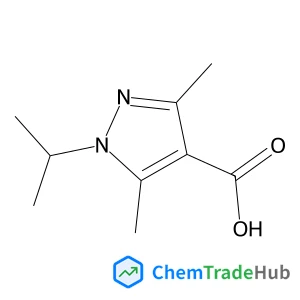
1-isopropyl-3,5-dimethyl-1H-pyrazole-4-carboxylic acid
CAS Number:
1007542-01-9
Molecular Formula:
C9H14N2O2
Recommended Suppliers






Disclaimer
This page provides academic journal information for reference and research purposes only. We are not affiliated with any journal publishers and do not handle publication submissions. For publication-related inquiries, please contact the respective journal publishers directly.
If you notice any inaccuracies in the information displayed, please contact us at support@chemtradehub.com. We will promptly review and address your concerns.