













Understanding the patterns that neural networks learn from chemical spectra
Literature Information
Publication Date
2023-11-10
DOI
10.1039/D3DD00203A
Impact Factor
0
Authors
Laura Hannemose Rieger, Max Wilson, Tejs Vegge, Eibar Flores
View Original
Abstract
Analysing spectra from experimental characterization of materials is time consuming, susceptible to distortions in data, requires specific domain knowledge, and may be susceptible to biases in general heuristics under human analysis. Recent work has shown the potential of using neural networks to solve this task, and assist spectral interpretation with automated and unbiased analysis on-the-fly. However, the black-box nature of most neural networks poses challenges when interpreting which patterns from the data are being used to make predictions. Understanding how neural networks learn is critical to assess their accuracy on unseen data, justify critical decision-making based on predictions, and potentially unravel meaningful scientific insights. We present a 1D neural network to classify infrared spectra from small organic molecules according to their functional groups. Our model is within range of state-of-the-art performance while being significantly less complex than previously used networks reported in the literature. A smaller network reduces the risk of overfitting and enables exploring what the model has learned about the patterns in the spectra that relate to molecular structure and composition. With a novel two-step approach for explaining the neural network's classification process, our findings not only demonstrate that the model learns the characteristic group frequencies of functional groups, but also suggest it uses non-intuitive patterns such as tails and overtones when classifying spectra.
Related Literature
Enantioselective conjugate addition of phenylboronic acid to enones catalysed by a chiral tropos/atropos rhodium complex at the coalescence temperature
Chiara Monti, Cesare Gennari, Umberto Piarulli
2005-09-21
Communication
DOI: 10.1039/B508832A
Recent progress in cobalt-mediated [2 + 2 + 2] cycloaddition reactions
Vincent Gandon, Corinne Aubert, Max Malacria
2006-03-16
Feature Article
DOI: 10.1039/B517696B
Two novel non-viral gene delivery vectors: low molecular weight polyethylenimine cross-linked by (2-hydroxypropyl)-β-cyclodextrin or (2-hydroxypropyl)-γ-cyclodextrin
Hongliang Huang, Guping Tang, Qingqing Wang, Da Li, Fenping Shen, Jun Zhou, Hai Yu
2006-03-22
Communication
DOI: 10.1039/B601130F
Fatigue-resistant photochromic dithienylethenes by controlling the oxidation state
Yong-Chul Jeong, Dae Gyu Park, Eunkyoung Kim, Kwang-Hyun Ahn, Sung Ik Yang
2006-03-21
Communication
DOI: 10.1039/B600754F
Achiral benzophenoneligand–rhodium complex with chiral diamine activator for high enantiocontrol in asymmetric transfer hydrogenation
Koichi Mikami, Kazuki Wakabayashi, Yukinori Yusa, Kohsuke Aikawa
2006-05-03
Communication
DOI: 10.1039/B517585B
Bergman cyclopolymerization within the channels of functional hybrid nanocomposites formed by co-assembly of silica and polymerizable surfactant monomer
Chetan Jagdish Bhongale, Chung-He Yang, Chain-Shu Hsu
2006-04-26
Communication
DOI: 10.1039/B603195A
Phosphoester-transfer mechanism of an RNA-cleaving acidic deoxyribozyme revealed by radioactivity tracking and enzymatic digestion
Srinivas A. Kandadai, William Chiuman, Yingfu Li
2006-05-09
Communication
DOI: 10.1039/B604682G
You might also like
Compound Q&A
What are the main uses of 1H-Indazole-6-carbonitrile (CAS: 141290-59-7)?
1H-Indazole-6-carbonitrile finds applications in pharmaceuticals, where it serve...
141290-59-71H-Indazole-6-carbon...
Compound Q&A
How should waste containing Dioctyl (2E)-2-butenedioate (CAS: 2997-85-5) be handled?
Waste containing Dioctyl (2E)-2-butenedioate (CAS: 2997-85-5) should be collecte...
2997-85-5Dioctyl (2E)-2-buten...
Compound Q&A
What industries use Sodium [(1,2-benzoxazol-3-ylmethyl)sulfonyl]azanide (CAS: 68291-98-5)?
Sodium [(1,2-benzoxazol-3-ylmethyl)sulfonyl]azanide is primarily used in pharmac...
68291-98-5Sodium [(1,2-benzoxa...
Compound Q&A
Are there alternatives to Dimethyl 4-(4,4,5,5-tetramethyl-1,3,2-dioxaborolan-2-yl)-2,6-pyridinedicarboxylate (CAS: 741709-66-0) in synthesis?
Dimethyl 4-(4,4,5,5-tetramethyl-1,3,2-dioxaborolan-2-yl)-2,6-pyridinedicarboxyla...
741709-66-0Dimethyl 4-(4,4,5,5-...
Compound Q&A
How should waste containing 2-Fluoro-6-hydrazinopyridine (CAS: 80714-39-2) be handled?
Waste containing 2-Fluoro-6-hydrazinopyridine (CAS: 80714-39-2) should be manage...
80714-39-22-Fluoro-6-hydrazino...
Compound Q&A
What is 6-Formyl-2-pyridinecarboxylic acid (CAS: 499214-11-8)?
6-Formyl-2-pyridinecarboxylic acid is an organic compound with the molecular for...
499214-11-86-Formyl-2-pyridinec...
Compound Q&A
What is the market or research trend for 3-(3,4-dimethoxyphenyl)-2,5-dimethyl-N-(2-morpholin-4-ylethyl)pyrazolo[1,5-a]pyrimidin-7-amine (CAS: 900874-91-1)?
Research trends for this compound indicate a focus on its potential applications...
900874-91-13-(3,4-dimethoxyphen...
Compound Q&A
How is 9H-Tribenzo[b,d,f]azepine (CAS: 29875-73-8) typically synthesized?
9H-Tribenzo[b,d,f]azepine is typically synthesized via a multi-step process invo...
29875-73-89H-Tribenzo[b,d,f]az...
Compound Q&A
How is 1-Cyclopropyl-7-ethoxy-6-fluoro-8-methoxy-4-oxo-1,4-dihydro-3-quinolinecarboxylic acid (CAS: 1797982-51-4) typically synthesized?
1-Cyclopropyl-7-ethoxy-6-fluoro-8-methoxy-4-oxo-1,4-dihydro-3-quinolinecarboxyli...
1797982-51-41-Cyclopropyl-7-etho...
Compound Q&A
How should waste containing Methyl 3-oxo-1,2,3,4-tetrahydro-6-quinoxalinecarboxylate (CAS: 671820-52-3) be handled?
Waste containing Methyl 3-oxo-1,2,3,4-tetrahydro-6-quinoxalinecarboxylate (CAS: ...
671820-52-3Methyl 3-oxo-1,2,3,4...
Source Journal
Recommended Compounds
![N-[(9H-Fluoren-9-ylmethoxy)carbonyl]serine structure](https://static.chemtradehub.com/structs/737/73724-45-5-b0dc.webp "N-[(9H-Fluoren-9-ylmethoxy)carbonyl]serine structure")
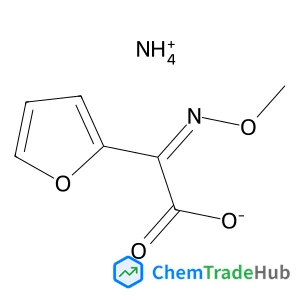
Ammonium (Z)-2-(furan-2-yl)-2-(methoxyimino)acetate
CAS Number:
97148-39-5
Molecular Formula:
C7H10N2O4
Recommended Suppliers





Disclaimer
This page provides academic journal information for reference and research purposes only. We are not affiliated with any journal publishers and do not handle publication submissions. For publication-related inquiries, please contact the respective journal publishers directly.
If you notice any inaccuracies in the information displayed, please contact us at support@chemtradehub.com. We will promptly review and address your concerns.