













Towards a modular architecture for science factories
Literature Information
Publication Date
2023-11-07
DOI
10.1039/D3DD00142C
Impact Factor
0
Authors
Rafael Vescovi, Tobias Ginsburg, Kyle Hippe, Doga Ozgulbas, Casey Stone, Abraham Stroka, Rory Butler, Tom Brettin, Arvind Ramanathan, Aikaterini Vriza, Qingteng Zhang
View Original
Abstract
Advances in robotic automation, high-performance computing (HPC), and artificial intelligence (AI) encourage us to conceive of science factories: large, general-purpose computation- and AI-enabled self-driving laboratories (SDLs) with the generality and scale needed both to tackle large discovery problems and to support thousands of scientists. Science factories require modular hardware and software that can be replicated for scale and (re)configured to support many applications. To this end, we propose a prototype modular science factory architecture in which reconfigurable modules encapsulating scientific instruments are linked with manipulators to form workcells, that can themselves be combined to form larger assemblages, and linked with distributed computing for simulation, AI model training and inference, and related tasks. Workflows that perform sets of actions on modules can be specified, and various applications, comprising workflows plus associated computational and data manipulation steps, can be run concurrently. We report on our experiences prototyping this architecture and applying it in experiments involving 15 different robotic apparatus, five applications (one in education, two in biology, two in materials), and a variety of workflows, across four laboratories. We describe the reuse of modules, workcells, and workflows in different applications, the migration of applications between workcells, and the use of digital twins, and suggest directions for future work aimed at yet more generality and scalability. Code and data are available at https://ad-sdl.github.io/wei2023 and in the ESI.
Related Literature
Ferrimagnetic Mn2SnO4nanowires
Chan Woong Na, Doo Suk Han, Jeunghee Park, Younghun Jo, Myung-Hwa Jung
2006-04-25
Communication
DOI: 10.1039/B601404F
A novel route for in-situ H2O2 generation from selective reduction of O2 by hydrazine using heterogeneous Pd catalyst in an aqueous medium
Vasant R. Choudhary, Chanchal Samanta, Prabhas Jana
2005-10-03
Communication
DOI: 10.1039/B510543A
Rapid stereocontrolled assembly of the fully substituted C-aryl glycoside of kendomycin with a Prins cyclization: a formal synthesis
Kevin B. Bahnck, Scott D. Rychnovsky
2006-05-02
Communication
DOI: 10.1039/B602937J
Unusual variations in the incidence of Z′ > 1 in oxo-anion structures
Kirsty M. Anderson, Andres E. Goeta, Kirsty S. B. Hancock, Jonathan W. Steed
2006-04-04
Communication
DOI: 10.1039/B602492K
Hexagonally ordered mesoporous ternary Li2O–TiO2–P2O5 oxides with high lithium content
Donglin Li, Haoshen Zhou, Itaru Honma, Masaki Ichihara
2005-09-20
Communication
DOI: 10.1039/B509028H
The direct α-zincation of amides, phosphonates and phosphine oxides by H–Zn exchange
Mark L. Hlavinka, Jeffrey F. Greco, John R. Hagadorn
2005-09-23
Communication
DOI: 10.1039/B509190J
Synthesis and spectroscopic observation of dendrimer-encapsulated gold nanoclusters
M. Linh Tran, Andrei V. Zvyagin, Taras Plakhotnik
2006-05-03
Communication
DOI: 10.1039/B602079H
Cyclopolymerization of dimethyl dipropargylmalonate in supercritical carbon dioxide to give a highly regular polyene containing predominantly five-membered rings
Ji Won Pack, Young-Jae Hur, Hwayong Kim, Youn-Woo Lee
2005-09-21
Communication
DOI: 10.1039/B510046A
Samarium diiodide-induced intramolecular pinacol coupling of dinitrones: synthesis of cyclic cis-vicinal diamines
Jean-Philippe Ebran, Rita G. Hazell, Troels Skrydstrup
2005-09-30
Communication
DOI: 10.1039/B511491H
Synthesis of organic–inorganic hybrid mesoporous tin oxophosphate in the presence of anionic surfactant
Masahiro Fujiwara, Masahiko Matsukata
2005-09-20
Communication
DOI: 10.1039/B508589F
You might also like
Compound Q&A
What are the main uses of 1H-Indazole-6-carbonitrile (CAS: 141290-59-7)?
1H-Indazole-6-carbonitrile finds applications in pharmaceuticals, where it serve...
141290-59-71H-Indazole-6-carbon...
Compound Q&A
How should waste containing Dioctyl (2E)-2-butenedioate (CAS: 2997-85-5) be handled?
Waste containing Dioctyl (2E)-2-butenedioate (CAS: 2997-85-5) should be collecte...
2997-85-5Dioctyl (2E)-2-buten...
Compound Q&A
What industries use Sodium [(1,2-benzoxazol-3-ylmethyl)sulfonyl]azanide (CAS: 68291-98-5)?
Sodium [(1,2-benzoxazol-3-ylmethyl)sulfonyl]azanide is primarily used in pharmac...
68291-98-5Sodium [(1,2-benzoxa...
Compound Q&A
Are there alternatives to Dimethyl 4-(4,4,5,5-tetramethyl-1,3,2-dioxaborolan-2-yl)-2,6-pyridinedicarboxylate (CAS: 741709-66-0) in synthesis?
Dimethyl 4-(4,4,5,5-tetramethyl-1,3,2-dioxaborolan-2-yl)-2,6-pyridinedicarboxyla...
741709-66-0Dimethyl 4-(4,4,5,5-...
Compound Q&A
How should waste containing 2-Fluoro-6-hydrazinopyridine (CAS: 80714-39-2) be handled?
Waste containing 2-Fluoro-6-hydrazinopyridine (CAS: 80714-39-2) should be manage...
80714-39-22-Fluoro-6-hydrazino...
Compound Q&A
What is 6-Formyl-2-pyridinecarboxylic acid (CAS: 499214-11-8)?
6-Formyl-2-pyridinecarboxylic acid is an organic compound with the molecular for...
499214-11-86-Formyl-2-pyridinec...
Compound Q&A
What is the market or research trend for 3-(3,4-dimethoxyphenyl)-2,5-dimethyl-N-(2-morpholin-4-ylethyl)pyrazolo[1,5-a]pyrimidin-7-amine (CAS: 900874-91-1)?
Research trends for this compound indicate a focus on its potential applications...
900874-91-13-(3,4-dimethoxyphen...
Compound Q&A
How is 9H-Tribenzo[b,d,f]azepine (CAS: 29875-73-8) typically synthesized?
9H-Tribenzo[b,d,f]azepine is typically synthesized via a multi-step process invo...
29875-73-89H-Tribenzo[b,d,f]az...
Compound Q&A
How is 1-Cyclopropyl-7-ethoxy-6-fluoro-8-methoxy-4-oxo-1,4-dihydro-3-quinolinecarboxylic acid (CAS: 1797982-51-4) typically synthesized?
1-Cyclopropyl-7-ethoxy-6-fluoro-8-methoxy-4-oxo-1,4-dihydro-3-quinolinecarboxyli...
1797982-51-41-Cyclopropyl-7-etho...
Compound Q&A
How should waste containing Methyl 3-oxo-1,2,3,4-tetrahydro-6-quinoxalinecarboxylate (CAS: 671820-52-3) be handled?
Waste containing Methyl 3-oxo-1,2,3,4-tetrahydro-6-quinoxalinecarboxylate (CAS: ...
671820-52-3Methyl 3-oxo-1,2,3,4...
Source Journal
Recommended Compounds
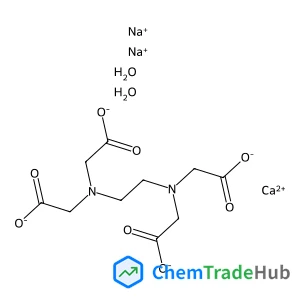
EthylenediaminetetraaceticacidcalciumDisodiumsalthydrate
CAS Number:
23411-34-9
Molecular Formula:
C10H16CaN2Na2O10



Recommended Suppliers






Disclaimer
This page provides academic journal information for reference and research purposes only. We are not affiliated with any journal publishers and do not handle publication submissions. For publication-related inquiries, please contact the respective journal publishers directly.
If you notice any inaccuracies in the information displayed, please contact us at support@chemtradehub.com. We will promptly review and address your concerns.