












Rapid stereocontrolled assembly of the fully substituted C-aryl glycoside of kendomycin with a Prins cyclization: a formal synthesis
Literature Information
Publication Date
2006-05-02
DOI
10.1039/B602937J
Impact Factor
6.222
Authors
Kevin B. Bahnck, Scott D. Rychnovsky
View Original
Abstract
Prins cyclization using an electron-rich benzaldehyde and a homoallylic alcohol efficiently delivered the fully substituted C-aryl tetrahydropyranoside of kendomycin.
Related Literature
A variable dispersion flow injection manifold for calibration and sample dilution in flame atomic absorption spectrometry
Paper
DOI: 10.1039/JA9860100273
Analysis of different Flos Chrysanthemum tea samples with the use of two-dimensional chromatographic fingerprints, which were interpreted by different multivariate methods
Serge Kokot
2014-12-02
Paper
DOI: 10.1039/C4AY02115K
Designs from single junctions, heterojunctions to multijunctions for high-performance perovskite solar cells
Xin Wu, Bo Li, Chu-Chen Chueh
2021-10-22
Review Article
DOI: 10.1039/D1CS00841B
Boronate decorated membrane via atom transfer radical polymerization for separation and enrichment of polyphenols from tea drinks
Xiang-Jin Kong, Chao Peng, Yao-Han Lan, Wen-xiu Li, Shuai-Shuai Chi, Chao Zheng, Lin-Yi Dong, Xian-Hua Wang
2019-07-24
Paper
DOI: 10.1039/C9AY01229J
Stepping stones to the future of haemoglobin-based blood products: clinical, preclinical and innovative examples
Clara Coll-Satue, Shahana Bishnoi, Jiantao Chen, Leticia Hosta-Rigau
2020-12-07
Review Article
DOI: 10.1039/D0BM01767A
ForSDAT: an automated platform for analyzing force spectroscopy measurements
Tal Duanis-Assaf, Yair Razvag, Meital Reches
2019-08-23
Paper
DOI: 10.1039/C9AY01150A
Sensing of citrulline modifications in histone peptides by deep cavitand hosts
Adam D. Gill, Briana L. Hickey, Siwen Wang
2019-10-11
Communication
DOI: 10.1039/C9CC07002H
Fluorescence-quenching CdTe quantum dots applied for identification of cocaine-structure analogues
Jacqueline Q. Alves, Lilian P. Franco, Marcelo F. de Oliveira
2018-11-28
Paper
DOI: 10.1039/C8AY02243G
You might also like
Compound Q&A
What are the main uses of 1H-Indazole-6-carbonitrile (CAS: 141290-59-7)?
1H-Indazole-6-carbonitrile finds applications in pharmaceuticals, where it serve...
141290-59-71H-Indazole-6-carbon...
Compound Q&A
How should waste containing Dioctyl (2E)-2-butenedioate (CAS: 2997-85-5) be handled?
Waste containing Dioctyl (2E)-2-butenedioate (CAS: 2997-85-5) should be collecte...
2997-85-5Dioctyl (2E)-2-buten...
Compound Q&A
What industries use Sodium [(1,2-benzoxazol-3-ylmethyl)sulfonyl]azanide (CAS: 68291-98-5)?
Sodium [(1,2-benzoxazol-3-ylmethyl)sulfonyl]azanide is primarily used in pharmac...
68291-98-5Sodium [(1,2-benzoxa...
Compound Q&A
Are there alternatives to Dimethyl 4-(4,4,5,5-tetramethyl-1,3,2-dioxaborolan-2-yl)-2,6-pyridinedicarboxylate (CAS: 741709-66-0) in synthesis?
Dimethyl 4-(4,4,5,5-tetramethyl-1,3,2-dioxaborolan-2-yl)-2,6-pyridinedicarboxyla...
741709-66-0Dimethyl 4-(4,4,5,5-...
Compound Q&A
How should waste containing 2-Fluoro-6-hydrazinopyridine (CAS: 80714-39-2) be handled?
Waste containing 2-Fluoro-6-hydrazinopyridine (CAS: 80714-39-2) should be manage...
80714-39-22-Fluoro-6-hydrazino...
Compound Q&A
What is 6-Formyl-2-pyridinecarboxylic acid (CAS: 499214-11-8)?
6-Formyl-2-pyridinecarboxylic acid is an organic compound with the molecular for...
499214-11-86-Formyl-2-pyridinec...
Compound Q&A
What is the market or research trend for 3-(3,4-dimethoxyphenyl)-2,5-dimethyl-N-(2-morpholin-4-ylethyl)pyrazolo[1,5-a]pyrimidin-7-amine (CAS: 900874-91-1)?
Research trends for this compound indicate a focus on its potential applications...
900874-91-13-(3,4-dimethoxyphen...
Compound Q&A
How is 9H-Tribenzo[b,d,f]azepine (CAS: 29875-73-8) typically synthesized?
9H-Tribenzo[b,d,f]azepine is typically synthesized via a multi-step process invo...
29875-73-89H-Tribenzo[b,d,f]az...
Compound Q&A
How is 1-Cyclopropyl-7-ethoxy-6-fluoro-8-methoxy-4-oxo-1,4-dihydro-3-quinolinecarboxylic acid (CAS: 1797982-51-4) typically synthesized?
1-Cyclopropyl-7-ethoxy-6-fluoro-8-methoxy-4-oxo-1,4-dihydro-3-quinolinecarboxyli...
1797982-51-41-Cyclopropyl-7-etho...
Compound Q&A
How should waste containing Methyl 3-oxo-1,2,3,4-tetrahydro-6-quinoxalinecarboxylate (CAS: 671820-52-3) be handled?
Waste containing Methyl 3-oxo-1,2,3,4-tetrahydro-6-quinoxalinecarboxylate (CAS: ...
671820-52-3Methyl 3-oxo-1,2,3,4...
Source Journal
Chemical Communications

CiteScore:
8.6
Self-citation Rate:
4.7%
Articles per Year:
2458
ChemComm publishes urgent research which is of outstanding significance and interest to experts in the field, while also appealing to the journal’s broad chemistry readership. Our communication format is ideally suited to short, urgent studies that are of such importance that they require accelerated publication. Our scope covers all topics in chemistry, and research at the interface of chemistry and other disciplines (such as materials science, nanoscience, physics, engineering and biology) where there is a significant novelty in the chemistry aspects. Major topic areas covered include: Analytical Chemistry Catalysis Chemical Biology and medicinal chemistry Computational Chemistry and Machine Learning Energy and sustainable chemistry Environmental Chemistry Green Chemistry Inorganic Chemistry Materials Chemistry Nanoscience Organic Chemistry Physical Chemistry Polymer Chemistry Supramolecular Chemistry
Recommended Compounds

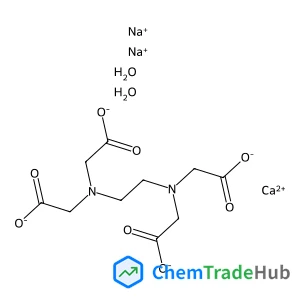
EthylenediaminetetraaceticacidcalciumDisodiumsalthydrate
CAS Number:
23411-34-9
Molecular Formula:
C10H16CaN2Na2O10
Recommended Suppliers







Disclaimer
This page provides academic journal information for reference and research purposes only. We are not affiliated with any journal publishers and do not handle publication submissions. For publication-related inquiries, please contact the respective journal publishers directly.
If you notice any inaccuracies in the information displayed, please contact us at support@chemtradehub.com. We will promptly review and address your concerns.