













Uncovering novel liquid organic hydrogen carriers: a systematic exploration of chemical compound space using cheminformatics and quantum chemical methods
Literature Information
Publication Date
2023-10-11
DOI
10.1039/D3DD00123G
Impact Factor
0
Authors
Hassan Harb, Sarah N. Elliott, Logan Ward, Ian T. Foster, Stephen J. Klippenstein, Larry A. Curtiss, Rajeev Surendran Assary
View Original
Abstract
We present a comprehensive, in silico-based discovery approach to identifying novel liquid organic hydrogen carrier (LOHC) candidates using cheminformatics methods and quantum chemical calculations. We screened over 160 billion molecules from ZINC15 and GDB-17 chemical databases for structural similarity to known LOHCs and employed a data-driven selection criterion connecting molecular features with dehydrogenation enthalpy. This scoring criterion effectively predicts dehydrogenation enthalpies from SMILES strings, streamlining the LOHC screening process. After rigorous screening and down-selection, we compiled a database of 3000 dehydrogenation reactions for the most promising LOHC candidates, setting the stage for future selection based on kinetics and catalysis. This work demonstrates the significant impact of integrating quantum chemistry and cheminformatics in materials discovery, accelerating the selection process while reducing experimental efforts and time. By proposing new molecules as prospective LOHC candidates, our study provides a valuable resource for researchers and engineers in the development of advanced LOHC systems and showcases a successful approach for high-throughput discovery, contributing to more efficient and sustainable energy storage solutions.
Related Literature
The direct α-zincation of amides, phosphonates and phosphine oxides by H–Zn exchange
Mark L. Hlavinka, Jeffrey F. Greco, John R. Hagadorn
2005-09-23
Communication
DOI: 10.1039/B509190J
Phosphoester-transfer mechanism of an RNA-cleaving acidic deoxyribozyme revealed by radioactivity tracking and enzymatic digestion
Srinivas A. Kandadai, William Chiuman, Yingfu Li
2006-05-09
Communication
DOI: 10.1039/B604682G
Effect of residual monomer on the spectroscopic properties of polythiophenes
Yu Wang, Ashley A. Mills, William B. Euler, Brett L. Lucht
2006-04-11
Communication
DOI: 10.1039/B600793G
Biomimetic approaches to diazonamide A. Direct synthesis of the indole bis-oxazole fragment by oxidation of a TyrValTrpTrp tetrapeptide
Jonathan Sperry
2006-05-09
Communication
DOI: 10.1039/B604294E
Enantioselective conjugate addition of phenylboronic acid to enones catalysed by a chiral tropos/atropos rhodium complex at the coalescence temperature
Chiara Monti, Cesare Gennari, Umberto Piarulli
2005-09-21
Communication
DOI: 10.1039/B508832A
Anion-templated assembly of interpenetrated and interlocked structures
Paul D. Beer, Mark R. Sambrook, David Curiel
2006-03-08
Feature Article
DOI: 10.1039/B516435B
Samarium diiodide-induced intramolecular pinacol coupling of dinitrones: synthesis of cyclic cis-vicinal diamines
Jean-Philippe Ebran, Rita G. Hazell, Troels Skrydstrup
2005-09-30
Communication
DOI: 10.1039/B511491H
On the influence of porphyrin π–π stacking on supramolecular chirality created in the porphyrin-based twisted tape structure
Masayuki Takeuchi, Satoshi Tanaka, Seiji Shinkai
2005-10-04
Communication
DOI: 10.1039/B512128K
Regiochemical control of the catalytic asymmetric hydroboration of 1,2-diarylalkenes
Antonia Black, John M. Brown, Christophe Pichon
2005-10-05
Communication
DOI: 10.1039/B508292G
Construction of superhydrophobic surfaces by fibrous aggregation of perfluoroalkyl chain-containing organogelators
Motoshi Yamanaka, Kazuki Sada, Mikiji Miyata, Kenji Hanabusa, Kazunori Nakano
2006-04-24
Communication
DOI: 10.1039/B601485B
You might also like
Compound Q&A
What are the main uses of 1H-Indazole-6-carbonitrile (CAS: 141290-59-7)?
1H-Indazole-6-carbonitrile finds applications in pharmaceuticals, where it serve...
141290-59-71H-Indazole-6-carbon...
Compound Q&A
How should waste containing Dioctyl (2E)-2-butenedioate (CAS: 2997-85-5) be handled?
Waste containing Dioctyl (2E)-2-butenedioate (CAS: 2997-85-5) should be collecte...
2997-85-5Dioctyl (2E)-2-buten...
Compound Q&A
What industries use Sodium [(1,2-benzoxazol-3-ylmethyl)sulfonyl]azanide (CAS: 68291-98-5)?
Sodium [(1,2-benzoxazol-3-ylmethyl)sulfonyl]azanide is primarily used in pharmac...
68291-98-5Sodium [(1,2-benzoxa...
Compound Q&A
Are there alternatives to Dimethyl 4-(4,4,5,5-tetramethyl-1,3,2-dioxaborolan-2-yl)-2,6-pyridinedicarboxylate (CAS: 741709-66-0) in synthesis?
Dimethyl 4-(4,4,5,5-tetramethyl-1,3,2-dioxaborolan-2-yl)-2,6-pyridinedicarboxyla...
741709-66-0Dimethyl 4-(4,4,5,5-...
Compound Q&A
How should waste containing 2-Fluoro-6-hydrazinopyridine (CAS: 80714-39-2) be handled?
Waste containing 2-Fluoro-6-hydrazinopyridine (CAS: 80714-39-2) should be manage...
80714-39-22-Fluoro-6-hydrazino...
Compound Q&A
What is 6-Formyl-2-pyridinecarboxylic acid (CAS: 499214-11-8)?
6-Formyl-2-pyridinecarboxylic acid is an organic compound with the molecular for...
499214-11-86-Formyl-2-pyridinec...
Compound Q&A
What is the market or research trend for 3-(3,4-dimethoxyphenyl)-2,5-dimethyl-N-(2-morpholin-4-ylethyl)pyrazolo[1,5-a]pyrimidin-7-amine (CAS: 900874-91-1)?
Research trends for this compound indicate a focus on its potential applications...
900874-91-13-(3,4-dimethoxyphen...
Compound Q&A
How is 9H-Tribenzo[b,d,f]azepine (CAS: 29875-73-8) typically synthesized?
9H-Tribenzo[b,d,f]azepine is typically synthesized via a multi-step process invo...
29875-73-89H-Tribenzo[b,d,f]az...
Compound Q&A
How is 1-Cyclopropyl-7-ethoxy-6-fluoro-8-methoxy-4-oxo-1,4-dihydro-3-quinolinecarboxylic acid (CAS: 1797982-51-4) typically synthesized?
1-Cyclopropyl-7-ethoxy-6-fluoro-8-methoxy-4-oxo-1,4-dihydro-3-quinolinecarboxyli...
1797982-51-41-Cyclopropyl-7-etho...
Compound Q&A
How should waste containing Methyl 3-oxo-1,2,3,4-tetrahydro-6-quinoxalinecarboxylate (CAS: 671820-52-3) be handled?
Waste containing Methyl 3-oxo-1,2,3,4-tetrahydro-6-quinoxalinecarboxylate (CAS: ...
671820-52-3Methyl 3-oxo-1,2,3,4...
Source Journal
Recommended Compounds
![Sodium 3-[(E)-(4-anilinophenyl)diazenyl]benzenesulfonate structure](https://static.chemtradehub.com/structs/587/587-98-4-035f.webp "Sodium 3-[(E)-(4-anilinophenyl)diazenyl]benzenesulfonate structure")
Sodium 3-[(E)-(4-anilinophenyl)diazenyl]benzenesulfonate
CAS Number:
587-98-4
Molecular Formula:
C18H14N3NaO3S
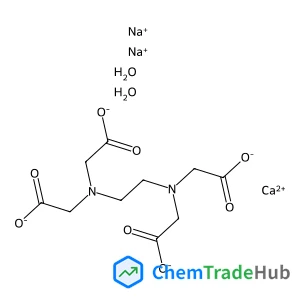
EthylenediaminetetraaceticacidcalciumDisodiumsalthydrate
CAS Number:
23411-34-9
Molecular Formula:
C10H16CaN2Na2O10
Recommended Suppliers






Disclaimer
This page provides academic journal information for reference and research purposes only. We are not affiliated with any journal publishers and do not handle publication submissions. For publication-related inquiries, please contact the respective journal publishers directly.
If you notice any inaccuracies in the information displayed, please contact us at support@chemtradehub.com. We will promptly review and address your concerns.