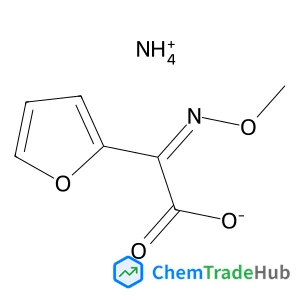
Ammonium (Z)-2-(furan-2-yl)-2-(methoxyimino)acetate
CAS Number:
97148-39-5
Molecular Formula:
C7H10N2O4
Masayuki Takeuchi, Satoshi Tanaka, Seiji Shinkai
Achiral porphyrin derivatives 1-M form twisted supramolecular assemblies and the pitch of the twisted tape structure can be altered by changing the central metal.
Ting Zhang, Hao-zhou Huang, Run-chun Xu, Jia-bo Wang, Ming Yang, Jun-han Cao, Yi Zhang, Ding-kun Zhang, Li Han
DOI: 10.1039/C9AY01420A
DOI: 10.1039/JA9860100265
Hai Linh Tran, Ruey-an Doong
DOI: 10.1039/C9AY01138B
Yu Xiao, Haijun Wu, Dongyang Wang, Liangwei Fu, Yang Zhang, Yue Chen, Jiaqing He, Stephen J. Pennycook, Li-Dong Zhao
DOI: 10.1039/C8EE01151F
Serhat Döker
DOI: 10.1039/C6AY03140D
Alexander Dreger, Elric Engelage, Bert Mallick, Paul D. Beer, Stefan M. Huber
DOI: 10.1039/C8CC00527C
James R. Durrant
DOI: 10.1039/D1CS00577D
Ebrahim Azadniya, Gertrud E. Morlock
DOI: 10.1039/C9AY01465A
DOI: 10.1039/C9CC07092C
1H-Indazole-6-carbonitrile finds applications in pharmaceuticals, where it serve...
Waste containing Dioctyl (2E)-2-butenedioate (CAS: 2997-85-5) should be collecte...
Sodium [(1,2-benzoxazol-3-ylmethyl)sulfonyl]azanide is primarily used in pharmac...
Dimethyl 4-(4,4,5,5-tetramethyl-1,3,2-dioxaborolan-2-yl)-2,6-pyridinedicarboxyla...
Waste containing 2-Fluoro-6-hydrazinopyridine (CAS: 80714-39-2) should be manage...
6-Formyl-2-pyridinecarboxylic acid is an organic compound with the molecular for...
Research trends for this compound indicate a focus on its potential applications...
9H-Tribenzo[b,d,f]azepine is typically synthesized via a multi-step process invo...
1-Cyclopropyl-7-ethoxy-6-fluoro-8-methoxy-4-oxo-1,4-dihydro-3-quinolinecarboxyli...
Waste containing Methyl 3-oxo-1,2,3,4-tetrahydro-6-quinoxalinecarboxylate (CAS: ...

ChemComm publishes urgent research which is of outstanding significance and interest to experts in the field, while also appealing to the journal’s broad chemistry readership. Our communication format is ideally suited to short, urgent studies that are of such importance that they require accelerated publication. Our scope covers all topics in chemistry, and research at the interface of chemistry and other disciplines (such as materials science, nanoscience, physics, engineering and biology) where there is a significant novelty in the chemistry aspects. Major topic areas covered include: Analytical Chemistry Catalysis Chemical Biology and medicinal chemistry Computational Chemistry and Machine Learning Energy and sustainable chemistry Environmental Chemistry Green Chemistry Inorganic Chemistry Materials Chemistry Nanoscience Organic Chemistry Physical Chemistry Polymer Chemistry Supramolecular Chemistry