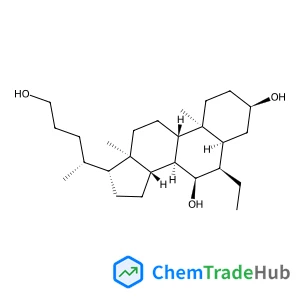
(3alpha,5beta,6alpha,7alpha)-6-Ethylcholane-3,7,24-triol
CAS Number:
1537866-49-1
Molecular Formula:
C26H46O3
Krister Holmberg
Ternary oil–water–surfactant systems can give rise to an O/W microemulsion in equilibrium with excess oil, a W/O microemulsion in equilibrium with excess water, or a bicontinuous microemulsion in equilibrium with excess oil and water. This type of phase behavior has been known for a long time and the three systems are often referred to as Winsor I, Winsor II and Winsor III, respectively after the British scientist P. A. Winsor who pioneered the area. The Winsor systems are technically important and well understood today. It was later found that addition of a polymer to the oil–water–surfactant system can influence the phase behavior considerably. While a hydrophilic polymer will be incorporated in the water phase and a hydrophobic polymer in the oil phase, an amphiphilic polymer with the right hydrophilic–lipophilic balance may expand the middle phase microemulsion in a Winsor III system. Expansion of the middle phase of such a system will lead to a reduction of the oil/microemulsion and the microemulsion/water interfacial tensions. This can be practically important, and the effect is currently of considerable interest for so-called surfactant flooding for enhanced oil recovery (EOR). Boosting the middle phase of the Winsor III system by addition of a polymer to the surfactant system is still not an established procedure and not so well understood from a scientific point of view. In this review we summarize the work done in the field and we demonstrate that the role of the polymer is intimately linked to its interactions with the three other components in the system: the oil, the water, and the surfactant(s).
Helmuth Möhwald, Kenneth Suslick
DOI: 10.1039/C3CP52850B
Yu. B. Vysotsky, E. A. Belyaeva, E. S. Fomina, D. Vollhardt, V. B. Fainerman, R. Miller
DOI: 10.1039/C3CP54124J
Ameneh Gholami, Travis D. Fridgen
DOI: 10.1039/C3CP53716A
D. J. Stewart, T. C. Preston, J. S. Walker, Y.-H. Zhang, J. P. Reid
DOI: 10.1039/C3CP54948H
M. P. Lavin-Lopez, J. L. Valverde, M. C. Cuevas, A. Garrido, L. Sanchez-Silva, P. Martinez, A. Romero-Izquierdo
DOI: 10.1039/C3CP54832E
M. Dahbi, T. Gustafsson, K. Edström, D. Newby, K. E. Smith, L.-C. Duda
DOI: 10.1039/C3CP54103G
Songqiu Yang, Peng Li, Panwang Zhou, Keli Han
DOI: 10.1039/C3CP54093F
Li-Min Liu, Shi-Jin Zhao
DOI: 10.1039/C3CP54333A
Matthieu Sala, Oliver M. Kirkby, Stéphane Guérin, Helen H. Fielding
DOI: 10.1039/C3CP54418D
N-(4-Methoxybenzyl)-2-pyridinamine (CAS: 52818-63-0) is increasingly being used ...
When handling Ethyl 4-(2-chlorophenyl)-1,3-thiazole-2-carboxylate, appropriate p...
Diethyldiselane (CAS: 628-39-7) is classified under the Globally Harmonized Syst...
The market for oxocopper (CAS: 12053-18-8) is primarily driven by its use in cat...
The market for 5-{[(2-Methyl-2-propanyl)oxy]carbonyl}-5-azaspiro[2.4]heptane-7-c...
2-(1-Pyrrolidinyl)-4-pyridinamine is a chemical compound with the CAS number 359...
2-(3-Pyridinyl)-1-azabicyclo[2.2.2]octane (CAS: 91556-75-1) is a crystalline sol...
(S)-Alpha-allyl-proline hydrochloride is usually synthesized via a Wittig reacti...
3-Methyl-1,2-oxazole-5-carboxylic acid (CAS: 4857-42-5) is an organic compound w...
Lys-SMCC-DM1 is synthesized via a multi-step process involving the coupling of S...

Physical Chemistry Chemical Physics (PCCP) is an international journal co-owned by 19 physical chemistry and physics societies from around the world. This journal publishes original, cutting-edge research in physical chemistry, chemical physics and biophysical chemistry. To be suitable for publication in PCCP, articles must include significant innovation and/or insight into physical chemistry; this is the most important criterion that reviewers and Editors will judge against when evaluating submissions. The journal has a broad scope and welcomes contributions spanning experiment, theory, computation and data science. Topical coverage includes spectroscopy, dynamics, kinetics, statistical mechanics, thermodynamics, electrochemistry, catalysis, surface science, quantum mechanics, quantum computing and machine learning. Interdisciplinary research areas such as polymers and soft matter, materials, nanoscience, energy, surfaces/interfaces, and biophysical chemistry are welcomed if they demonstrate significant innovation and/or insight into physical chemistry. Joined experimental/theoretical studies are particularly appreciated when complementary and based on up-to-date approaches.
![1-[6-(1H-Imidazol-1-yl)-3-pyridinyl]methanamine structure](https://static.chemtradehub.com/structs/914/914637-08-4-8825.webp "1-[6-(1H-Imidazol-1-yl)-3-pyridinyl]methanamine structure")