












New insight into the potential energy landscape and relaxation pathways of photoexcited aniline from CASSCF and XMCQDPT2 electronic structure calculations
Literature Information
Publication Date
2014-01-02
DOI
10.1039/C3CP54418D
Impact Factor
3.676
Authors
Matthieu Sala, Oliver M. Kirkby, Stéphane Guérin, Helen H. Fielding
View Original
Abstract
There have been a number of recent experimental investigations of the nonadiabatic relaxation dynamics of aniline following excitation to the first three singlet excited states, 11ππ*, 11π3s/πσ* and 21ππ*. Motivated by differences between the interpretations of experimental observations, we have employed CASSCF and XMCQDPT2 calculations to explore the potential energy landscape and relaxation pathways of photoexcited aniline. We find a new prefulvene-like MECI connecting the 11ππ* state with the GS in which the carbon-atom carrying the amino group is distorted out-of-plane. This suggests that excitation above the 11π3s/πσ* vertical excitation energy could be followed by electronic relaxation from the 11ππ* state to the ground-electronic state through this MECI. We find a MECI connecting the 11π3s/πσ* and 11ππ* states close to the local minimum on 11π3s/πσ* which suggests that photoexcitation to the 11π3s/πσ* state could be followed by relaxation to the 11ππ* state and to the dissociative component of the 11π3s/πσ* state. We also find evidence for a new pathway from the 21ππ* state to the ground electronic state that is likely to pass through a three-state conical intersection involving the 21ππ*, 11π3s/πσ* and 11ππ* states.
Recommended Journals
Related Literature
Azlactone-based heterobifunctional linkers with orthogonal clickable groups: efficient tools for bioconjugation with complete atom economy
Hien The Ho, Alexandre Bénard, Gwenaël Forcher, Maël Le Bohec, Véronique Montembault, Sagrario Pascual, Laurent Fontaine
2018-09-19
Communication
DOI: 10.1039/C8OB01807C
Through-space interactions between face-to-face, center-to-edge oriented arenes: importance of polar–π effects
Franco Cozzi, Rita Annunziata, Maurizio Benaglia, Mauro Cinquini, Laura Raimondi, Kim K. Baldridge, Jay S. Siegel
2002-12-06
Paper
DOI: 10.1039/B208871A
A convergent approach to the marine natural product eleutherobin: synthesis of key intermediates and attempts to produce the basic skeleton
Gaia Scalabrino, Xiao-Wen Sun, John Mann, Anne Baron
2002-12-13
Paper
DOI: 10.1039/B207800G
Asymmetric fluorination of indanone-2-carboxylates using a polystyrene-supported diphenylamine-linked bis(oxazoline) complex
Biao Wang, Yifeng Wang, Yidong Jiang, Mingming Chu, Suosuo Qi, Wanzhen Ju, Danqian Xu
2018-09-28
Paper
DOI: 10.1039/C8OB01943F
Diastereoselective synthesis and profiling of bicyclic imidazolidinone derivatives bearing a difluoromethylated catechol unit as potent phosphodiesterase 4 inhibitors
Ivan S. Golovanov, Vladimir A. Tartakovsky, Alexey Yu. Sukhorukov, Sema L. Ioffe
2018-07-10
Paper
DOI: 10.1039/C8OB01039K
One-pot synthesis of natural-product inspired spiroindolines with anti-cancer activities
Shi-Qiang Li, Liu-Jun He, Ming Zhang, Dian-Yong Tang, Hong-yu Li, Zhong-Zhu Chen, Zhi-Gang Xu
2021-12-15
Research Article
DOI: 10.1039/D1QO01694F
Aminative Umpolung cyclization for synthesis of chiral exocyclic vicinal diamines
Feng Liu, Guoqing Zhao, Weiqi Cai, Dongfang Xu, Baoguo Zhao
2018-09-26
Paper
DOI: 10.1039/C8OB02000K
Catalytic asymmetric Tamura cycloaddition of homophthalic anhydrides with 2-arylidene-1,3-diones
Han Xu, Feng Sha, Qiong Li, Xin-Yan Wu
2018-09-19
Paper
DOI: 10.1039/C8OB01970C
Facile synthesis of triphenylenes and triphenylene/phenanthrene fused heteroaromatics
Vijay Gupta, Satish K. Pandey, Ravi P. Singh
2018-09-14
Communication
DOI: 10.1039/C8OB01930D
You might also like
Compound Q&A
What is the market or research trend for N-(4-Methoxybenzyl)-2-pyridinamine (CAS: 52818-63-0)?
N-(4-Methoxybenzyl)-2-pyridinamine (CAS: 52818-63-0) is increasingly being used ...
52818-63-0N-(4-Methoxybenzyl)-...
Compound Q&A
What precautions should be taken when handling Ethyl 4-(2-chlorophenyl)-1,3-thiazole-2-carboxylate (CAS: 1050507-06-6)?
When handling Ethyl 4-(2-chlorophenyl)-1,3-thiazole-2-carboxylate, appropriate p...
1050507-06-6Ethyl 4-(2-chlorophe...
Compound Q&A
What regulatory guidelines apply to diethyldiselane (CAS: 628-39-7)?
Diethyldiselane (CAS: 628-39-7) is classified under the Globally Harmonized Syst...
628-39-7Diethyldiselane
Compound Q&A
What is the market or research trend for oxocopper (CAS: 12053-18-8)?
The market for oxocopper (CAS: 12053-18-8) is primarily driven by its use in cat...
12053-18-8oxocopper; oxo-(oxoc...
Compound Q&A
What is the market or research trend for 5-{[(2-Methyl-2-propanyl)oxy]carbonyl}-5-azaspiro[2.4]heptane-7-carboxylic acid?
The market for 5-{[(2-Methyl-2-propanyl)oxy]carbonyl}-5-azaspiro[2.4]heptane-7-c...
1268519-54-55-{[(2-Methyl-2-prop...
Compound Q&A
What is 2-(1-Pyrrolidinyl)-4-pyridinamine (CAS: 35981-63-6)?
2-(1-Pyrrolidinyl)-4-pyridinamine is a chemical compound with the CAS number 359...
35981-63-62-(1-Pyrrolidinyl)-4...
Compound Q&A
What are the physical and chemical properties of 2-(3-Pyridinyl)-1-azabicyclo[2.2.2]octane (CAS: 91556-75-1)?
2-(3-Pyridinyl)-1-azabicyclo[2.2.2]octane (CAS: 91556-75-1) is a crystalline sol...
91556-75-12-(3-Pyridinyl)-1-az...
Compound Q&A
How is (S)-Alpha-allyl-proline hydrochloride (CAS: 129704-91-2) typically synthesized?
(S)-Alpha-allyl-proline hydrochloride is usually synthesized via a Wittig reacti...
129704-91-2(S)-Alpha-allyl-prol...
Compound Q&A
What is 3-Methyl-1,2-oxazole-5-carboxylic acid (CAS: 4857-42-5)?
3-Methyl-1,2-oxazole-5-carboxylic acid (CAS: 4857-42-5) is an organic compound w...
4857-42-53-Methyl-1,2-oxazole...
Compound Q&A
How is Lys-SMCC-DM1 (CAS: 1281816-04-3) typically synthesized?
Lys-SMCC-DM1 is synthesized via a multi-step process involving the coupling of S...
1281816-04-3Lys-SMCC-DM1
Source Journal
Physical Chemistry Chemical Physics

CiteScore:
5.5
Self-citation Rate:
10.3%
Articles per Year:
3036
Physical Chemistry Chemical Physics (PCCP) is an international journal co-owned by 19 physical chemistry and physics societies from around the world. This journal publishes original, cutting-edge research in physical chemistry, chemical physics and biophysical chemistry. To be suitable for publication in PCCP, articles must include significant innovation and/or insight into physical chemistry; this is the most important criterion that reviewers and Editors will judge against when evaluating submissions. The journal has a broad scope and welcomes contributions spanning experiment, theory, computation and data science. Topical coverage includes spectroscopy, dynamics, kinetics, statistical mechanics, thermodynamics, electrochemistry, catalysis, surface science, quantum mechanics, quantum computing and machine learning. Interdisciplinary research areas such as polymers and soft matter, materials, nanoscience, energy, surfaces/interfaces, and biophysical chemistry are welcomed if they demonstrate significant innovation and/or insight into physical chemistry. Joined experimental/theoretical studies are particularly appreciated when complementary and based on up-to-date approaches.
Recommended Compounds
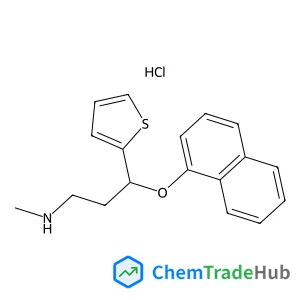
N-Methyl-3-(1-naphthyloxy)-3-(2-thienyl)-1-propanamine hydrochloride (1:1)
CAS Number:
1188266-11-6
Molecular Formula:
C18H20ClNOS
Recommended Suppliers







Disclaimer
This page provides academic journal information for reference and research purposes only. We are not affiliated with any journal publishers and do not handle publication submissions. For publication-related inquiries, please contact the respective journal publishers directly.
If you notice any inaccuracies in the information displayed, please contact us at support@chemtradehub.com. We will promptly review and address your concerns.