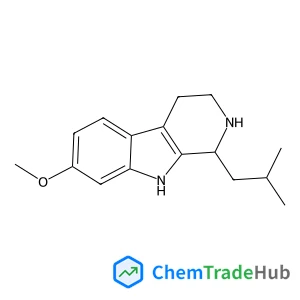
1-Isobutyl-7-methoxy-2,3,4,9-tetrahydro-1H-beta-carboline
CAS Number:
175975-76-5
Molecular Formula:
C16H22N2O
M. P. Lavin-Lopez, J. L. Valverde, M. C. Cuevas, A. Garrido, L. Sanchez-Silva, P. Martinez, A. Romero-Izquierdo
The optimization of graphene growth on copper foils using an atmospheric pressure chemical vapor deposition setup is reported. CH4 and H2 were used as precursor gases and Raman spectroscopy as the main graphene characterization technique. Different growth parameters, including temperature and reaction time, the molar ratio of CH4/H2 in the feed and total flow of gases during the reaction step, were studied in detail. It was shown that graphene growth was not homogeneous in the entire sample, multilayer graphene was present in most of the sample, however as the synthesis parameters were optimized, graphene gained better quality, obtaining bilayer graphene over most of the sheet in the final optimized sample. Homemade software was used to analyze the quality of the synthesised graphene, obtaining a more quality graphene according to the synthesis parameters optimized. An optimal bilayer graphene sample was prepared at the lowest growth time (10 min) and the highest synthesis temperature (1050 °C), using a CH4/H2 flow ratio and a total flow rate ratio of precursors of 7% and 60 Nml (CH4 + H4) per min respectively.
Madhu Ramesh, Pandeeswar Makam, Chandrashekhar Voshavar, Harshavardhan Khare, Kolla Rajasekhar, Suryanarayanarao Ramakumar, Thimmaiah Govindaraju
DOI: 10.1039/C8OB01691G
J. E. Tungen, M. Aursnes, S. Ramon, R. A. Colas, C. N. Serhan, S. Nuruddin, F. Willoch, T. V. Hansen
DOI: 10.1039/C8OB01232F
Hideto Miyabe, Kayoko Fujii, Takeaki Naito
DOI: 10.1039/B208823A
Gregory Bar, Andrew F. Parsons, C. Barry Thomas
DOI: 10.1039/B209123B
Ben Bradshaw, David Collison, C. David Garner, John A. Joule
DOI: 10.1039/B209217D
Yun Lu, Yixing Zhao, Kishan L. Handoo, Vernon D. Parker
DOI: 10.1039/B208186E
Claire Empel, Katharina J. Hock, Rene M. Koenigs
DOI: 10.1039/C8OB01991F
Tine Risgaard, Kurt V. Gothelf, Karl Anker Jørgensen
DOI: 10.1039/B208859M
Pei Chen, Qian-Qian Zhang, Jia Guo, Lu-Lu Chen, Yan-Bo Wang, Xiao Zhang
DOI: 10.1039/C8OB01861H
N-(4-Methoxybenzyl)-2-pyridinamine (CAS: 52818-63-0) is increasingly being used ...
When handling Ethyl 4-(2-chlorophenyl)-1,3-thiazole-2-carboxylate, appropriate p...
Diethyldiselane (CAS: 628-39-7) is classified under the Globally Harmonized Syst...
The market for oxocopper (CAS: 12053-18-8) is primarily driven by its use in cat...
The market for 5-{[(2-Methyl-2-propanyl)oxy]carbonyl}-5-azaspiro[2.4]heptane-7-c...
2-(1-Pyrrolidinyl)-4-pyridinamine is a chemical compound with the CAS number 359...
2-(3-Pyridinyl)-1-azabicyclo[2.2.2]octane (CAS: 91556-75-1) is a crystalline sol...
(S)-Alpha-allyl-proline hydrochloride is usually synthesized via a Wittig reacti...
3-Methyl-1,2-oxazole-5-carboxylic acid (CAS: 4857-42-5) is an organic compound w...
Lys-SMCC-DM1 is synthesized via a multi-step process involving the coupling of S...

Physical Chemistry Chemical Physics (PCCP) is an international journal co-owned by 19 physical chemistry and physics societies from around the world. This journal publishes original, cutting-edge research in physical chemistry, chemical physics and biophysical chemistry. To be suitable for publication in PCCP, articles must include significant innovation and/or insight into physical chemistry; this is the most important criterion that reviewers and Editors will judge against when evaluating submissions. The journal has a broad scope and welcomes contributions spanning experiment, theory, computation and data science. Topical coverage includes spectroscopy, dynamics, kinetics, statistical mechanics, thermodynamics, electrochemistry, catalysis, surface science, quantum mechanics, quantum computing and machine learning. Interdisciplinary research areas such as polymers and soft matter, materials, nanoscience, energy, surfaces/interfaces, and biophysical chemistry are welcomed if they demonstrate significant innovation and/or insight into physical chemistry. Joined experimental/theoretical studies are particularly appreciated when complementary and based on up-to-date approaches.