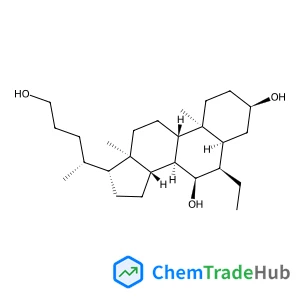
(3alpha,5beta,6alpha,7alpha)-6-Ethylcholane-3,7,24-triol
CAS Number:
1537866-49-1
Molecular Formula:
C26H46O3
Songqiu Yang, Peng Li, Panwang Zhou, Keli Han
In this article, the sensing mechanism of a fluorescence probe for hypochloric acid, NI–Se, has been investigated using experimental and theoretical methods. Based on the results of the steady-state and time-resolved emission spectra of NI–Se and its oxidized form NI–SeO, we suggested that there was twist internal charge transfer (TICT) state with faint fluorescence in NI–Se. Subsequently, the ground and excited state minimum geometries of NI–Se and NI–SeO were optimized with DFT/TD-DFT methods. The results demonstrated there was a twisting process in the excited state of NI–Se and that this twist process was induced by the nonbonding interaction between the Se and N atoms. In addition, the calculated spectra and molecular orbitals confirmed the charge transfer character of the TICT state in NI–Se. To further investigate the driving force behind the twist in NI–Se, we synthesized NI–O, which has no Se⋯N nonbonding interaction, as a control sample. Herein, we also present the characterization, fluorescence properties and the optimized geometries of NI–O. Moreover, the results showed that Se⋯N nonbonding interaction plays a significant role in the twisting process of NI–Se.
Zhi Ren, Cao Wang, Xiang-fan Xu, Guang-han Cao, Zhu-an Xu, Yu-heng Zhang
DOI: 10.1039/B800378E
Adrian Fegan, Pravin S. Shirude, Shankar Balasubramanian
DOI: 10.1039/B801629A
Pierangelo Metrangolo, Frank Meyer, Tullio Pilati, Giancarlo Terraneo
DOI: 10.1039/B716879A
Lidong Shao, Tsung-Wu Lin, Gerard Tobias, Malcolm L. H. Green
DOI: 10.1039/B800881G
Emanuela Berni, Joachim Garric, Corinne Lamit, Brice Kauffmann, Jean-Michel Léger, Ivan Huc
DOI: 10.1039/B719712H
Patrick Eisenberger, Iris Kieltsch, Nicolas Armanino, Antonio Togni
DOI: 10.1039/B801424H
Suk-Wah Tam-Chang, Liming Huang
DOI: 10.1039/B714319B
Jye-Shane Yang, Jyu-Lun Yan
DOI: 10.1039/B713428M
M. Baidya, Herbert Mayr
DOI: 10.1039/B801811A
N-(4-Methoxybenzyl)-2-pyridinamine (CAS: 52818-63-0) is increasingly being used ...
When handling Ethyl 4-(2-chlorophenyl)-1,3-thiazole-2-carboxylate, appropriate p...
Diethyldiselane (CAS: 628-39-7) is classified under the Globally Harmonized Syst...
The market for oxocopper (CAS: 12053-18-8) is primarily driven by its use in cat...
The market for 5-{[(2-Methyl-2-propanyl)oxy]carbonyl}-5-azaspiro[2.4]heptane-7-c...
2-(1-Pyrrolidinyl)-4-pyridinamine is a chemical compound with the CAS number 359...
2-(3-Pyridinyl)-1-azabicyclo[2.2.2]octane (CAS: 91556-75-1) is a crystalline sol...
(S)-Alpha-allyl-proline hydrochloride is usually synthesized via a Wittig reacti...
3-Methyl-1,2-oxazole-5-carboxylic acid (CAS: 4857-42-5) is an organic compound w...
Lys-SMCC-DM1 is synthesized via a multi-step process involving the coupling of S...

Physical Chemistry Chemical Physics (PCCP) is an international journal co-owned by 19 physical chemistry and physics societies from around the world. This journal publishes original, cutting-edge research in physical chemistry, chemical physics and biophysical chemistry. To be suitable for publication in PCCP, articles must include significant innovation and/or insight into physical chemistry; this is the most important criterion that reviewers and Editors will judge against when evaluating submissions. The journal has a broad scope and welcomes contributions spanning experiment, theory, computation and data science. Topical coverage includes spectroscopy, dynamics, kinetics, statistical mechanics, thermodynamics, electrochemistry, catalysis, surface science, quantum mechanics, quantum computing and machine learning. Interdisciplinary research areas such as polymers and soft matter, materials, nanoscience, energy, surfaces/interfaces, and biophysical chemistry are welcomed if they demonstrate significant innovation and/or insight into physical chemistry. Joined experimental/theoretical studies are particularly appreciated when complementary and based on up-to-date approaches.
![1-{3-[4-Amino-3-(4-phenoxyphenyl)-1H-pyrazolo[3,4-d]pyrimidin-1-yl]-1-piperidinyl}-2,3-dihydroxy-1-propanone structure](https://static.chemtradehub.com/structs/122/1226872-27-0-e037.webp "1-{3-[4-Amino-3-(4-phenoxyphenyl)-1H-pyrazolo[3,4-d]pyrimidin-1-yl]-1-piperidinyl}-2,3-dihydroxy-1-propanone structure")
![1,10-bis(3,5-dimethylphenyl)-12-hydroxy-4,5,6,7-tetrahydroiindeno[7,1-de:1',7'-fg][1,3,2]dioxaphosphocine 12-oxide structure](https://static.chemtradehub.com/structs/141/1412439-82-7-b9a9.webp "1,10-bis(3,5-dimethylphenyl)-12-hydroxy-4,5,6,7-tetrahydroiindeno[7,1-de:1',7'-fg][1,3,2]dioxaphosphocine 12-oxide structure")