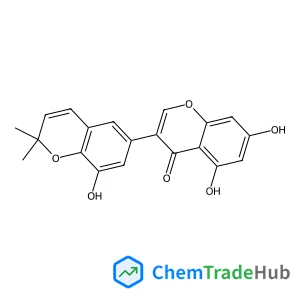
5,7,8'-Trihydroxy-2',2'-dimethyl-2'H,4H-3,6'-bichromen-4-one
CAS Number:
129280-33-7
Molecular Formula:
C20H16O6
Flavio Tollini, Alice Occhetta, Francesca Broglia, Vincenzo Calemma, Stefano Carminati, Giuseppe Storti, Mattia Sponchioni, Davide Moscatelli
Glycidol (GL) and epichlorohydrin (EPI) are two widely used molecules in chemical, pharmaceutical and food industry applications. However, their use in aqueous environments causes the formation of compounds, like monochloropropanediol (MCPD) and dichloropropanol (DCP), reported as dangerous for human health and therefore regulated by severe law restrictions. To identify the conditions leading to such species and design the corresponding processes in order to prevent their formation, hydrolysis and chlorination of EPI and GL, together with dehydrohalogenation of DCP and MCPD, have been systematically analysed. Different reaction conditions in terms of temperature, pH and chloride ion concentration have been experimentally investigated and the concentration of the involved species was tracked over time by gas chromatography and high-performance liquid chromatography. These experimental data were fitted through a kinetic model, which allowed a general expression of the observed rate constant of each reaction as a function of temperature and pH to be quantified. In particular, the reaction rates are conveniently expressed as combinations of three contributions: alkaline, neutral and acid. The corresponding rate laws explicitly account for the critical role of pH. The developed mechanistic model exhibits good prediction ability and may represent the basis for optimising processes employing EPI and GL.
A. Bellili, M. C. Gazeau, Y. Bénilan, N. Fray, J. C. Guillemin, M. Hochlaf, M. Schwell
DOI: 10.1039/C9CP04310A
M. Guruprasad Reddy, Nitin P. Lobo, Arun Roy, K. V. Ramanathan, T. Narasimhaswamy
DOI: 10.1039/D0CP03933K
Manzoor Ahmad Dar
DOI: 10.1039/D0CP01918F
Tathagata Nandi, Amogh Desai, Sri Rama Koti Ainavarapu
DOI: 10.1039/D0CP03876H
Liu-Cheng Chen, Hui Yang, Ming-An Fu, Jia Cheng, Xiao-Lin Wu, Yun Gao, Zhong-Bing Huang, Xiao-Jia Chen
DOI: 10.1039/C9CP04227J
X. He, Z. Q. Fan, Z. H. Zhang
DOI: 10.1039/D0CP04346J
Bernard Ryan
DOI: 10.1039/D0CP04053C
Ivo Jukić, Martina Požar, Bernarda Lovrinčević
DOI: 10.1039/D0CP03160G
Yang Liu, Hongwei Song, Jun Li
DOI: 10.1039/D0CP04120C
Julian M. Schmidt-Engler, Larissa Blankenburg, Rene Zangl, Jan Hoffmann, Nina Morgner, Jens Bredenbeck
DOI: 10.1039/D0CP04307A
Waste containing 2-Ethyl-4-Methyl-1H-Imidazole-5-Carbaldehyde (CAS: 88634-80-4) ...
Triethoxy(octyl)silane (CAS: 1385031-14-0) is widely used in the pharmaceuticals...
Several alternatives to 3-iodo-7-nitro-1H-indazole (CAS: 864724-64-1) exist in t...
Yes, there are alternatives to Benzene, bis[(trimethoxysilyl)ethyl] (CAS: 266317...
Isothiazole-3-carbonitrile (CAS: 1452-17-1) is generally considered safe when us...
(3-Chlorophenyl)methanol (CAS: 873-63-2) is considered low to moderately toxic. ...
(2S,3S)-2-Hydroxy-3-({[(2-methyl-2-propanyl)oxy]carbonyl}amino)-3-(2-naphthyl)pr...
Proper handling of methyl 2-(bromomethyl)-5-methoxybenzoate requires the use of ...
6,8-Dibromoimidazo[1,2-a]pyridine-2-carboxylic acid (CAS: 904805-36-3) is an aro...
3-Amino-5-bromo-2-pyridinecarbonitrile is considered safe when handled under pro...

Reaction Chemistry & Engineering is an interdisciplinary journal reporting cutting-edge research focused on enhancing the understanding and efficiency of reactions. Reaction engineering leverages the interface where fundamental molecular chemistry meets chemical engineering and technology. Challenges in chemistry can be overcome by the application of new technologies, while engineers may find improved solutions for process development from the latest developments in reaction chemistry. Reaction Chemistry & Engineering is a unique forum for researchers whose interests span the broad areas of chemical engineering and chemical sciences to come together in solving problems of importance to wider society. All papers should be written to be approachable by readers across the engineering and chemical sciences. Papers that consider multiple scales, from the laboratory up to and including plant scale, are particularly encouraged.
![N-[(1S,2R,4S)-2-Amino-4-(dimethylcarbamoyl)cyclohexyl]-N'-(5-chloro-2-pyridinyl)ethanediamide structure](https://static.chemtradehub.com/structs/480/480452-37-7-0898.webp "N-[(1S,2R,4S)-2-Amino-4-(dimethylcarbamoyl)cyclohexyl]-N'-(5-chloro-2-pyridinyl)ethanediamide structure")