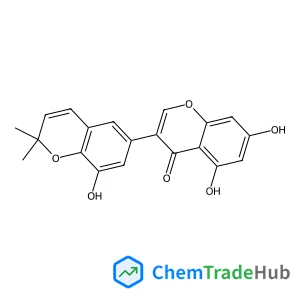
5,7,8'-Trihydroxy-2',2'-dimethyl-2'H,4H-3,6'-bichromen-4-one
CAS Number:
129280-33-7
Molecular Formula:
C20H16O6
M. Guruprasad Reddy, Nitin P. Lobo, Arun Roy, K. V. Ramanathan, T. Narasimhaswamy
For a successful design of functional mesogens, it is paramount to understand factors that contribute to molecular organisation such as molecular shape, the non-covalent interactions of the constituent moieties as well as nanosegregation of incompatible molecular parts. In this study on four tetracatenar mesogens, we show that by a slight change in the length of the terminal chain, the molecular organization changes from lamellar to columnar phase and that the orientational order experiences profound change between the lamellar, the center rectangular columnar and the hexagonal columnar mesophases. We consider here, mesogens that exhibit lamellar and columnar mesophases with five phenyl rings in the central rod-like core which are subjected to XRD and high resolution solid state 13C NMR investigations in their mesophases. The XRD studies indicate that the lower homologs exhibit a lamellar mesophase while the higher homologs show either a centre rectangular columnar phase or a 2D hexagonal columnar mesophase. 13C NMR investigations reveal interesting and strikingly different molecular orientations in each of these phases. For example, values of order parameters of one of the phenyl rings in the core region of the mesogens vary from 0.75 and 0.77 for the lamellar mesogens to 0.45 and 0.17 for the centre rectangular columnar and the hexagonal columnar mesogens respectively. While these values indicate that the mesogenic molecules are oriented along the magnetic field as expected in the lamellar phases, the very low order parameter in the hexagonal columnar phase arises due to molecules distributed azimuthally in layers and undergoing motion about the columnar axis which itself is oriented orthogonal to the magnetic field. Such cutting edge information extracted from the combined use of XRD and 13C NMR studies on tetracatenar mesogens is expected to be of significant use for the study of π–conjugated polycatenar systems where functional properties depend on the molecular orientation and order.

NDT & E International

Critical Reviews in Solid State and Materials Sciences

Journal of Chemical Sciences

Herald of the Russian Academy of Sciences

Heteroatom Chemistry

Bioorganic & Medicinal Chemistry

Biocatalysis and Biotransformation

Cellulose

Bioorganic & Medicinal Chemistry Letters

Journal of the Indian Institute of Science
Alvaro Cimas
DOI: 10.1039/B924025J
Ronald Göbel, Peter Hesemann, Jens Weber, Eléonore Möller, Alwin Friedrich, Sabine Beuermann
DOI: 10.1039/B821833A
Alexander C. Santulli, Wenqian Xu, Liusuo Wu, Fen Zhang, Chang-Yong Nam, Charles T. Black, Amanda L. Tiano
DOI: 10.1039/B822902C
Christophe Morell, Vanessa Labet, André Grand, Henry Chermette
DOI: 10.1039/B818534D
Florian Evers, Christian Reichhart, Roland Steitz, Metin Tolan, Claus Czeslik
DOI: 10.1039/B925134K
Huan-Chang Tseng, Jiann-Shing Wu, Rong-Yeu Chang
DOI: 10.1039/B919672B
Juanjuan Gao, Shuangyang Li, Xianren Zhang, Wenchuan Wang
DOI: 10.1039/B918449J
Philip Walther, Michael Puchberger, F. Rene Kogler, Karlheinz Schwarz, Ulrich Schubert
DOI: 10.1039/B820731C
A. Chaudhuri, D. C. Jackson, T. J. Lerotholi, Robert G. Jones, T.-L. Lee, B. Detlefs, D. P. Woodruff
DOI: 10.1039/B921281G
Joseph M. Beames, Andrew J. Hudson
DOI: 10.1039/B923202H
Waste containing 2-Ethyl-4-Methyl-1H-Imidazole-5-Carbaldehyde (CAS: 88634-80-4) ...
Triethoxy(octyl)silane (CAS: 1385031-14-0) is widely used in the pharmaceuticals...
Several alternatives to 3-iodo-7-nitro-1H-indazole (CAS: 864724-64-1) exist in t...
Yes, there are alternatives to Benzene, bis[(trimethoxysilyl)ethyl] (CAS: 266317...
Isothiazole-3-carbonitrile (CAS: 1452-17-1) is generally considered safe when us...
(3-Chlorophenyl)methanol (CAS: 873-63-2) is considered low to moderately toxic. ...
(2S,3S)-2-Hydroxy-3-({[(2-methyl-2-propanyl)oxy]carbonyl}amino)-3-(2-naphthyl)pr...
Proper handling of methyl 2-(bromomethyl)-5-methoxybenzoate requires the use of ...
6,8-Dibromoimidazo[1,2-a]pyridine-2-carboxylic acid (CAS: 904805-36-3) is an aro...
3-Amino-5-bromo-2-pyridinecarbonitrile is considered safe when handled under pro...

Physical Chemistry Chemical Physics (PCCP) is an international journal co-owned by 19 physical chemistry and physics societies from around the world. This journal publishes original, cutting-edge research in physical chemistry, chemical physics and biophysical chemistry. To be suitable for publication in PCCP, articles must include significant innovation and/or insight into physical chemistry; this is the most important criterion that reviewers and Editors will judge against when evaluating submissions. The journal has a broad scope and welcomes contributions spanning experiment, theory, computation and data science. Topical coverage includes spectroscopy, dynamics, kinetics, statistical mechanics, thermodynamics, electrochemistry, catalysis, surface science, quantum mechanics, quantum computing and machine learning. Interdisciplinary research areas such as polymers and soft matter, materials, nanoscience, energy, surfaces/interfaces, and biophysical chemistry are welcomed if they demonstrate significant innovation and/or insight into physical chemistry. Joined experimental/theoretical studies are particularly appreciated when complementary and based on up-to-date approaches.
![N-[(9H-Fluoren-9-ylmethoxy)carbonyl]-beta-phenyl-L-phenylalanine structure](https://static.chemtradehub.com/structs/201/201484-50-6-c2fc.webp "N-[(9H-Fluoren-9-ylmethoxy)carbonyl]-beta-phenyl-L-phenylalanine structure")