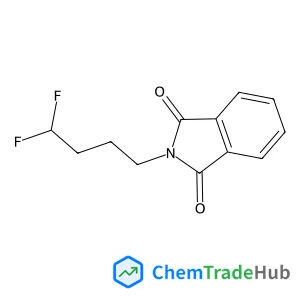
2-(4,4-Difluorobutyl)-1H-isoindole-1,3(2H)-dione
CAS Number:
1265341-14-7
Molecular Formula:
C12H11F2NO2
Rio Mikami, Yuto Nakamura, Naoki Shida, Mahito Atobe
An anodic substitution reaction in a flow microreactor using a stable emulsion solution prepared by tandem acoustic emulsification is demonstrated for the first time. The emulsion solution facilitated the selective anodic oxidation of carbamates, and the α-substituted products were ejected from the flow reactor to suppress overoxidation, resulting in an increase in the current efficiency for the desired reaction.

Israel Journal of Chemistry

Journal of Catalysis

Russian Chemical Reviews

Organic Preparations and Procedures International

Planta Medica

Proceedings of the National Academy of Sciences of the United States of America

Kinetics and Catalysis

Fibre Chemistry

Molecular Pharmacology

Journal of Heterocyclic Chemistry
Jennifer Frommer, Beatrice Karg, Klaus Weisz, Sabine Müller
DOI: 10.1039/C8OB02246A
Edda E. Neuteboom, Edwin H. A. Beckers, Stefan C. J. Meskers, E. W. Meijer, René A. J. Janssen
DOI: 10.1039/B208824J
Leslie J. Oates, Richard F. W. Jackson, Michael H. Block
DOI: 10.1039/B208632H
Per Wiklund, Jan Bergman
DOI: 10.1039/B209505J
Bernd Neumann, Hendrik Zipse
DOI: 10.1039/B209981K
Ji Liu, Qing-Yun Liu, Xing-Xiao Fang, Gong-Qing Liu, Yong Ling
DOI: 10.1039/C8OB02161A
Feng Liu, Guoqing Zhao, Weiqi Cai, Dongfang Xu, Baoguo Zhao
DOI: 10.1039/C8OB02000K
Ismail Althagafi, Ranjay Shaw, Rahul Panwar, Shally, Chanda Sinha, Amit Kumar, Yong-Tang Zheng, Ramendra Pratap
DOI: 10.1039/C8OB01733F
Gennaro Pescitelli, Nina Berova, Tom L. Xiao, Roman V. Rozhkov, Richard C. Larock, Daniel W. Armstrong
DOI: 10.1039/B207652G
N-(4-Methoxybenzyl)-2-pyridinamine (CAS: 52818-63-0) is increasingly being used ...
When handling Ethyl 4-(2-chlorophenyl)-1,3-thiazole-2-carboxylate, appropriate p...
Diethyldiselane (CAS: 628-39-7) is classified under the Globally Harmonized Syst...
The market for oxocopper (CAS: 12053-18-8) is primarily driven by its use in cat...
The market for 5-{[(2-Methyl-2-propanyl)oxy]carbonyl}-5-azaspiro[2.4]heptane-7-c...
2-(1-Pyrrolidinyl)-4-pyridinamine is a chemical compound with the CAS number 359...
2-(3-Pyridinyl)-1-azabicyclo[2.2.2]octane (CAS: 91556-75-1) is a crystalline sol...
(S)-Alpha-allyl-proline hydrochloride is usually synthesized via a Wittig reacti...
3-Methyl-1,2-oxazole-5-carboxylic acid (CAS: 4857-42-5) is an organic compound w...
Lys-SMCC-DM1 is synthesized via a multi-step process involving the coupling of S...

Reaction Chemistry & Engineering is an interdisciplinary journal reporting cutting-edge research focused on enhancing the understanding and efficiency of reactions. Reaction engineering leverages the interface where fundamental molecular chemistry meets chemical engineering and technology. Challenges in chemistry can be overcome by the application of new technologies, while engineers may find improved solutions for process development from the latest developments in reaction chemistry. Reaction Chemistry & Engineering is a unique forum for researchers whose interests span the broad areas of chemical engineering and chemical sciences to come together in solving problems of importance to wider society. All papers should be written to be approachable by readers across the engineering and chemical sciences. Papers that consider multiple scales, from the laboratory up to and including plant scale, are particularly encouraged.
![N-{15-[(2,5-Dioxo-1-pyrrolidinyl)oxy]-15-oxo-3,6,9,12-tetraoxapentadec-1-yl}-2-(2-propyn-1-yloxy)acetamide structure](https://static.chemtradehub.com/structs/210/2101206-92-0-2eb5.webp "N-{15-[(2,5-Dioxo-1-pyrrolidinyl)oxy]-15-oxo-3,6,9,12-tetraoxapentadec-1-yl}-2-(2-propyn-1-yloxy)acetamide structure")