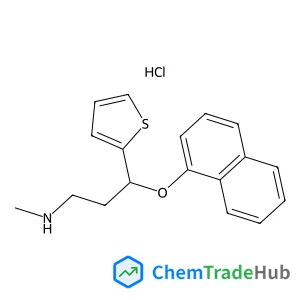
N-Methyl-3-(1-naphthyloxy)-3-(2-thienyl)-1-propanamine hydrochloride (1:1)
CAS Number:
1188266-11-6
Molecular Formula:
C18H20ClNOS
Ram Ji Dixit, Aditya Singh, Vijay K. Ramani
The valorization of biomass-derived furfural (FF) provides platform chemicals such as furfuryl alcohol (FA) and furoic acid (FU) for the polymer, pharmaceutical, and bio-fuel industries. The valorization based upon electrocatalytic reactions is a green and economical approach; however, utilization of solar energy can further reduce the overall cost and electrical energy requirement. Herein, we analyzed the generation of FA from electrocatalytic hydrogenation (ECH) of FF in an electrochemical cell (EC) using the Cu–Ni/NF cathode/Pt anode and in a photoelectrochemical cell (PEC) using the Cu–Ni/NF cathode/TiO2 nanotube photoanode. The PEC saved 50% of electrical energy as compared to the EC due to the use of solar energy. We demonstrated the feasibility of the PEC for paired ECH and TEMPO (2,2,6,6-tetramethylpiperidine-1-oxyl) mediated photoelectrochemical oxidation of FF to generate FA at the cathode and FU at the photoanode. The formation rate of FA and FU was obtained as 9.1 ± 0.3 μmol h−1 and 0.65 ± 0.03 μmol h−1, respectively, at an applied bias of 1 V for 4 h in a 21 mL batch PEC. A flow PEC was employed to increase the cell capacity and to tackle the mass transfer limitations, demonstrating the sustainable industrial-scale generation of platform chemicals. For the flow PEC at a flow rate of 1.5 mL min−1 at 1 V for 1.1 h, the single-pass conversion of FF in the cathode and anode compartments was 14.5% and 11.6%, respectively. The FA and FU formation rates were obtained as 6.4 ± 0.5 μmol h−1 and 5.4 ± 0.2 μmol h−1, respectively, indicating the better performance of the flow PEC as compared to the batch PEC.
Cong Lin, Sai Chen, Yihua Wang, Fei Gao, Liang Shen
DOI: 10.1039/D1QO01579F
David Hall, Henry S. Rzepa
DOI: 10.1039/B210415F
Leslie J. Oates, Richard F. W. Jackson, Michael H. Block
DOI: 10.1039/B208632H
Vinni H. Lillelund, Huizhen Liu, Xifu Liang, Helmer Søhoel, Mikael Bols
DOI: 10.1039/B208784G
Liyu Li, Kunfeng Li, Guangpu Zhang, Yuan Ma, Baobin Cai, Shaohua Li, Hongmei Ding, Jiali Deng, Xiyan Nan, Jing Sun, Yun Wu, Ningsheng Shao, Lihe Zhang, Zhenjun Yang
DOI: 10.1039/C8OB01454J
Madhu Ramesh, Pandeeswar Makam, Chandrashekhar Voshavar, Harshavardhan Khare, Kolla Rajasekhar, Suryanarayanarao Ramakumar, Thimmaiah Govindaraju
DOI: 10.1039/C8OB01691G
Michael Harding, Robert Hodgson, Tahir Majid, Kenneth J. McDowall
DOI: 10.1039/B208781B
Ivan S. Golovanov, Vladimir A. Tartakovsky, Alexey Yu. Sukhorukov, Sema L. Ioffe
DOI: 10.1039/C8OB01039K
Martin G. Banwell, Alison J. Edwards, Jason A. Smith, Ernest Hamel, Pascal Verdier-Pinard
DOI: 10.1039/B209992F
Yu Wang, Chenlong Wei, Ruyun Tang, Haosheng Zhan, Jing Lin, Zhenhua Liu, Weihua Tao, Zhongxue Fang
DOI: 10.1039/C8OB01749B
N-(4-Methoxybenzyl)-2-pyridinamine (CAS: 52818-63-0) is increasingly being used ...
When handling Ethyl 4-(2-chlorophenyl)-1,3-thiazole-2-carboxylate, appropriate p...
Diethyldiselane (CAS: 628-39-7) is classified under the Globally Harmonized Syst...
The market for oxocopper (CAS: 12053-18-8) is primarily driven by its use in cat...
The market for 5-{[(2-Methyl-2-propanyl)oxy]carbonyl}-5-azaspiro[2.4]heptane-7-c...
2-(1-Pyrrolidinyl)-4-pyridinamine is a chemical compound with the CAS number 359...
2-(3-Pyridinyl)-1-azabicyclo[2.2.2]octane (CAS: 91556-75-1) is a crystalline sol...
(S)-Alpha-allyl-proline hydrochloride is usually synthesized via a Wittig reacti...
3-Methyl-1,2-oxazole-5-carboxylic acid (CAS: 4857-42-5) is an organic compound w...
Lys-SMCC-DM1 is synthesized via a multi-step process involving the coupling of S...

Reaction Chemistry & Engineering is an interdisciplinary journal reporting cutting-edge research focused on enhancing the understanding and efficiency of reactions. Reaction engineering leverages the interface where fundamental molecular chemistry meets chemical engineering and technology. Challenges in chemistry can be overcome by the application of new technologies, while engineers may find improved solutions for process development from the latest developments in reaction chemistry. Reaction Chemistry & Engineering is a unique forum for researchers whose interests span the broad areas of chemical engineering and chemical sciences to come together in solving problems of importance to wider society. All papers should be written to be approachable by readers across the engineering and chemical sciences. Papers that consider multiple scales, from the laboratory up to and including plant scale, are particularly encouraged.