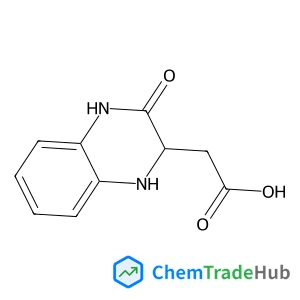
(3-Oxo-1,2,3,4-tetrahydro-2-quinoxalinyl)acetic acid
CAS Number:
136584-14-0
Molecular Formula:
C10H10N2O3
Salvador León, Sejin Oh, Antxon Martínez de Ilarduya
The use of renewable monomers to make new polyesters which could replace the ones obtained from petrochemical resources employing green processes is attracting a lot of attention these days. With this in mind, three different macrolactones, ω-pentadecalactone, globalide and 6-hexadecenlactone, have been polymerized in bulk by enzymatic ring opening polymerization (e-ROP) using immobilized Candida antarctica lipase B to give their corresponding polymacrolactones (PMLs). For the first time, these PMLs have been depolymerized enzymatically in solution with the concourse of the same enzyme and at mild temperatures. GPC, NMR and ESI MS demonstrated that the main products recovered after the enzymatic processive recycling were cyclic monomers and dimers, with a small amount of higher size macrocyclic oligoesters (MCOs). It was observed that these depolymerizations followed a Michaelis–Menten kinetic model. Finally it was shown that these MCOs could be repolymerized. This research provides a biosynthetic method for chemical recycling of these interesting polymeric materials providing a pathway towards a circular economy.
Yong-Feng Wang, Shan Xi Tian, Jinlong Yang
DOI: 10.1039/C1CP21267B
Peilin Liao, Emily A. Carter
DOI: 10.1039/C1CP20829B
Jonathan Romero, Andres Reyes, Jorge David, Albeiro Restrepo
DOI: 10.1039/C1CP20903E
Micael J. T. Oliveira, Miguel A. L. Marques
DOI: 10.1039/C1CP20719A
Abu Md Asaduzzaman, Georg Schreckenbach
DOI: 10.1039/C1CP21168D
Subhash S. Pingale
DOI: 10.1039/C1CP20071B
Srinivasan Anandan, Masahiro Miyauchi
DOI: 10.1039/C1CP21514K
Yufang Liu, Kai Jiang, Deheng Shi, Jinfeng Sun
DOI: 10.1039/C1CP20729F
This compound is mainly used as an intermediate in the synthesis of antipsychoti...
Waste containing 1-(D-Ribofuranosyl)-1,4-dihydro-3-pyridinecarboxamide (CAS: 191...
2-Methyl-2-propanyl 3-bromo-3-(hydroxymethyl)-1-azetidinecarboxylate (CAS: 20079...
N-(4-Chloro-2-pyridinyl)acetamide (CAS: 245056-66-0) is a chemical compound with...
5-Chloro-2-hydroxybenzoic acid, also known as 5-chlorosalicylic acid, is an arom...
When handling 1,1-Dichloro-1-fluoroethane (CAS: 1717-00-6), it is important to u...
Fmoc-(2S,3R)-3-phenylpyrrolidine-2-carboxylic acid is a white crystalline solid ...
4-Amino-5-bromo-2-pyridinecarboxylic acid is primarily used as a precursor in th...
Handling this compound should be done with personal protective equipment (PPE) i...
When handling 8-bromo-2,2-dimethyl-3,4-dihydro-2H-1,4-benzoxazin-3-one, use prop...

Polymer Chemistry welcomes submissions in all areas of polymer science that have a strong focus on macromolecular chemistry. Manuscripts may cover a broad range of fields, yet no direct application focus is required.