












Molecular electrostatic potential for exploring π-conjugation: a density-functional investigation‡
Literature Information
Publication Date
2011-07-21
DOI
10.1039/C1CP20071B
Impact Factor
3.676
Authors
Subhash S. Pingale
View Original
Abstract
Molecular electrostatic potentials (MESP) of the most common building blocks of organic π-conjugated systems, viz.ethylene, acetylene, benzene, furan, pyrrole, thiophene and phenylvinylene, are examined at the B3LYP/6-311++G(2d,2p) level. The topography of MESP is employed for mapping the strength of electronic conjugation between these building blocks. When electron-rich molecular regions are connected to each other, the MESP value of the corresponding conjugation critical point (CCP) is able to provide a quantitative measure of the strength of the conjugation. The systems with stronger conjugation are generally seen to possess a larger negative value of CCP and a smaller difference (ΔVCM−CCP) between the MESP values of respective conjugated minimum (CM) and the CCP, in agreement with the experimental as well as other theoretical results. The present MESP topography-based approach thus offers a measure of the quantitative strength of π-conjugation in molecules.
Related Literature
4-Nitrophenyl activated esters are superior synthons for indirect radiofluorination of biomolecules
Peter D. Roselt
2020-07-07
Research Article
DOI: 10.1039/D0MD00140F
Antibiotic administration in targeted nanoparticles protects the faecal microbiota of mice
Baris A. Borsa, Mert Sudagidan, Mehmet E. Aldag, Isik I. Baris, Elif E. Acar, Cagatay Acuner, Murat Kavruk, Veli C. Ozalp
2021-01-15
Research Article
DOI: 10.1039/D0MD00347F
Allocolchicinoids bearing a Michael acceptor fragment for possible irreversible binding of tubulin
Ekaterina S. Sazanova, Iuliia A. Gracheva, Diane Allegro, Pascale Barbier, Elena V. Svirshchevskaya, Alexey Yu Fedorov
2020-06-04
Research Article
DOI: 10.1039/D0MD00060D
Biological evaluation of native streptococcal competence stimulating peptides reveals potential crosstalk between Streptococcus mitis and Streptococcus pneumoniae and a new scaffold for the development of S. pneumoniae quorum sensing modulators
Tahmina Ahmed Milly, Yftah Tal-Gan
2020-05-29
Paper
DOI: 10.1039/D0CB00012D
The development of HEC-866 and its analogues for the treatment of idiopathic pulmonary fibrosis
Runfeng Lin, Zheng Zhang, Shengtian Cao, Wen Yang, Yinglin Zuo, Xinye Yang, Jiancun Zhang, Juan Xu, Jing Li, Xiaojun Wang
2021-06-02
Research Article
DOI: 10.1039/D1MD00023C
Design and optimisation of a small-molecule TLR2/4 antagonist for anti-tumour therapy
Qun Xu, Tian Li, Hekai Chen, Jun Kong, Liwei Zhang
2021-09-07
Research Article
DOI: 10.1039/D1MD00175B
Glycosylated cyclophellitol-derived activity-based probes and inhibitors for cellulases
Casper de Boer, Nicholas G. S. McGregor, Evert Peterse, Sybrin P. Schröder, Bogdan I. Florea, Jianbing Jiang, Jos Reijngoud, Arthur F. J. Ram, Gilles P. van Wezel, Gijsbert A. van der Marel, Jeroen D. C. Codée, Herman S. Overkleeft, Gideon J. Davies
2020-07-28
Paper
DOI: 10.1039/D0CB00045K
Shifting the paradigm in treating multi-factorial diseases: polypharmacological co-inhibitors of HDAC6
Alexandria M. Chan
2020-12-11
Review Article
DOI: 10.1039/D0MD00286K
You might also like
Compound Q&A
What are the main uses of 1-(3-Aminophenyl)-3-[(3R)-1-(3,3-dimethyl-2-oxobutyl)-2-oxo-5-(2-pyridinyl)-2,3-dihydro-1H-1,4-benzodiazepin-3-yl]urea (CAS: 155412-88-7)?
This compound is mainly used as an intermediate in the synthesis of antipsychoti...
155412-88-71-(3-Aminophenyl)-3-...
Compound Q&A
How should waste containing 1-(D-Ribofuranosyl)-1,4-dihydro-3-pyridinecarboxamide (CAS: 19132-12-8) be handled?
Waste containing 1-(D-Ribofuranosyl)-1,4-dihydro-3-pyridinecarboxamide (CAS: 191...
19132-12-81-(D-Ribofuranosyl)-...
Compound Q&A
What regulatory guidelines apply to 2-Methyl-2-propanyl 3-bromo-3-(hydroxymethyl)-1-azetidinecarboxylate (CAS: 2007919-81-3)?
2-Methyl-2-propanyl 3-bromo-3-(hydroxymethyl)-1-azetidinecarboxylate (CAS: 20079...
2007919-81-32-Methyl-2-propanyl ...
Compound Q&A
What is N-(4-Chloro-2-pyridinyl)acetamide (CAS: 245056-66-0)?
N-(4-Chloro-2-pyridinyl)acetamide (CAS: 245056-66-0) is a chemical compound with...
245056-66-0N-(4-Chloro-2-pyridi...
Compound Q&A
What is 5-Chloro-2-hydroxybenzoic acid (CAS: 321-14-2)?
5-Chloro-2-hydroxybenzoic acid, also known as 5-chlorosalicylic acid, is an arom...
321-14-25-Chloro-2-hydroxybe...
Compound Q&A
What precautions should be taken when handling 1,1-Dichloro-1-fluoroethane (CAS: 1717-00-6)?
When handling 1,1-Dichloro-1-fluoroethane (CAS: 1717-00-6), it is important to u...
1717-00-61,1-Dichloro-1-fluor...
Compound Q&A
What are the physical and chemical properties of Fmoc-(2S,3R)-3-phenylpyrrolidine-2-carboxylic acid (CAS: 281655-32-1)?
Fmoc-(2S,3R)-3-phenylpyrrolidine-2-carboxylic acid is a white crystalline solid ...
281655-32-1Fmoc-(2S,3R)-3-pheny...
Compound Q&A
What are the main uses of 4-Amino-5-bromo-2-pyridinecarboxylic acid (CAS: 1363381-01-4)?
4-Amino-5-bromo-2-pyridinecarboxylic acid is primarily used as a precursor in th...
1363381-01-44-Amino-5-bromo-2-py...
Compound Q&A
What precautions should be taken when handling (S)-tert-butyl 2-((2-(4-bromophenyl)-2-oxoethyl)carbamoyl)pyrrolidine-1-carboxylate (CAS: 1007881-98-2)?
Handling this compound should be done with personal protective equipment (PPE) i...
1007881-98-2(S)-tert-butyl 2-((2...
Compound Q&A
What precautions should be taken when handling 8-bromo-2,2-dimethyl-3,4-dihydro-2H-1,4-benzoxazin-3-one (CAS: 688363-73-7)?
When handling 8-bromo-2,2-dimethyl-3,4-dihydro-2H-1,4-benzoxazin-3-one, use prop...
688363-73-78-bromo-2,2-dimethyl...
Source Journal
Physical Chemistry Chemical Physics

CiteScore:
5.5
Self-citation Rate:
10.3%
Articles per Year:
3036
Physical Chemistry Chemical Physics (PCCP) is an international journal co-owned by 19 physical chemistry and physics societies from around the world. This journal publishes original, cutting-edge research in physical chemistry, chemical physics and biophysical chemistry. To be suitable for publication in PCCP, articles must include significant innovation and/or insight into physical chemistry; this is the most important criterion that reviewers and Editors will judge against when evaluating submissions. The journal has a broad scope and welcomes contributions spanning experiment, theory, computation and data science. Topical coverage includes spectroscopy, dynamics, kinetics, statistical mechanics, thermodynamics, electrochemistry, catalysis, surface science, quantum mechanics, quantum computing and machine learning. Interdisciplinary research areas such as polymers and soft matter, materials, nanoscience, energy, surfaces/interfaces, and biophysical chemistry are welcomed if they demonstrate significant innovation and/or insight into physical chemistry. Joined experimental/theoretical studies are particularly appreciated when complementary and based on up-to-date approaches.
Recommended Compounds
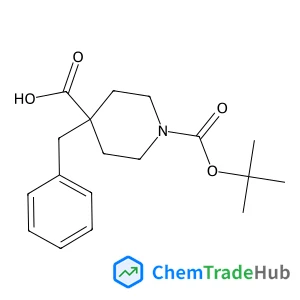
4-Benzyl-1-(tert-butoxycarbonyl)piperidine-4-carboxylic acid
CAS Number:
170838-87-6
Molecular Formula:
C18H25NO4
Recommended Suppliers





Disclaimer
This page provides academic journal information for reference and research purposes only. We are not affiliated with any journal publishers and do not handle publication submissions. For publication-related inquiries, please contact the respective journal publishers directly.
If you notice any inaccuracies in the information displayed, please contact us at support@chemtradehub.com. We will promptly review and address your concerns.