


Modeling van der Waals interactions between proteins and inorganic surfaces from time-dependent density functional theory calculations
Literature Information
Publication Date
2011-07-25
DOI
10.1039/C1CP20719A
Impact Factor
3.676
Authors
Micael J. T. Oliveira, Miguel A. L. Marques
View Original
Abstract
In this work we show how the ab initio determination of van der Waals coefficients within time-dependent density functional theory can be used to build efficient and accurate atomistic models that describe the long-range interactions of proteins with other proteins and of proteins with semi-conducting surfaces. The model parameters are fitted so that they reproduce the ab initio van der Waals coefficients of amino acids and dipeptides. We then assess the quality of our results by comparing ab initio van der Waals coefficients for larger peptides with the coefficients yielded by the models. The different sets of parameters can be easily incorporated in current empirical force field methods, thus providing an essential ingredient for molecular dynamics simulations of proteins close to surfaces.
Recommended Journals

Australian Journal of Chemistry

Cement and Concrete Research

Advances in Colloid and Interface Science

Journal of the Chinese Chemical Society

Journal of the American Chemical Society

Accounts of Chemical Research

Biopolymers

Chemical & Pharmaceutical Bulletin

Bulletin of the Chemical Society of Japan

Corrosion Science
Related Literature
Oxygen surface exchange kinetics of Ba0.5Sr0.5Co0.8Fe0.2O3−δ
V. A. Eremin, M. V. Ananyev, H. J. M. Bouwmeester, E. Kh. Kurumchin, Ch.-Y. Yoo
2020-04-29
Paper
DOI: 10.1039/C9CP06650K
Influence of the type of carrier on ferromagnetism in a Si semiconductor implanted with Cu ions
Li Wang, Denglu Hou, Chunfang Wu, Yuanping Shi, Shaohui Shi, Weikun Gao, Shunzhen Feng, Yingdi Liu, Li Li, Denghui Ji
2020-03-09
Paper
DOI: 10.1039/C9CP05608D
The energetics of carbonated PuO2 surfaces affects nanoparticle morphology: a DFT+U study
Samuel Moxon, Adam R. Symington, Joshua S. Tse, James Dawson, Joseph M. Flitcroft, Stephen C. Parker, David J. Cooke, Robert M. Harker, Marco Molinari
2020-03-11
Paper
DOI: 10.1039/D0CP00021C
Distinct microscopic mechanisms for the accelerated aggregation of pathogenic Tau mutants revealed by kinetic analysis
Liu Hong
2020-03-17
Paper
DOI: 10.1039/C9CP06083A
Tuning of ORR activity through the stabilization of the adsorbates by hydrogen bonding with substituent groups
Nagaprasad Reddy Samala, Ilya Grinberg
2020-11-04
Paper
DOI: 10.1039/D0CP04478D
Yields of primary species in the low-linear energy transfer radiolysis of water in the temperature range of 25–700 °C
Abida Sultana, Jintana Meesungnoen, Jean-Paul Jay-Gerin
2020-03-18
Paper
DOI: 10.1039/D0CP00601G
Low-index dielectric metasurfaces supported by metallic substrates for efficient second-harmonic generation in the blue-ultraviolet range
Kwang-Hyon Kim
2020-02-29
Paper
DOI: 10.1039/D0CP00150C
Electron injection effect in In2O3 and SnO2 nanocrystals modified by ruthenium heteroleptic complexes
Marina Rumyantseva, Abulkosim Nasriddinov, Alexander Gaskov, Anna Moiseeva, Yuri Fedorov, Gediminas Jonusauskas
2020-03-16
Paper
DOI: 10.1039/C9CP07016H
Penning spectroscopy and structure of acetylene oligomers in He nanodroplets
S. Mandal, R. Gopal, M. Shcherbinin, A. D’Elia, H. Srinivas, R. Richter, B. Bapat, S. R. Krishnan, V. Sharma
2020-04-21
Paper
DOI: 10.1039/D0CP00689K
Incorporation of trivalent cations in NaX zeolite nanocrystals for the adsorption of O2 in the presence of CO2
Sarah Komaty, Ayoub Daouli, Michael Badawi, Clément Anfray, Moussa Zaarour, Samuel Valable, Svetlana Mintova
2020-04-14
Paper
DOI: 10.1039/D0CP00111B
You might also like
Compound Q&A
What are the main uses of 1-(3-Aminophenyl)-3-[(3R)-1-(3,3-dimethyl-2-oxobutyl)-2-oxo-5-(2-pyridinyl)-2,3-dihydro-1H-1,4-benzodiazepin-3-yl]urea (CAS: 155412-88-7)?
This compound is mainly used as an intermediate in the synthesis of antipsychoti...
155412-88-71-(3-Aminophenyl)-3-...
Compound Q&A
How should waste containing 1-(D-Ribofuranosyl)-1,4-dihydro-3-pyridinecarboxamide (CAS: 19132-12-8) be handled?
Waste containing 1-(D-Ribofuranosyl)-1,4-dihydro-3-pyridinecarboxamide (CAS: 191...
19132-12-81-(D-Ribofuranosyl)-...
Compound Q&A
What regulatory guidelines apply to 2-Methyl-2-propanyl 3-bromo-3-(hydroxymethyl)-1-azetidinecarboxylate (CAS: 2007919-81-3)?
2-Methyl-2-propanyl 3-bromo-3-(hydroxymethyl)-1-azetidinecarboxylate (CAS: 20079...
2007919-81-32-Methyl-2-propanyl ...
Compound Q&A
What is N-(4-Chloro-2-pyridinyl)acetamide (CAS: 245056-66-0)?
N-(4-Chloro-2-pyridinyl)acetamide (CAS: 245056-66-0) is a chemical compound with...
245056-66-0N-(4-Chloro-2-pyridi...
Compound Q&A
What is 5-Chloro-2-hydroxybenzoic acid (CAS: 321-14-2)?
5-Chloro-2-hydroxybenzoic acid, also known as 5-chlorosalicylic acid, is an arom...
321-14-25-Chloro-2-hydroxybe...
Compound Q&A
What precautions should be taken when handling 1,1-Dichloro-1-fluoroethane (CAS: 1717-00-6)?
When handling 1,1-Dichloro-1-fluoroethane (CAS: 1717-00-6), it is important to u...
1717-00-61,1-Dichloro-1-fluor...
Compound Q&A
What are the physical and chemical properties of Fmoc-(2S,3R)-3-phenylpyrrolidine-2-carboxylic acid (CAS: 281655-32-1)?
Fmoc-(2S,3R)-3-phenylpyrrolidine-2-carboxylic acid is a white crystalline solid ...
281655-32-1Fmoc-(2S,3R)-3-pheny...
Compound Q&A
What are the main uses of 4-Amino-5-bromo-2-pyridinecarboxylic acid (CAS: 1363381-01-4)?
4-Amino-5-bromo-2-pyridinecarboxylic acid is primarily used as a precursor in th...
1363381-01-44-Amino-5-bromo-2-py...
Compound Q&A
What precautions should be taken when handling (S)-tert-butyl 2-((2-(4-bromophenyl)-2-oxoethyl)carbamoyl)pyrrolidine-1-carboxylate (CAS: 1007881-98-2)?
Handling this compound should be done with personal protective equipment (PPE) i...
1007881-98-2(S)-tert-butyl 2-((2...
Compound Q&A
What precautions should be taken when handling 8-bromo-2,2-dimethyl-3,4-dihydro-2H-1,4-benzoxazin-3-one (CAS: 688363-73-7)?
When handling 8-bromo-2,2-dimethyl-3,4-dihydro-2H-1,4-benzoxazin-3-one, use prop...
688363-73-78-bromo-2,2-dimethyl...
Source Journal
Physical Chemistry Chemical Physics

CiteScore:
5.5
Self-citation Rate:
10.3%
Articles per Year:
3036
Physical Chemistry Chemical Physics (PCCP) is an international journal co-owned by 19 physical chemistry and physics societies from around the world. This journal publishes original, cutting-edge research in physical chemistry, chemical physics and biophysical chemistry. To be suitable for publication in PCCP, articles must include significant innovation and/or insight into physical chemistry; this is the most important criterion that reviewers and Editors will judge against when evaluating submissions. The journal has a broad scope and welcomes contributions spanning experiment, theory, computation and data science. Topical coverage includes spectroscopy, dynamics, kinetics, statistical mechanics, thermodynamics, electrochemistry, catalysis, surface science, quantum mechanics, quantum computing and machine learning. Interdisciplinary research areas such as polymers and soft matter, materials, nanoscience, energy, surfaces/interfaces, and biophysical chemistry are welcomed if they demonstrate significant innovation and/or insight into physical chemistry. Joined experimental/theoretical studies are particularly appreciated when complementary and based on up-to-date approaches.
Recommended Compounds
![2,6-Di(thiophen-2-yl)dithieno[3,2-b:2',3'-d]thiophene structure](https://static.chemtradehub.com/structs/910/910788-24-8-5b70.webp "2,6-Di(thiophen-2-yl)dithieno[3,2-b:2',3'-d]thiophene structure")
2,6-Di(thiophen-2-yl)dithieno[3,2-b:2',3'-d]thiophene
CAS Number:
910788-24-8
Molecular Formula:
C16H8S5
![Methyl 4-({[(2-methyl-2-propanyl)oxy]carbonyl}amino)bicyclo[2.2.2]octane-1-carboxylate structure](https://static.chemtradehub.com/structs/943/943845-74-7-b7e5.webp "Methyl 4-({[(2-methyl-2-propanyl)oxy]carbonyl}amino)bicyclo[2.2.2]octane-1-carboxylate structure")
Methyl 4-({[(2-methyl-2-propanyl)oxy]carbonyl}amino)bicyclo[2.2.2]octane-1-carboxylate
CAS Number:
943845-74-7
Molecular Formula:
C15H25NO4

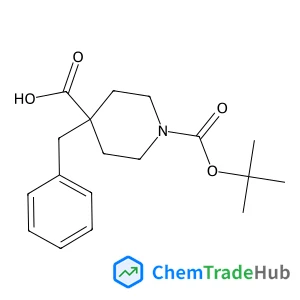
4-Benzyl-1-(tert-butoxycarbonyl)piperidine-4-carboxylic acid
CAS Number:
170838-87-6
Molecular Formula:
C18H25NO4
Recommended Suppliers




Disclaimer
This page provides academic journal information for reference and research purposes only. We are not affiliated with any journal publishers and do not handle publication submissions. For publication-related inquiries, please contact the respective journal publishers directly.
If you notice any inaccuracies in the information displayed, please contact us at support@chemtradehub.com. We will promptly review and address your concerns.