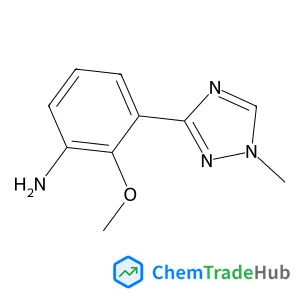
2-Methoxy-3-(1-methyl-1H-1,2,4-triazol-3-yl)aniline
CAS Number:
1609394-10-6
Molecular Formula:
C10H12N4O
Tengfei Miao, Xiaoxiao Cheng, Haotian Ma, Wei Zhang, Xiulin Zhu
The fixation, storage and self-recovery of chiral information in superstructures constructed by weak noncovalent bonds remain a big challenge in nature. Here, we describe a novel self-assembled system where the molecular chirality can be transferred and further stored into a helical superstructure. Based on achiral liquid crystalline polymers (LCPs), the twist between azobenzene (Azo) units in polymer side chains can be switched by the configuration or alkyl chain length of the introduced chiral dopant. Furthermore, the cross-linking strategy of polymer side chains was adopted to allow permanent memory of the induced helical superstructure after complete removal of the chiral dopant. Although the helical superstructure was temporarily destroyed by UV light irradiation, the stored chiral information enabled self-recovery of the previous helical chirality, without the need for any pre-existing chiral source. The chiral switching in the absence of chiral source is unprecedented and opens a new window for the design and application of chiral materials.
Takeo Arai, Masatoshi Yanagida, Hideki Sugihara, Kazuhiro Sayama
DOI: 10.1039/B811657A
Liz O’Donovan, Michael P. Carty, Fawaz Aldabbagh
DOI: 10.1039/B814706J
Chenghong Lei, Dehong Hu, Eric J. Ackerman
DOI: 10.1039/B812161C
Sylvestre Bonnet, Maxime A. Siegler, José Sánchez Costa, Gábor Molnár, Azzedine Bousseksou, Anthony L. Spek, Patrick Gamez, Jan Reedijk
DOI: 10.1039/B811746B
Cheng Peng, Lian Gao, Songwang Yang, Jing Sun
DOI: 10.1039/B812033A
Tomoya Miura, Keita Ueda, Yusuke Takahashi, Masahiro Murakami
DOI: 10.1039/B810665G
James P. Collman, Richard A. Decréau
DOI: 10.1039/B808070B
Fei Cheng, Andrew L. Hector, William Levason, Gillian Reid, Michael Webster, Wenjian Zhang
DOI: 10.1039/B809444F
Alan R. Bassindale, Zhihua Liu, Peter G. Taylor, Peter N. Horton, Michael B. Hursthouse
DOI: 10.1039/B808456D
1H-Indazole-6-carbonitrile finds applications in pharmaceuticals, where it serve...
Waste containing Dioctyl (2E)-2-butenedioate (CAS: 2997-85-5) should be collecte...
Sodium [(1,2-benzoxazol-3-ylmethyl)sulfonyl]azanide is primarily used in pharmac...
Dimethyl 4-(4,4,5,5-tetramethyl-1,3,2-dioxaborolan-2-yl)-2,6-pyridinedicarboxyla...
Waste containing 2-Fluoro-6-hydrazinopyridine (CAS: 80714-39-2) should be manage...
6-Formyl-2-pyridinecarboxylic acid is an organic compound with the molecular for...
Research trends for this compound indicate a focus on its potential applications...
9H-Tribenzo[b,d,f]azepine is typically synthesized via a multi-step process invo...
1-Cyclopropyl-7-ethoxy-6-fluoro-8-methoxy-4-oxo-1,4-dihydro-3-quinolinecarboxyli...
Waste containing Methyl 3-oxo-1,2,3,4-tetrahydro-6-quinoxalinecarboxylate (CAS: ...

Polymer Chemistry welcomes submissions in all areas of polymer science that have a strong focus on macromolecular chemistry. Manuscripts may cover a broad range of fields, yet no direct application focus is required.