












Front cover
Literature Information
Publication Date
DOI
10.1039/B817831N
Impact Factor
6.222
Authors
View Original
Abstract
The first page of this article is displayed as the abstract.
Related Literature
NMR and computational studies of the chemical reduction of [2.2]paracyclophane: formation of dianionic p-xylenyl oligomers
Ilya D. Gridnev, Fabio Pichierri
2003-11-26
Communication
DOI: 10.1039/B311885A
The intramolecular Baylis–Hillman reaction: easy preparation of versatile substrates, facile reactions, and synthetic applications
Jung Eun Yeo, Xiuling Yang, Hee Jin Kim, Sangho Koo
2003-11-10
Communication
DOI: 10.1039/B311951C
Living cationic polymerisation of styrene in an ionic liquid
R. Vijayaraghavan, D. R. MacFarlane
2004-02-13
Communication
DOI: 10.1039/B315100J
Highly diastereoselective formation of C2-symmetric bis-thioglycoside Pd(ii) complexes: the role of the exo anomeric effect
Noureddine Khiar, Cristina S. Araújo, Bélen Suárez, Eleuterio Alvarez, Inmaculada Fernández
2004-02-16
Communication
DOI: 10.1039/B313798H
Mesocellular polymer foams with unprecedented uniform large mesopores and high surface areas
Jinwoo Lee, Jaeyun Kim, Sang-Wook Kim, Chae-Ho Shin, Taeghwan Hyeon
2004-02-06
Communication
DOI: 10.1039/B310713B
Paired cell for the preparation of AgI nanowires using nanoporous alumina membrane templates
Yuanzhe Piao, Hasuck Kim
2003-10-17
Communication
DOI: 10.1039/B310212B
Self-indicating amine scavenger resins
Jin Ku Cho, Peter D. White, Wolfgang Klute, Tony W. Dean, Mark Bradley
2004-01-27
Communication
DOI: 10.1039/B315426B
Easy access to diastereomerically pure platinacycles
Concepción López, Amparo Caubet, Sonia Pérez, Xavier Solans, Mercè Font-Bardía
2004-01-27
Communication
DOI: 10.1039/B315157C
Electrospray mass spectrometry of undiluted ionic liquids
Glen P. Jackson, Douglas C. Duckworth
2004-01-27
Communication
DOI: 10.1039/B314754A
Construction of porphyrin–cyclodextrinself-assembly with molecular wedge
Ken Sasaki, Hiroki Nakagawa, Xiaoyong Zhang, Shinichi Sakurai, Koji Kano, Yasuhisa Kuroda
2004-01-19
Communication
DOI: 10.1039/B311079F
You might also like
Compound Q&A
What are the main uses of 1H-Indazole-6-carbonitrile (CAS: 141290-59-7)?
1H-Indazole-6-carbonitrile finds applications in pharmaceuticals, where it serve...
141290-59-71H-Indazole-6-carbon...
Compound Q&A
How should waste containing Dioctyl (2E)-2-butenedioate (CAS: 2997-85-5) be handled?
Waste containing Dioctyl (2E)-2-butenedioate (CAS: 2997-85-5) should be collecte...
2997-85-5Dioctyl (2E)-2-buten...
Compound Q&A
What industries use Sodium [(1,2-benzoxazol-3-ylmethyl)sulfonyl]azanide (CAS: 68291-98-5)?
Sodium [(1,2-benzoxazol-3-ylmethyl)sulfonyl]azanide is primarily used in pharmac...
68291-98-5Sodium [(1,2-benzoxa...
Compound Q&A
Are there alternatives to Dimethyl 4-(4,4,5,5-tetramethyl-1,3,2-dioxaborolan-2-yl)-2,6-pyridinedicarboxylate (CAS: 741709-66-0) in synthesis?
Dimethyl 4-(4,4,5,5-tetramethyl-1,3,2-dioxaborolan-2-yl)-2,6-pyridinedicarboxyla...
741709-66-0Dimethyl 4-(4,4,5,5-...
Compound Q&A
How should waste containing 2-Fluoro-6-hydrazinopyridine (CAS: 80714-39-2) be handled?
Waste containing 2-Fluoro-6-hydrazinopyridine (CAS: 80714-39-2) should be manage...
80714-39-22-Fluoro-6-hydrazino...
Compound Q&A
What is 6-Formyl-2-pyridinecarboxylic acid (CAS: 499214-11-8)?
6-Formyl-2-pyridinecarboxylic acid is an organic compound with the molecular for...
499214-11-86-Formyl-2-pyridinec...
Compound Q&A
What is the market or research trend for 3-(3,4-dimethoxyphenyl)-2,5-dimethyl-N-(2-morpholin-4-ylethyl)pyrazolo[1,5-a]pyrimidin-7-amine (CAS: 900874-91-1)?
Research trends for this compound indicate a focus on its potential applications...
900874-91-13-(3,4-dimethoxyphen...
Compound Q&A
How is 9H-Tribenzo[b,d,f]azepine (CAS: 29875-73-8) typically synthesized?
9H-Tribenzo[b,d,f]azepine is typically synthesized via a multi-step process invo...
29875-73-89H-Tribenzo[b,d,f]az...
Compound Q&A
How is 1-Cyclopropyl-7-ethoxy-6-fluoro-8-methoxy-4-oxo-1,4-dihydro-3-quinolinecarboxylic acid (CAS: 1797982-51-4) typically synthesized?
1-Cyclopropyl-7-ethoxy-6-fluoro-8-methoxy-4-oxo-1,4-dihydro-3-quinolinecarboxyli...
1797982-51-41-Cyclopropyl-7-etho...
Compound Q&A
How should waste containing Methyl 3-oxo-1,2,3,4-tetrahydro-6-quinoxalinecarboxylate (CAS: 671820-52-3) be handled?
Waste containing Methyl 3-oxo-1,2,3,4-tetrahydro-6-quinoxalinecarboxylate (CAS: ...
671820-52-3Methyl 3-oxo-1,2,3,4...
Source Journal
Chemical Communications

CiteScore:
8.6
Self-citation Rate:
4.7%
Articles per Year:
2458
ChemComm publishes urgent research which is of outstanding significance and interest to experts in the field, while also appealing to the journal’s broad chemistry readership. Our communication format is ideally suited to short, urgent studies that are of such importance that they require accelerated publication. Our scope covers all topics in chemistry, and research at the interface of chemistry and other disciplines (such as materials science, nanoscience, physics, engineering and biology) where there is a significant novelty in the chemistry aspects. Major topic areas covered include: Analytical Chemistry Catalysis Chemical Biology and medicinal chemistry Computational Chemistry and Machine Learning Energy and sustainable chemistry Environmental Chemistry Green Chemistry Inorganic Chemistry Materials Chemistry Nanoscience Organic Chemistry Physical Chemistry Polymer Chemistry Supramolecular Chemistry
Recommended Compounds
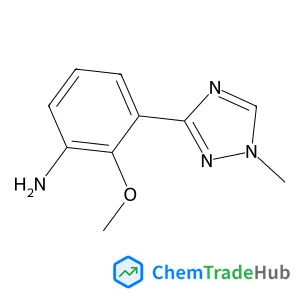
2-Methoxy-3-(1-methyl-1H-1,2,4-triazol-3-yl)aniline
CAS Number:
1609394-10-6
Molecular Formula:
C10H12N4O
Recommended Suppliers





Disclaimer
This page provides academic journal information for reference and research purposes only. We are not affiliated with any journal publishers and do not handle publication submissions. For publication-related inquiries, please contact the respective journal publishers directly.
If you notice any inaccuracies in the information displayed, please contact us at support@chemtradehub.com. We will promptly review and address your concerns.