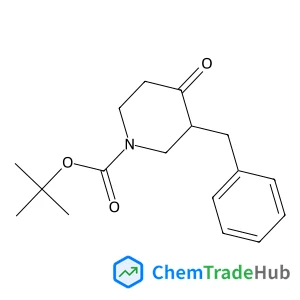
2-Methyl-2-propanyl 3-benzyl-4-oxo-1-piperidinecarboxylate
CAS Number:
193274-82-7
Molecular Formula:
C17H23NO3
Cheng Peng, Lian Gao, Songwang Yang, Jing Sun
A general precipitation strategy has been developed for the large-scale synthesis of molybdate nanostructures, and a series of molybdate nanostructures such as Fe2(MoO4)3nanoparticles, ZnMoO4 nanoplates, MnMoO4nanorods and CoMoO4nanowires have been successfully prepared.
James P. Collman, Li Zeng, Richard A. Decréau
DOI: 10.1039/B310763A
Ji-Hoon Lee, Do-Hoon Hwang
DOI: 10.1039/B309006J
Colin D. Abernethy
DOI: 10.1039/B314558A
Frédéric Boschetti, Franck Denat, Enrique Espinosa, Jean-Marie Lagrange, Roger Guilard
DOI: 10.1039/B315285E
Viktor V. Zhdankin, Dmitry N. Litvinov, Alexey Y. Koposov, Thanh Luu, Michael J. Ferguson, Robert McDonald, Rik R. Tykwinski
DOI: 10.1039/B312961F
Paul L. Burn, Graham R. Webster
DOI: 10.1039/B312936E
T. Ranganathan, C. Ramesh, Anil Kumar
DOI: 10.1039/B312826A
Naoyoshi Maezaki, Hiroaki Tominaga, Naoto Kojima, Minori Yanai, Daisuke Urabe, Tetsuaki Tanaka
DOI: 10.1039/B312362F
Colin L. Raston
DOI: 10.1039/B309455C
DOI: 10.1039/B310770A
1H-Indazole-6-carbonitrile finds applications in pharmaceuticals, where it serve...
Waste containing Dioctyl (2E)-2-butenedioate (CAS: 2997-85-5) should be collecte...
Sodium [(1,2-benzoxazol-3-ylmethyl)sulfonyl]azanide is primarily used in pharmac...
Dimethyl 4-(4,4,5,5-tetramethyl-1,3,2-dioxaborolan-2-yl)-2,6-pyridinedicarboxyla...
Waste containing 2-Fluoro-6-hydrazinopyridine (CAS: 80714-39-2) should be manage...
6-Formyl-2-pyridinecarboxylic acid is an organic compound with the molecular for...
Research trends for this compound indicate a focus on its potential applications...
9H-Tribenzo[b,d,f]azepine is typically synthesized via a multi-step process invo...
1-Cyclopropyl-7-ethoxy-6-fluoro-8-methoxy-4-oxo-1,4-dihydro-3-quinolinecarboxyli...
Waste containing Methyl 3-oxo-1,2,3,4-tetrahydro-6-quinoxalinecarboxylate (CAS: ...

ChemComm publishes urgent research which is of outstanding significance and interest to experts in the field, while also appealing to the journal’s broad chemistry readership. Our communication format is ideally suited to short, urgent studies that are of such importance that they require accelerated publication. Our scope covers all topics in chemistry, and research at the interface of chemistry and other disciplines (such as materials science, nanoscience, physics, engineering and biology) where there is a significant novelty in the chemistry aspects. Major topic areas covered include: Analytical Chemistry Catalysis Chemical Biology and medicinal chemistry Computational Chemistry and Machine Learning Energy and sustainable chemistry Environmental Chemistry Green Chemistry Inorganic Chemistry Materials Chemistry Nanoscience Organic Chemistry Physical Chemistry Polymer Chemistry Supramolecular Chemistry