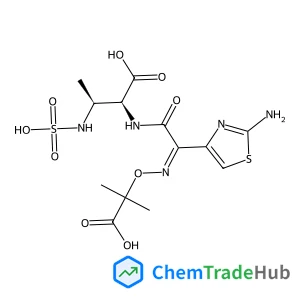
Aztreonam USP Related Compound A (Open-ring Aztreonam)
CAS Number:
87500-74-1
Molecular Formula:
C13H19N5O9S2
A graphical abstract is available for this content
Venkata S. Pavan K. Neti, Xiaofei Wu, Shuguang Deng, Luis Echegoyen
DOI: 10.1039/C3PY00798G
Lionel Petton, Edwin P. C. Mes, Hanno Van Der Wal, Sven Claessens, Freddy Van Damme, Sam Verbrugghe, Filip E. Du Prez
DOI: 10.1039/C3PY00600J
Marya Ahmed, Phanphen Wattanaarsakit, Ravin Narain
DOI: 10.1039/C3PY00425B
Aashish Sharma, Aasheesh Srivastava
DOI: 10.1039/C3PY00741C
Yeli Fan, Baoping Lin, Ying Sun, Xiaohui Gong, Hong Yang, Xueqin Zhang
DOI: 10.1039/C3PY00454F
Yoshiaki Yoshida, Yasuteru Mawatari, Asahi Motoshige, Ranko Motodshige, Toshifumi Hiraoki, Masayoshi Tabata
DOI: 10.1039/C3PY00295K
Mingming Zhang, Qingqing Xiong, Jinqian Chen, Yinsong Wang
DOI: 10.1039/C3PY00656E
6-(3-Fluorophenyl)picolinic acid is generally considered safe for laboratory use...
(3R)-3-Pyrrolidinol is used in the pharmaceutical industry as a precursor for dr...
When handling (4R,5R)-4,5-Diethoxycarbonyl-2,2-dimethyldioxolane (CAS: 59779-75-...
1-(6-Chloroimidazo[1,2-b]pyridazin-3-yl)ethanone is often synthesized via a mult...
The market for N-Ethyl-3,4-dimethylbenzylamine (CAS: 39180-83-1) remains steady,...
Tert-butyl 3-(pyrrolidin-1-yl)azetidine-1-carboxylate is a chemical compound wit...
1-Bromo-3-chloro-2,4-dimethoxybenzene (CAS: 1228956-93-1) falls under the classi...
The safety of 8-Bromo-2-methyl-3,4-dihydroisoquinolin-1(2H)-one (CAS: 1368622-07...
Benzyl [(3S)-2,6-dioxo-3-piperidinyl]carbamate is generally safe when handled wi...
1-{[4-(4,4,5,5-Tetramethyl-1,3,2-dioxaborolan-2-yl)phenyl]sulfonyl}pyrrolidine s...

Physical Chemistry Chemical Physics (PCCP) is an international journal co-owned by 19 physical chemistry and physics societies from around the world. This journal publishes original, cutting-edge research in physical chemistry, chemical physics and biophysical chemistry. To be suitable for publication in PCCP, articles must include significant innovation and/or insight into physical chemistry; this is the most important criterion that reviewers and Editors will judge against when evaluating submissions. The journal has a broad scope and welcomes contributions spanning experiment, theory, computation and data science. Topical coverage includes spectroscopy, dynamics, kinetics, statistical mechanics, thermodynamics, electrochemistry, catalysis, surface science, quantum mechanics, quantum computing and machine learning. Interdisciplinary research areas such as polymers and soft matter, materials, nanoscience, energy, surfaces/interfaces, and biophysical chemistry are welcomed if they demonstrate significant innovation and/or insight into physical chemistry. Joined experimental/theoretical studies are particularly appreciated when complementary and based on up-to-date approaches.