












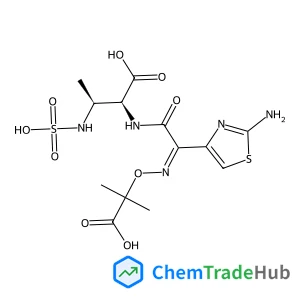
Aztreonam USP Related Compound A (Open-ring Aztreonam)
CAS Number:
87500-74-1
Molecular Formula:
C13H19N5O9S2
Lionel Petton, Edwin P. C. Mes, Hanno Van Der Wal, Sven Claessens, Freddy Van Damme, Sam Verbrugghe, Filip E. Du Prez
A straightforward synthetic pathway based on nitroxide mediated polymerisation (NMP) for the synthesis of a variety of high molar mass segmented copolymers comprising both polystyrene (PS) and polyether segments is reported. First, various precursors such as linear or star-shaped polyether macromonomers, containing either α-methylstyrene or styrene functions at one polymer terminus, as well as PS and polyether macroalkoxyamines bearing either 2,2,6,6-tetramethyl-1-piperidinyloxy (TEMPO) or N-tert-butyl-1-diethylphosphono-2,2-dimethylpropyl nitroxide (SG1) end-groups, were prepared. In a second step, these prepolymers were used to design different copolymer architectures such as block, graft, star-grafted, toothbrush and palm tree structures, in which PS constituted the backbone and polyether the side chains. Block copolymers were obtained by NMP of styrene initiated with polyether macroalkoxyamines. Copolymerisation of styrene with linear and star-shaped polyether macromonomers by NMP resulted in graft and star-grafted copolymers, respectively. A toothbrush copolymer was produced in a similar way with the exception of the initiator, which was a PS macroalkoxyamine. Likewise, palm tree architectures were obtained by homopolymerising polyether macromonomers initiated by PS macroinitiators. Advanced characterisation of the different polymer structures was performed, including 2D chromatography.
Jing Kong, Zheng Bo, Huachao Yang, Jinyuan Yang, Xiaorui Shuai, Jianhua Yan, Kefa Cen
DOI: 10.1039/C6CP08752C
Martin Schilling, Sylvain Brimaud, R. Jürgen Behm
DOI: 10.1039/C7CP03961A
Dominik Lindorfer, Frank Müh, Thomas Renger
DOI: 10.1039/C6CP08778G
G. R. Darling, M. Forster, C. Lin, N. Liu, R. Raval, A. Hodgson
DOI: 10.1039/C7CP00622E
Masaaki Fujii
DOI: 10.1039/C7CP03480F
E. Fadda, M. G. Nixon
DOI: 10.1039/C7CP02485A
C. T. Liu, J. F. Chu, C. K. Lin, C. W. Hong
DOI: 10.1039/C7CP00541E
DOI: 10.1039/C7CP90191G
E. Cassette, S. Pedetti, B. Mahler, S. Ithurria, B. Dubertret, G. D. Scholes
DOI: 10.1039/C6CP08689F
DOI: 10.1039/C7CP05102F
6-(3-Fluorophenyl)picolinic acid is generally considered safe for laboratory use...
(3R)-3-Pyrrolidinol is used in the pharmaceutical industry as a precursor for dr...
When handling (4R,5R)-4,5-Diethoxycarbonyl-2,2-dimethyldioxolane (CAS: 59779-75-...
1-(6-Chloroimidazo[1,2-b]pyridazin-3-yl)ethanone is often synthesized via a mult...
The market for N-Ethyl-3,4-dimethylbenzylamine (CAS: 39180-83-1) remains steady,...
Tert-butyl 3-(pyrrolidin-1-yl)azetidine-1-carboxylate is a chemical compound wit...
1-Bromo-3-chloro-2,4-dimethoxybenzene (CAS: 1228956-93-1) falls under the classi...
The safety of 8-Bromo-2-methyl-3,4-dihydroisoquinolin-1(2H)-one (CAS: 1368622-07...
Benzyl [(3S)-2,6-dioxo-3-piperidinyl]carbamate is generally safe when handled wi...
1-{[4-(4,4,5,5-Tetramethyl-1,3,2-dioxaborolan-2-yl)phenyl]sulfonyl}pyrrolidine s...

Polymer Chemistry welcomes submissions in all areas of polymer science that have a strong focus on macromolecular chemistry. Manuscripts may cover a broad range of fields, yet no direct application focus is required.

![[4-Chloro-3-(diethylcarbamoyl)phenyl]boronic acid structure](https://static.chemtradehub.com/structs/871/871332-68-2-0e3b.webp "[4-Chloro-3-(diethylcarbamoyl)phenyl]boronic acid structure")





