













Salt-in-water and water-in-salt electrolytes: the effects of the asymmetry in cation and anion valence on their properties
Literature Information
Publication Date
2021-11-22
DOI
10.1039/D1CP04259A
Impact Factor
3.676
Authors
Andresa Messias, Débora A. C. da Silva, Eudes E. Fileti
View Original
Abstract
We investigated the structural, dynamic, energetic, and electrostatic properties of electrolytes based on the ion pairs LiCl and Li2SO4. Atomistic molecular dynamics simulations were used to simulate these aqueous electrolytic solutions at two different concentrations 2 M (normal) and 21 M (superconcentrated, WiSE). The effects of the valence asymmetry of the Li2SO4 electrolyte were also discussed for both salt concentrations. Our results differ in the physical aspect of pure electrolytes, showing the drastic effect of high concentration, in particular on the viscosity, which is dramatically increased in WiSE. This is a consequence of their reduced ionic mobility and has a direct effect on ionic conductivity. Also, our results for graphene-based supercapacitors, as indicated by some experimental work, do not indicate any better performance of WiSEs over normal electrolytes. In fact, the differences in the total capacitance, due to the concentration of ions, presented by both electrolytes are negligible. The valence asymmetry can be clearly observed in some properties but for most of them its effects could not be quantified or isolated.
Related Literature
New insights into the mechanism of asymmetric hydrogenation catalysed by monophosphonite–rhodium complexes
Ilya D. Gridnev, Cheng Fan, Paul G. Pringle
2007-02-27
Communication
DOI: 10.1039/B617705K
Miniaturizing chemistry and biology in microdroplets
Bernard T. Kelly, Jean-Christophe Baret, Andrew D. Griffiths
2007-02-23
Feature Article
DOI: 10.1039/B616252E
Unexpected four- and eight-membered organo P–Se heterocycles‡
Guoxiong Hua, Yang Li, Alexandra M. Z. Slawin, J. Derek Woollins
2007-02-01
Communication
DOI: 10.1039/B617418C
Cyclometalated ruthenium complexes for sensitizing nanocrystalline TiO2 solar cells
Sipke H. Wadman, Jan M. Kroon, Klaas Bakker, Martin Lutz, Anthony L. Spek, Gerard P. M. van Klink, Gerard van Koten
2007-04-19
Communication
DOI: 10.1039/B703636A
A novel Heck reaction catalyzed by Co hollow nanospheres in ligand-free condition
Ping Zhou, Yingguang Li, Peipei Sun, Jiahong Zhou, Jianchun Bao
2007-01-29
Communication
DOI: 10.1039/B617556B
Photoinduced reduction of catalytically and biologically active Ru(ii)bisterpyridine–cytochrome c bioconjugates
Joshua R. Peterson, Trevor A. Smith, Pall Thordarson
2007-04-13
Communication
DOI: 10.1039/B702996A
Activity-based fingerprinting and inhibitor discovery of cysteine proteases in a microarray
Mahesh Uttamchandani, Kai Liu, Resmi C. Panicker
2007-03-15
Communication
DOI: 10.1039/B702826A
A photoswitchable molecular wire with the dithienylethene (DTE) linker, (dppe)(η5-C5Me5)Fe–CC–DTE–CC–Fe(η5-C5Me5)(dppe)
Yuya Tanaka, Akiko Inagaki, Munetaka Akita
2006-12-19
Communication
DOI: 10.1039/B614748H
Palladium-catalyzed conjugate reduction of enones into α,β-dideuterioketones with hexamethyldisilane and deuterium oxide
Hidehito Otsuka, Eiji Shirakawa, Tamio Hayashi
2007-02-08
Communication
DOI: 10.1039/B618107D
You might also like
Compound Q&A
What precautions should be taken when handling 2-Chloro-1,2-bis(4-methylphenyl)ethanone (CAS: 71193-32-3)?
When handling 2-Chloro-1,2-bis(4-methylphenyl)ethanone (CAS: 71193-32-3), it is ...
71193-32-32-Chloro-1,2-bis(4-m...
Compound Q&A
What industries use 4-Ethoxy-3-(5-methyl-4-oxo-7-propyl-1,4-dihydroimidazo[5,1-f][1,2,4]triazin-2-yl)benzenesulfonyl chloride (CAS: 224789-26-8)?
4-Ethoxy-3-(5-methyl-4-oxo-7-propyl-1,4-dihydroimidazo[5,1-f][1,2,4]triazin-2-yl...
224789-26-84-Ethoxy-3-(5-methyl...
Compound Q&A
How should Methyl 3-Oxo-4-Androsten-17-Carboxylate (CAS: 2681-55-2) be stored?
Methyl 3-Oxo-4-Androsten-17-Carboxylate (CAS: 2681-55-2) should be stored in a c...
2681-55-2Methyl 3-Oxo-4-Andro...
Compound Q&A
What are the main uses of (R)-3-Amino-4-(3-hexylphenylamino)-4-oxobutylphosphonic acid (CAS: 909725-61-7)?
(R)-3-Amino-4-(3-hexylphenylamino)-4-oxobutylphosphonic acid is primarily used i...
909725-61-7(R)-3-Amino-4-(3-hex...
Compound Q&A
What regulatory guidelines apply to 2-Methyl-2-propanyl 3-amino-3-carbamoyl-1-azetidinecarboxylate (CAS: 1254120-14-3)?
2-Methyl-2-propanyl 3-amino-3-carbamoyl-1-azetidinecarboxylate (CAS: 1254120-14-...
1254120-14-32-Methyl-2-propanyl ...
Compound Q&A
Are there alternatives to (E)-4-(tert-Butoxy)-4-oxobut-2-enoic acid (CAS: 135355-96-3) in synthesis?
There are alternative reagents that can be used in synthesis instead of (E)-4-(t...
135355-96-3(E)-4-(tert-Butoxy)-...
Compound Q&A
What are the physical and chemical properties of [2-(3-Chlorophenyl)-1,3-thiazol-4-yl]methanol (CAS: 121202-20-8)?
[2-(3-Chlorophenyl)-1,3-thiazol-4-yl]methanol (CAS: 121202-20-8) is a crystallin...
121202-20-8[2-(3-Chlorophenyl)-...
Compound Q&A
What is the market or research trend for Methyl (2S)-[(4S)-2,2-dimethyl-1,3-dioxolan-4-yl]{[(4-methylphenyl)sulfonyl]oxy}acetate (CAS: 166249-17-8)?
The market and research trends for Methyl (2S)-[(4S)-2,2-dimethyl-1,3-dioxolan-4...
166249-17-8Methyl (2S)-[(4S)-2,...
Compound Q&A
What is the market or research trend for 1-Bromo-2-isocyanatoethane (CAS: 42865-19-0)?
The market for 1-Bromo-2-isocyanatoethane (CAS: 42865-19-0) is driven by its use...
42865-19-01-Bromo-2-isocyanato...
Compound Q&A
What are the main uses of 4-Nitro-D-phenylalanine hydrochloride (CAS: 147065-06-3)?
4-Nitro-D-phenylalanine hydrochloride (CAS: 147065-06-3) is primarily used in re...
147065-06-34-Nitro-D-phenylalan...
Source Journal
Physical Chemistry Chemical Physics

CiteScore:
5.5
Self-citation Rate:
10.3%
Articles per Year:
3036
Physical Chemistry Chemical Physics (PCCP) is an international journal co-owned by 19 physical chemistry and physics societies from around the world. This journal publishes original, cutting-edge research in physical chemistry, chemical physics and biophysical chemistry. To be suitable for publication in PCCP, articles must include significant innovation and/or insight into physical chemistry; this is the most important criterion that reviewers and Editors will judge against when evaluating submissions. The journal has a broad scope and welcomes contributions spanning experiment, theory, computation and data science. Topical coverage includes spectroscopy, dynamics, kinetics, statistical mechanics, thermodynamics, electrochemistry, catalysis, surface science, quantum mechanics, quantum computing and machine learning. Interdisciplinary research areas such as polymers and soft matter, materials, nanoscience, energy, surfaces/interfaces, and biophysical chemistry are welcomed if they demonstrate significant innovation and/or insight into physical chemistry. Joined experimental/theoretical studies are particularly appreciated when complementary and based on up-to-date approaches.
Recommended Compounds

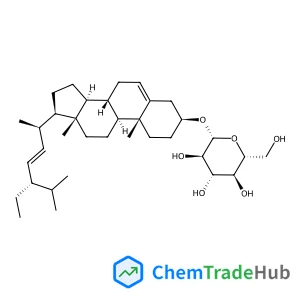
(3beta,22E)-Stigmasta-5,22-dien-3-yl beta-D-glucopyranoside
CAS Number:
19716-26-8
Molecular Formula:
C35H58O6
Recommended Suppliers



Disclaimer
This page provides academic journal information for reference and research purposes only. We are not affiliated with any journal publishers and do not handle publication submissions. For publication-related inquiries, please contact the respective journal publishers directly.
If you notice any inaccuracies in the information displayed, please contact us at support@chemtradehub.com. We will promptly review and address your concerns.