












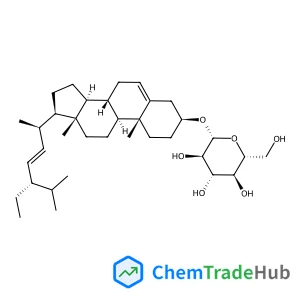
(3beta,22E)-Stigmasta-5,22-dien-3-yl beta-D-glucopyranoside
CAS Number:
19716-26-8
Molecular Formula:
C35H58O6
Bernard T. Kelly, Jean-Christophe Baret, Andrew D. Griffiths
By compartmentalizing reactions in aqueous microdroplets of water-in-oil emulsions, reaction volumes can be reduced by factors of up to 109 compared to conventional microtitre-plate based systems. This allows massively parallel processing of as many as 1010 reactions in a total volume of only 1 ml of emulsion. This review describes the use of emulsions for directed evolution of proteins and RNAs, and for performing polymerase chain reactions (PCRs). To illustrate these applications we describe certain specific experiments, each of which exemplifies a different facet of the technique, in some detail. These examples include directed evolution of Diels–Alderase and RNA ligase ribozymes and several classes of protein enzymes, including DNA polymerases, phosphotriesterases, β-galactosidases and thiolactonases. We also describe the application of emulsion PCR to screen for rare mutations and for new ultra-high throughput sequencing technologies. Finally, we discuss the recent development of microfluidic tools for making and manipulating microdroplets and their likely impact on the future development of the field.
Tongyan Zhang, Shiguo Sun, Fengyu Liu, Jiangli Fan, Licheng Sun, Xiaojun Peng
DOI: 10.1039/B916591F
Joachim Maier
DOI: 10.1039/B902586N
Helena Meresman, Jon B. Wills, Michael Summers, David McGloin, Jonathan P. Reid
DOI: 10.1039/B914165K
Wesley O. Gordon, Ye Xu, David R. Mullins, Steven H. Overbury
DOI: 10.1039/B913310K
Joseph Wontcheu, Wolfgang Bensch
DOI: 10.1039/B822397A
Thomas Schmierer, Wolfgang J. Schreier, Florian O. Koller, Tobias E. Schrader
DOI: 10.1039/B915451E
Xiaofeng Cui, Qiang Liu, Fushi Zhang
DOI: 10.1039/B819521H
Anu M. Kantola, Perttu Lantto, Jukka Jokisaari
DOI: 10.1039/B923506J
Hana Gerbelová, Tiago Q. Faria, Maria Manuel Sampaio, Rainer Rudolph, António L. Maçanita, Helena Santos
DOI: 10.1039/B819365G
Mark A. Blitz, Paul W. Seakins, Ian W. M. Smith
DOI: 10.1039/B917734E
When handling 2-Chloro-1,2-bis(4-methylphenyl)ethanone (CAS: 71193-32-3), it is ...
4-Ethoxy-3-(5-methyl-4-oxo-7-propyl-1,4-dihydroimidazo[5,1-f][1,2,4]triazin-2-yl...
Methyl 3-Oxo-4-Androsten-17-Carboxylate (CAS: 2681-55-2) should be stored in a c...
(R)-3-Amino-4-(3-hexylphenylamino)-4-oxobutylphosphonic acid is primarily used i...
2-Methyl-2-propanyl 3-amino-3-carbamoyl-1-azetidinecarboxylate (CAS: 1254120-14-...
There are alternative reagents that can be used in synthesis instead of (E)-4-(t...
[2-(3-Chlorophenyl)-1,3-thiazol-4-yl]methanol (CAS: 121202-20-8) is a crystallin...
The market and research trends for Methyl (2S)-[(4S)-2,2-dimethyl-1,3-dioxolan-4...
The market for 1-Bromo-2-isocyanatoethane (CAS: 42865-19-0) is driven by its use...
4-Nitro-D-phenylalanine hydrochloride (CAS: 147065-06-3) is primarily used in re...

ChemComm publishes urgent research which is of outstanding significance and interest to experts in the field, while also appealing to the journal’s broad chemistry readership. Our communication format is ideally suited to short, urgent studies that are of such importance that they require accelerated publication. Our scope covers all topics in chemistry, and research at the interface of chemistry and other disciplines (such as materials science, nanoscience, physics, engineering and biology) where there is a significant novelty in the chemistry aspects. Major topic areas covered include: Analytical Chemistry Catalysis Chemical Biology and medicinal chemistry Computational Chemistry and Machine Learning Energy and sustainable chemistry Environmental Chemistry Green Chemistry Inorganic Chemistry Materials Chemistry Nanoscience Organic Chemistry Physical Chemistry Polymer Chemistry Supramolecular Chemistry


![2-Hydroxy-4-[({[(4-methylphenyl)sulfonyl]oxy}acetyl)amino]benzoic acid structure](https://static.chemtradehub.com/structs/501/501919-59-1-579f.webp "2-Hydroxy-4-[({[(4-methylphenyl)sulfonyl]oxy}acetyl)amino]benzoic acid structure")





