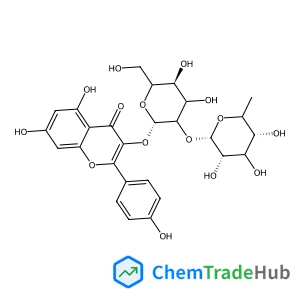
5,7-Dihydroxy-2-(4-hydroxyphenyl)-4-oxo-4H-chromen-3-yl 2-O-(6-deoxy-alpha-L-mannopyranosyl)-beta-D-glucopyranoside
CAS Number:
32602-81-6
Molecular Formula:
C27H30O15
Sipke H. Wadman, Jan M. Kroon, Klaas Bakker, Martin Lutz, Anthony L. Spek, Gerard P. M. van Klink, Gerard van Koten
Cyclometalated ruthenium complexes of [Ru(C^N^N)(N^N^N)] configuration are a promising new class of molecular sensitizers for dye-sensitized solar cells, as a result of their broad and red-shifted visible absorption in comparison to the analogous [Ru(N^N^N)2] type coordinative complexes.
Rajesh K. Raju, Anitha Ramraj, Ian H. Hillier, Mark A. Vincent, Neil A. Burton
DOI: 10.1039/B822877A
Conrad P. Corbyn, Paul D. I. Fletcher, Rabia Gemici, Rita S. Dias, Maria G. Miguel
DOI: 10.1039/B916116C
Wolfgang Haiss, Santiago Martin, Lisa E. Scullion, Laurent Bouffier, Simon J. Higgins, Richard J. Nichols
DOI: 10.1039/B910194B
Zhenhua Wang, Sizhu Wu, Wenchuan Wang
DOI: 10.1039/B919789C
Wesley O. Gordon, Ye Xu, David R. Mullins, Steven H. Overbury
DOI: 10.1039/B913310K
C. C. de Araujo, M. Schuster, G. Portale, H. Mendil-Jakani, G. Gebel, J. Maier
DOI: 10.1039/B822069G
Rahul K. Das, Anatoly B. Kolomeisky
DOI: 10.1039/B921303A
When handling 2-Chloro-1,2-bis(4-methylphenyl)ethanone (CAS: 71193-32-3), it is ...
4-Ethoxy-3-(5-methyl-4-oxo-7-propyl-1,4-dihydroimidazo[5,1-f][1,2,4]triazin-2-yl...
Methyl 3-Oxo-4-Androsten-17-Carboxylate (CAS: 2681-55-2) should be stored in a c...
(R)-3-Amino-4-(3-hexylphenylamino)-4-oxobutylphosphonic acid is primarily used i...
2-Methyl-2-propanyl 3-amino-3-carbamoyl-1-azetidinecarboxylate (CAS: 1254120-14-...
There are alternative reagents that can be used in synthesis instead of (E)-4-(t...
[2-(3-Chlorophenyl)-1,3-thiazol-4-yl]methanol (CAS: 121202-20-8) is a crystallin...
The market and research trends for Methyl (2S)-[(4S)-2,2-dimethyl-1,3-dioxolan-4...
The market for 1-Bromo-2-isocyanatoethane (CAS: 42865-19-0) is driven by its use...
4-Nitro-D-phenylalanine hydrochloride (CAS: 147065-06-3) is primarily used in re...

ChemComm publishes urgent research which is of outstanding significance and interest to experts in the field, while also appealing to the journal’s broad chemistry readership. Our communication format is ideally suited to short, urgent studies that are of such importance that they require accelerated publication. Our scope covers all topics in chemistry, and research at the interface of chemistry and other disciplines (such as materials science, nanoscience, physics, engineering and biology) where there is a significant novelty in the chemistry aspects. Major topic areas covered include: Analytical Chemistry Catalysis Chemical Biology and medicinal chemistry Computational Chemistry and Machine Learning Energy and sustainable chemistry Environmental Chemistry Green Chemistry Inorganic Chemistry Materials Chemistry Nanoscience Organic Chemistry Physical Chemistry Polymer Chemistry Supramolecular Chemistry