












Effect of Nafion content and hydration level on the electrochemical area of a Pt nanocatalyst in the triple-phase boundary
Literature Information
Publication Date
2021-11-19
DOI
10.1039/D1CP03731E
Impact Factor
3.676
Authors
View Original
Abstract
Despite the great scientific effort, there are still some aspects of a polymeric membrane-based fuel cell (PEMFC) operation that are difficult to access experimentally. This is the case of the so-called triple-phase boundary (TPB), where the ionomer (commonly Nafion) interacts with the supported nanocatalyst (commonly Pt) and is key to the catalytic activity of the system. In this work, we use molecular dynamics simulations and electrochemical experiments on a Nafion/Pt/C system. We perform a systematic analysis, at an atomistic level, to evaluate the effect of several fundamental factors and their intercorrelation on the electrochemically active area (ECSA) of the catalysts. Our results reveal that at high Nafion contents, the catalyst utilization is affected due to the strong interaction between the sulfonic groups of the ionomer and the surface of the Pt nanoparticles (NPs). On the other hand, when the hydration level of the membrane decreases, the sulfonic groups have a greater occupation on the NP surface, covering the active area with hydrophobic Nafion chains and therefore increasing the inactive area. Voltammograms can corroborate our calculations. Overall, this investigation allows us to rationalize how the catalyst utilization is affected, which is an important step in establishing the relationship between the environment and the effectiveness and durability of the PEMFC system.
Related Literature
Dissipative particle dynamics simulation study of poly(2-oxazoline)-based multicompartment micelle nanoreactor
Christina Clare Fisher
2016-01-28
Paper
DOI: 10.1039/C5CP07100C
A theoretical study on charge transport of dithiolene nickel complexes
Vu Thi Thu Huong, Truong Ba Tai, Minh Tho Nguyen
2016-01-27
Paper
DOI: 10.1039/C5CP07277H
Effects of Pt dispersion on electronic and oxide ionic conductivity in Pr1.90Ni0.71Cu0.24Ga0.05O4
J. Hyodo, H. Schraknepper, K. Tominaga
2016-03-22
Paper
DOI: 10.1039/C5CP07192E
Gas phase equilibrium structure of histamine
Anatolii N. Rykov, Olga E. Grikina, Leonid S. Khaikin
2016-01-19
Paper
DOI: 10.1039/C5CP07719B
Underlying mechanisms of the synergistic role of Li2MnO3 and LiNi1/3Co1/3Mn1/3O2 in high-Mn, Li-rich oxides
Jin-Myoung Lim, Duho Kim, Maenghyo Cho
2016-03-18
Paper
DOI: 10.1039/C6CP00088F
Structural analysis of bioinspired nano materials with synchrotron far IR spectroscopy
Rania S. Seoudi, Annette Dowd, Brian J. Smith, Adam Mechler
2016-04-04
Paper
DOI: 10.1039/C6CP01355D
Rational design of hierarchical ZnO superstructures for efficient charge transfer: mechanistic and photovoltaic studies of hollow, mesoporous, cage-like nanostructures with compacted 1D building blocks
Tridip Ranjan Chetia, Mohammad Shaad Ansari, Mohammad Qureshi
2016-01-19
Paper
DOI: 10.1039/C5CP07687K
Photon upconversion: from two-photon absorption (TPA) to triplet–triplet annihilation (TTA)
Changqing Ye, Liwei Zhou, Xiaomei Wang, Zuoqin Liang
2016-01-25
Perspective
DOI: 10.1039/C5CP07296D
Electron transport mechanism of bathocuproine exciton blocking layer in organic photovoltaics
Jeihyun Lee, Soohyung Park, Younjoo Lee, Hyein Kim, Dongguen Shin, Junkyeong Jeong, Kwangho Jeong, Sang Wan Cho, Hyunbok Lee, Yeonjin Yi
2016-01-19
Paper
DOI: 10.1039/C5CP07099F
Electrophoresis of pH-regulated nanoparticles: impact of the Stern layer
Lanju Mei, Tzung-Han Chou, Yu-Shen Cheng, Ming-Jiang Huang, Li-Hsien Yeh, Shizhi Qian
2015-10-14
Paper
DOI: 10.1039/C5CP05728K
You might also like
Compound Q&A
What are the main uses of 1-(3-Aminophenyl)-3-[(3R)-1-(3,3-dimethyl-2-oxobutyl)-2-oxo-5-(2-pyridinyl)-2,3-dihydro-1H-1,4-benzodiazepin-3-yl]urea (CAS: 155412-88-7)?
This compound is mainly used as an intermediate in the synthesis of antipsychoti...
155412-88-71-(3-Aminophenyl)-3-...
Compound Q&A
How should waste containing 1-(D-Ribofuranosyl)-1,4-dihydro-3-pyridinecarboxamide (CAS: 19132-12-8) be handled?
Waste containing 1-(D-Ribofuranosyl)-1,4-dihydro-3-pyridinecarboxamide (CAS: 191...
19132-12-81-(D-Ribofuranosyl)-...
Compound Q&A
What regulatory guidelines apply to 2-Methyl-2-propanyl 3-bromo-3-(hydroxymethyl)-1-azetidinecarboxylate (CAS: 2007919-81-3)?
2-Methyl-2-propanyl 3-bromo-3-(hydroxymethyl)-1-azetidinecarboxylate (CAS: 20079...
2007919-81-32-Methyl-2-propanyl ...
Compound Q&A
What is N-(4-Chloro-2-pyridinyl)acetamide (CAS: 245056-66-0)?
N-(4-Chloro-2-pyridinyl)acetamide (CAS: 245056-66-0) is a chemical compound with...
245056-66-0N-(4-Chloro-2-pyridi...
Compound Q&A
What is 5-Chloro-2-hydroxybenzoic acid (CAS: 321-14-2)?
5-Chloro-2-hydroxybenzoic acid, also known as 5-chlorosalicylic acid, is an arom...
321-14-25-Chloro-2-hydroxybe...
Compound Q&A
What precautions should be taken when handling 1,1-Dichloro-1-fluoroethane (CAS: 1717-00-6)?
When handling 1,1-Dichloro-1-fluoroethane (CAS: 1717-00-6), it is important to u...
1717-00-61,1-Dichloro-1-fluor...
Compound Q&A
What are the physical and chemical properties of Fmoc-(2S,3R)-3-phenylpyrrolidine-2-carboxylic acid (CAS: 281655-32-1)?
Fmoc-(2S,3R)-3-phenylpyrrolidine-2-carboxylic acid is a white crystalline solid ...
281655-32-1Fmoc-(2S,3R)-3-pheny...
Compound Q&A
What are the main uses of 4-Amino-5-bromo-2-pyridinecarboxylic acid (CAS: 1363381-01-4)?
4-Amino-5-bromo-2-pyridinecarboxylic acid is primarily used as a precursor in th...
1363381-01-44-Amino-5-bromo-2-py...
Compound Q&A
What precautions should be taken when handling (S)-tert-butyl 2-((2-(4-bromophenyl)-2-oxoethyl)carbamoyl)pyrrolidine-1-carboxylate (CAS: 1007881-98-2)?
Handling this compound should be done with personal protective equipment (PPE) i...
1007881-98-2(S)-tert-butyl 2-((2...
Compound Q&A
What precautions should be taken when handling 8-bromo-2,2-dimethyl-3,4-dihydro-2H-1,4-benzoxazin-3-one (CAS: 688363-73-7)?
When handling 8-bromo-2,2-dimethyl-3,4-dihydro-2H-1,4-benzoxazin-3-one, use prop...
688363-73-78-bromo-2,2-dimethyl...
Source Journal
Physical Chemistry Chemical Physics

CiteScore:
5.5
Self-citation Rate:
10.3%
Articles per Year:
3036
Physical Chemistry Chemical Physics (PCCP) is an international journal co-owned by 19 physical chemistry and physics societies from around the world. This journal publishes original, cutting-edge research in physical chemistry, chemical physics and biophysical chemistry. To be suitable for publication in PCCP, articles must include significant innovation and/or insight into physical chemistry; this is the most important criterion that reviewers and Editors will judge against when evaluating submissions. The journal has a broad scope and welcomes contributions spanning experiment, theory, computation and data science. Topical coverage includes spectroscopy, dynamics, kinetics, statistical mechanics, thermodynamics, electrochemistry, catalysis, surface science, quantum mechanics, quantum computing and machine learning. Interdisciplinary research areas such as polymers and soft matter, materials, nanoscience, energy, surfaces/interfaces, and biophysical chemistry are welcomed if they demonstrate significant innovation and/or insight into physical chemistry. Joined experimental/theoretical studies are particularly appreciated when complementary and based on up-to-date approaches.
Recommended Compounds
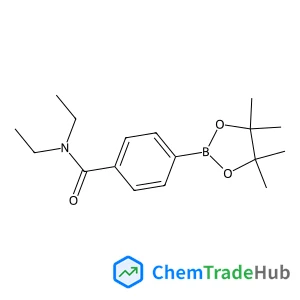
N,N-Diethyl-4-(4,4,5,5-tetramethyl-1,3,2-dioxaborolan-2-yl)benzamide
CAS Number:
325142-99-2
Molecular Formula:
C17H26BNO3
Recommended Suppliers






Disclaimer
This page provides academic journal information for reference and research purposes only. We are not affiliated with any journal publishers and do not handle publication submissions. For publication-related inquiries, please contact the respective journal publishers directly.
If you notice any inaccuracies in the information displayed, please contact us at support@chemtradehub.com. We will promptly review and address your concerns.