











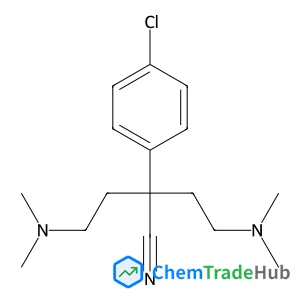
2-(4-Chlorophenyl)-4-(dimethylamino)-2-(2-(dimethylamino)ethyl)butanenitrile
CAS Number:
1246816-57-8
Molecular Formula:
C16H24ClN3
Christina Clare Fisher
We investigate multicompartment micelles consisting of poly(2-oxazoline)-based triblock copolymers for nanoreactor applications, using the DPD simulation method to characterize the internal structure of the micelles and the distribution of reactant. The DPD simulation parameters are determined from the Flory–Huggins interaction parameter (χFH). From the snapshots of the micellar structures and radial distribution function of polymer blocks, it is clearly presented that the micelle is multicompartmental. In addition, by implementing the DPD simulations in the presence of reactants, it is found that Reac-C4 and Reac-OPh are associate well with the hydrophilic shell of the micelle, whereas the other two reactants, Reac-Ph and Reac-Cl, are not incorporated into the micelle. From our DPD simulations, we confirm that the miscibility (solubility) of reactant with the micelle has a strong correlation with the rate of hydrolysis kinetic resolution. Utilizing accurate methods evaluating accurate χFH parameters for molecular interactions in micelle system, this DPD simulation can have a great potential to predict the structures of micelles consisting of designed multiblock copolymers for useful reactions.
Wolfgang F. Hölderich
DOI: 10.1039/C3GC41089G
Wei Wang, Lixiang Liu, Yunbo He, Cuiping Li, Yapeng Wang
DOI: 10.1039/C3GC41280F
Rocío García-Álvarez, Pascale Crochet, Carine Duhayon, Jean-Pierre Majoral, Victorio Cadierno
DOI: 10.1039/C3GC41201F
Jiansheng Wang, Jiye Cheng, Jiancheng Liu, Yanjing Gao
DOI: 10.1039/C3GC40704G
Jan Dijkmans, Dries Gabriëls, Michiel Dusselier, Filip de Clippel, Pieter Vanelderen, Kristof Houthoofd, Annelies Malfliet, Yiannis Pontikes, Bert F. Sels
DOI: 10.1039/C3GC41239C
Sébastien Génand-Pinaz, Nicolas Papaiconomou, Jean-Marc Leveque
DOI: 10.1039/C3GC40557E
Xuecheng Liu, Xian Feng, Zhibin Huang, Daqing Shi
DOI: 10.1039/C3GC41799A
Sarina Sarina, Sagala Bai, Yiming Huang, Chao Chen, Jianfeng Jia, Esa Jaatinen, Godwin A. Ayoko, Zhaorigetu Bao, Huaiyong Zhu
DOI: 10.1039/C3GC41866A
DOI: 10.1039/C3GC41376D
This compound is mainly used as an intermediate in the synthesis of antipsychoti...
Waste containing 1-(D-Ribofuranosyl)-1,4-dihydro-3-pyridinecarboxamide (CAS: 191...
2-Methyl-2-propanyl 3-bromo-3-(hydroxymethyl)-1-azetidinecarboxylate (CAS: 20079...
N-(4-Chloro-2-pyridinyl)acetamide (CAS: 245056-66-0) is a chemical compound with...
5-Chloro-2-hydroxybenzoic acid, also known as 5-chlorosalicylic acid, is an arom...
When handling 1,1-Dichloro-1-fluoroethane (CAS: 1717-00-6), it is important to u...
Fmoc-(2S,3R)-3-phenylpyrrolidine-2-carboxylic acid is a white crystalline solid ...
4-Amino-5-bromo-2-pyridinecarboxylic acid is primarily used as a precursor in th...
Handling this compound should be done with personal protective equipment (PPE) i...
When handling 8-bromo-2,2-dimethyl-3,4-dihydro-2H-1,4-benzoxazin-3-one, use prop...

Physical Chemistry Chemical Physics (PCCP) is an international journal co-owned by 19 physical chemistry and physics societies from around the world. This journal publishes original, cutting-edge research in physical chemistry, chemical physics and biophysical chemistry. To be suitable for publication in PCCP, articles must include significant innovation and/or insight into physical chemistry; this is the most important criterion that reviewers and Editors will judge against when evaluating submissions. The journal has a broad scope and welcomes contributions spanning experiment, theory, computation and data science. Topical coverage includes spectroscopy, dynamics, kinetics, statistical mechanics, thermodynamics, electrochemistry, catalysis, surface science, quantum mechanics, quantum computing and machine learning. Interdisciplinary research areas such as polymers and soft matter, materials, nanoscience, energy, surfaces/interfaces, and biophysical chemistry are welcomed if they demonstrate significant innovation and/or insight into physical chemistry. Joined experimental/theoretical studies are particularly appreciated when complementary and based on up-to-date approaches.
![2,6-Bis({(2R)-2-[hydroxy(diphenyl)methyl]-1-pyrrolidinyl}methyl)-4-methylphenol structure](https://static.chemtradehub.com/structs/877/877395-58-9-70bf.webp "2,6-Bis({(2R)-2-[hydroxy(diphenyl)methyl]-1-pyrrolidinyl}methyl)-4-methylphenol structure")
![tert-Butyl N-[(2-chloropyridin-4-yl)methyl]carbamate structure](https://static.chemtradehub.com/structs/916/916210-27-0-9f95.webp "tert-Butyl N-[(2-chloropyridin-4-yl)methyl]carbamate structure")






