













Caveat when using ADC(2) for studying the photochemistry of carbonyl-containing molecules
Literature Information
Publication Date
2021-06-04
DOI
10.1039/D1CP02185K
Impact Factor
3.676
Authors
Emanuele Marsili, Antonio Prlj, Basile F. E. Curchod
View Original
Abstract
Several electronic-structure methods are available to study the photochemistry and photophysics of organic molecules. Among them, ADC(2) stands as a sweet spot between computational efficiency and accuracy. As a result, ADC(2) has recently seen its number of applications booming, in particular to unravel the deactivation pathways and photodynamics of organic molecules. Despite this growing success, we demonstrate here that care has to be taken when studying the nonradiative pathways of carbonyl-containing molecules, as ADC(2) appears to suffer from a systematic flaw.
Recommended Journals
Related Literature
The dynamics of water exchange in gadolinium DOTA complexes studied by transition path sampling and potential of mean force methods
2007-01-30
Paper
DOI: 10.1039/B617068D
Tuning plasmons on nano-structured substrates for NIR-SERS
Sumeet Mahajan, Mamdouh Abdelsalam, Yoshiro Suguwara, Suzanne Cintra, Andrea Russell, Jeremy Baumberg, Philip Bartlett
2006-11-23
Paper
DOI: 10.1039/B611803H
Density functional theory calculations for the hydrogen evolution reaction in an electrochemical double layer on the Pt(111) electrode
Gustav S. Karlberg, Jan Rossmeisl, Jeff Greeley, Hannes Jónsson, Jens K. Nørskov
2007-05-30
Paper
DOI: 10.1039/B700099E
Effect of Ni(ii), Cu(ii) and Zn(ii) association on the keto-enol tautomerism of thymine in the gas phase‡
Elizabeth Rincón, Manuel Yáñez, Alejandro Toro-Labbé, Otilia Mó
2007-03-29
Paper
DOI: 10.1039/B618050G
Gas-phase electronic spectrum of the C14 ring
A. E. Boguslavskiy, J. P. Maier
2006-11-13
Paper
DOI: 10.1039/B613109C
Cross sections for low-energy electron scattering from adenine in the condensed phase
Radmila Panajotović, Marc Michaud, Léon Sanche
2006-11-17
Paper
DOI: 10.1039/B612700B
Fourier transform infrared spectroscopy and ab initio theory of acid–hydrogen sulfide clusters: H2S–HCl, D2S–DCl and H2S–(HCl)2
Pierre Asselin, Pascale Soulard, Bruno Madebène, Marius Lewerenz
2007-04-16
Paper
DOI: 10.1039/B702824E
Torsional anharmonicity in the conformational analysis of tryptamine
David C. Clary
2007-01-17
Paper
DOI: 10.1039/B615660F
Helices and Sheets in vacuoThe HTML version of this article has been enhanced with colour images.
2007-01-19
Invited Article
DOI: 10.1039/B612615D
Long-lived coherent oscillations of the femtosecond transients in cyanobacterial photosystem I
Oleg M. Sarkisov, Fedor E. Gostev, Vladimir I. Novoderezhkin, Oxana A. Gopta, Mahir D. Mamedov, Alexey Yu. Semenov
2006-11-13
Paper
DOI: 10.1039/B605660A
You might also like
Compound Q&A
What is the market or research trend for N-(4-Methoxybenzyl)-2-pyridinamine (CAS: 52818-63-0)?
N-(4-Methoxybenzyl)-2-pyridinamine (CAS: 52818-63-0) is increasingly being used ...
52818-63-0N-(4-Methoxybenzyl)-...
Compound Q&A
What precautions should be taken when handling Ethyl 4-(2-chlorophenyl)-1,3-thiazole-2-carboxylate (CAS: 1050507-06-6)?
When handling Ethyl 4-(2-chlorophenyl)-1,3-thiazole-2-carboxylate, appropriate p...
1050507-06-6Ethyl 4-(2-chlorophe...
Compound Q&A
What regulatory guidelines apply to diethyldiselane (CAS: 628-39-7)?
Diethyldiselane (CAS: 628-39-7) is classified under the Globally Harmonized Syst...
628-39-7Diethyldiselane
Compound Q&A
What is the market or research trend for oxocopper (CAS: 12053-18-8)?
The market for oxocopper (CAS: 12053-18-8) is primarily driven by its use in cat...
12053-18-8oxocopper; oxo-(oxoc...
Compound Q&A
What is the market or research trend for 5-{[(2-Methyl-2-propanyl)oxy]carbonyl}-5-azaspiro[2.4]heptane-7-carboxylic acid?
The market for 5-{[(2-Methyl-2-propanyl)oxy]carbonyl}-5-azaspiro[2.4]heptane-7-c...
1268519-54-55-{[(2-Methyl-2-prop...
Compound Q&A
What is 2-(1-Pyrrolidinyl)-4-pyridinamine (CAS: 35981-63-6)?
2-(1-Pyrrolidinyl)-4-pyridinamine is a chemical compound with the CAS number 359...
35981-63-62-(1-Pyrrolidinyl)-4...
Compound Q&A
What are the physical and chemical properties of 2-(3-Pyridinyl)-1-azabicyclo[2.2.2]octane (CAS: 91556-75-1)?
2-(3-Pyridinyl)-1-azabicyclo[2.2.2]octane (CAS: 91556-75-1) is a crystalline sol...
91556-75-12-(3-Pyridinyl)-1-az...
Compound Q&A
How is (S)-Alpha-allyl-proline hydrochloride (CAS: 129704-91-2) typically synthesized?
(S)-Alpha-allyl-proline hydrochloride is usually synthesized via a Wittig reacti...
129704-91-2(S)-Alpha-allyl-prol...
Compound Q&A
What is 3-Methyl-1,2-oxazole-5-carboxylic acid (CAS: 4857-42-5)?
3-Methyl-1,2-oxazole-5-carboxylic acid (CAS: 4857-42-5) is an organic compound w...
4857-42-53-Methyl-1,2-oxazole...
Compound Q&A
How is Lys-SMCC-DM1 (CAS: 1281816-04-3) typically synthesized?
Lys-SMCC-DM1 is synthesized via a multi-step process involving the coupling of S...
1281816-04-3Lys-SMCC-DM1
Source Journal
Physical Chemistry Chemical Physics

CiteScore:
5.5
Self-citation Rate:
10.3%
Articles per Year:
3036
Physical Chemistry Chemical Physics (PCCP) is an international journal co-owned by 19 physical chemistry and physics societies from around the world. This journal publishes original, cutting-edge research in physical chemistry, chemical physics and biophysical chemistry. To be suitable for publication in PCCP, articles must include significant innovation and/or insight into physical chemistry; this is the most important criterion that reviewers and Editors will judge against when evaluating submissions. The journal has a broad scope and welcomes contributions spanning experiment, theory, computation and data science. Topical coverage includes spectroscopy, dynamics, kinetics, statistical mechanics, thermodynamics, electrochemistry, catalysis, surface science, quantum mechanics, quantum computing and machine learning. Interdisciplinary research areas such as polymers and soft matter, materials, nanoscience, energy, surfaces/interfaces, and biophysical chemistry are welcomed if they demonstrate significant innovation and/or insight into physical chemistry. Joined experimental/theoretical studies are particularly appreciated when complementary and based on up-to-date approaches.
Recommended Compounds
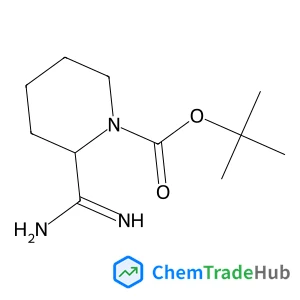
2-Methyl-2-propanyl 2-carbamimidoyl-1-piperidinecarboxylate
CAS Number:
1258640-98-0
Molecular Formula:
C11H21N3O2
Recommended Suppliers





Disclaimer
This page provides academic journal information for reference and research purposes only. We are not affiliated with any journal publishers and do not handle publication submissions. For publication-related inquiries, please contact the respective journal publishers directly.
If you notice any inaccuracies in the information displayed, please contact us at support@chemtradehub.com. We will promptly review and address your concerns.