












Single microbead-based fluorescent aptasensor (SMFA) for direct isolation and in situ quantification of exosomes from plasma
Literature Information
Publication Date
2021-03-23
DOI
10.1039/D1AN00463H
Impact Factor
4.616
Authors
Fangfang Wang, Yi Zhang, Desheng Chen, Zhuoqi Zhang, Zhengping Li
View Original
Abstract
Exosomes are cell-derived membrane-enclosed biological nanoparticles that carry lots of parental molecular information, and are recognized as an ideal biomarker for non-invasive diagnosis. However, due to the low abundance of exosomes in plasma samples and the interferences from complex biological matrices, the sensitive and direct detection of exosomes still remains a challenge. Here, by combining the direct magnetic isolation with in situ fluorescence imaging, we developed a Single Microbead-based Fluorescent Aptasensor (SMFA) for specific enrichment and sensitive quantification of exosomes from plasma. In the SMFA, a single aptamer-modified microbead (MB) served as the reaction carrier so that the specific exosomes inserted with a fluorescent anchor will be highly enriched on the single MB. By in situ fluorescence imaging to monitor the fluorescence signals on the single MB, sensitive detection of exosomes can be realized without the requirement of any signal amplification routes, and as low as 4.9 × 10⁴ particles per μL of exosomes could be simply detected. More importantly, the SMFA could be applied for direct detection of the exosomes from small amounts of clinical plasma samples without prior purification procedures, indicating its great potential applications in clinical diagnostics.
Related Literature
Rapid synthesis of oligosaccharides using an anomeric fluorous silyl protecting group
Leonardo Manzoni
2003-10-29
Communication
DOI: 10.1039/B311448A
The generation and trapping of organozinc carbenoids from N-diethoxymethyl amides: a new amidocyclopropanation reaction
Guillaume Bégis, David Cladingboel, William B. Motherwell
2003-10-03
Communication
DOI: 10.1039/B309887G
Selective deposition of polystyrene nanoparticles in a nanoetchpit array on a silicon substrate
Manabu Tanaka, Takumi Hosaka, Takashi Tanii, Iwao Ohdomari, Hiroyuki Nishide
2004-03-16
Communication
DOI: 10.1039/B315816K
Efficient electrophilic catalysis of 1,5-anhydrocellobiitol hydrolysis by AlIII; implications for the conservation of “rosin-alum” sized paper
John Baty, Michael L. Sinnott
2004-02-27
Communication
DOI: 10.1039/B316417A
Electrophilic terminal phosphinidene complex–Lewis base adducts: Chemistry between carbon–halide bond activation and weak Lewis base adduct formation
Arif Ali Khan, Cathleen Wismach, Peter G. Jones, Rainer Streubel
2003-10-22
Communication
DOI: 10.1039/B309443J
Long-term pervaporation performance of microporous methylated silica membranes
Jean Campaniello, Charles W. R. Engelen, Wim G. Haije, Paul P. A. C. Pex, Jaap F. Vente
2004-02-27
Communication
DOI: 10.1039/B401496K
DPA-substituted coumarins as chemosensors for zinc(ii): modulation of the chemosensory characteristics by variation of the position of the chelate on the coumarin
Nathaniel C. Lim, Christian Brückner
2004-04-01
Communication
DOI: 10.1039/B403448A
Applying reversible chemistry of CO2 to supramolecular polymers
Heng Xu, Erin M. Hampe, Dmitry M. Rudkevich
2003-10-14
Communication
DOI: 10.1039/B309580K
A rationally designed novel receptor for probing cooperative interaction between metal ions and bivalent tryptophan side chain in solution
Yitong Li, Chi Ming Yang
2003-10-22
Communication
DOI: 10.1039/B310543A
An efficient method to perform milliliter-scale PCR utilizing highly controlled microwave thermocycling
Kristina Orrling, Peter Nilsson, Mats Gullberg, Mats Larhed
2004-03-08
Communication
DOI: 10.1039/B317049G
You might also like
Compound Q&A
What is the market or research trend for N-(4-Methoxybenzyl)-2-pyridinamine (CAS: 52818-63-0)?
N-(4-Methoxybenzyl)-2-pyridinamine (CAS: 52818-63-0) is increasingly being used ...
52818-63-0N-(4-Methoxybenzyl)-...
Compound Q&A
What precautions should be taken when handling Ethyl 4-(2-chlorophenyl)-1,3-thiazole-2-carboxylate (CAS: 1050507-06-6)?
When handling Ethyl 4-(2-chlorophenyl)-1,3-thiazole-2-carboxylate, appropriate p...
1050507-06-6Ethyl 4-(2-chlorophe...
Compound Q&A
What regulatory guidelines apply to diethyldiselane (CAS: 628-39-7)?
Diethyldiselane (CAS: 628-39-7) is classified under the Globally Harmonized Syst...
628-39-7Diethyldiselane
Compound Q&A
What is the market or research trend for oxocopper (CAS: 12053-18-8)?
The market for oxocopper (CAS: 12053-18-8) is primarily driven by its use in cat...
12053-18-8oxocopper; oxo-(oxoc...
Compound Q&A
What is the market or research trend for 5-{[(2-Methyl-2-propanyl)oxy]carbonyl}-5-azaspiro[2.4]heptane-7-carboxylic acid?
The market for 5-{[(2-Methyl-2-propanyl)oxy]carbonyl}-5-azaspiro[2.4]heptane-7-c...
1268519-54-55-{[(2-Methyl-2-prop...
Compound Q&A
What is 2-(1-Pyrrolidinyl)-4-pyridinamine (CAS: 35981-63-6)?
2-(1-Pyrrolidinyl)-4-pyridinamine is a chemical compound with the CAS number 359...
35981-63-62-(1-Pyrrolidinyl)-4...
Compound Q&A
What are the physical and chemical properties of 2-(3-Pyridinyl)-1-azabicyclo[2.2.2]octane (CAS: 91556-75-1)?
2-(3-Pyridinyl)-1-azabicyclo[2.2.2]octane (CAS: 91556-75-1) is a crystalline sol...
91556-75-12-(3-Pyridinyl)-1-az...
Compound Q&A
How is (S)-Alpha-allyl-proline hydrochloride (CAS: 129704-91-2) typically synthesized?
(S)-Alpha-allyl-proline hydrochloride is usually synthesized via a Wittig reacti...
129704-91-2(S)-Alpha-allyl-prol...
Compound Q&A
What is 3-Methyl-1,2-oxazole-5-carboxylic acid (CAS: 4857-42-5)?
3-Methyl-1,2-oxazole-5-carboxylic acid (CAS: 4857-42-5) is an organic compound w...
4857-42-53-Methyl-1,2-oxazole...
Compound Q&A
How is Lys-SMCC-DM1 (CAS: 1281816-04-3) typically synthesized?
Lys-SMCC-DM1 is synthesized via a multi-step process involving the coupling of S...
1281816-04-3Lys-SMCC-DM1
Source Journal
Analyst

CiteScore:
7.8
Self-citation Rate:
5.6%
Articles per Year:
653
Analyst publishes analytical and bioanalytical research that reports premier fundamental discoveries and inventions, and the applications of those discoveries, unconfined by traditional discipline barriers.
Recommended Compounds
![5'-Fluoro-[2,3'-biindolinylidene]-2',3-dione structure](https://static.chemtradehub.com/structs/251/251903-00-1-9cb1.webp "5'-Fluoro-[2,3'-biindolinylidene]-2',3-dione structure")
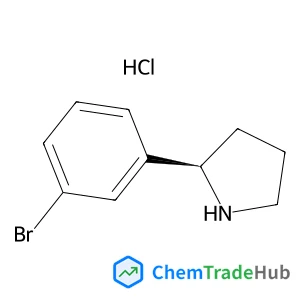
(2R)-2-(3-Bromophenyl)pyrrolidine hydrochloride (1:1)
CAS Number:
1391550-13-2
Molecular Formula:
C10H13BrClN
![1-oxaspiro[4.4]nonan-6-one structure](https://static.chemtradehub.com/structs/134/134179-01-4-e051.webp "1-oxaspiro[4.4]nonan-6-one structure")
Recommended Suppliers




Disclaimer
This page provides academic journal information for reference and research purposes only. We are not affiliated with any journal publishers and do not handle publication submissions. For publication-related inquiries, please contact the respective journal publishers directly.
If you notice any inaccuracies in the information displayed, please contact us at support@chemtradehub.com. We will promptly review and address your concerns.