













![5-Chloropyrrolo[2,1-f][1,2,4]triazin-4(3H)-one structure](https://static.chemtradehub.com/structs/888/888720-60-3-4f7c.webp "5-Chloropyrrolo[2,1-f][1,2,4]triazin-4(3H)-one structure")
Catalytic hydrodeoxygenation of biomass-derived oxygenates to bio-fuels over Co-based bimetallic catalysts
Literature Information
Publication Date
2020-06-11
DOI
10.1039/D0SE00332H
Impact Factor
6.367
Authors
Zhen-Hong He, Chong-Shan Jiang, Zhong-Yu Wang, Kuan Wang, Yong-Chang Sun, Man-Qing Yao, Zhu-Hui Li
View Original
Abstract
The rapid consumption of conventional fossil fuels has caused a sharp decline in their reserves and led to climate change. Exploitation of renewable energy sources especially bio-fuels such as 2,5-dimethylfuran (DMF), methylfuran (MF), γ-valerolactone (GVL), etc. has both environmental and economic benefits. In the present work, diverse Co-based bimetallic catalysts were prepared and used for catalyzing hydrodeoxygenation (HDO) of biomass-derived oxygenates. Co5Zn1Ox, obtained by the incorporation of Zn species into the Co metal catalyst especially with a Co/Zn molar ratio of 5, could enhance the catalytic performances obviously compared to the sole Co catalyst. For example, the DMF, MF, and GVL yields reached up to 94, 98, and 77% during the catalysis by Co5Zn1Ox, which were much greater than 74, 0, and 23% for the Co catalyst, respectively. The enhanced performances of Co5Zn1Ox stem from the strong interaction between the Co and Zn species. Specifically, the presence of ZnO could stabilize Co2+ species, by offering electrons to Co species and creating oxygen vacancies, resulting in Co5Zn1Ox showing the highest adsorption amounts of furfural and furfuryl alcohol compared to Co1Zn1Ox and Co7Zn1Ox catalysts. Moreover, the catalyst showed good universality and reusability, and the HDO of 5-HMF to DMF proceeded in a true heterogeneous manner. The present work is believed to extend the application of bimetallic catalysts to the synthesis of bio-fuels and utilization of biomass materials.
Related Literature
Ion collision-induced chemistry in pure and mixed loosely bound clusters of coronene and C60 molecules
Alicja Domaracka, Rudy Delaunay, Arkadiusz Mika, Michael Gatchell, Henning Zettergren, Henrik Cederquist, Patrick Rousseau, Bernd A. Huber
2018-05-02
Paper
DOI: 10.1039/C8CP01179F
The stabilization mechanism and size effect of nonpolar-to-polar crystallography facet tailored ZnO nano/micro rods via a top-down strategy
Xiangyang Duan, Chao Ma, Wentao Jin, Xiaoman Ma, Su-Huai Wei, Jinying Yu
2018-06-13
Paper
DOI: 10.1039/C8CP02494D
Computational study of the carbonyl–ene reaction between formaldehyde and propylene encapsulated in coordinatively unsaturated metal–organic frameworks M3(btc)2 (M = Fe, Co, Ni, Cu and Zn)
Thana Maihom, Michael Probst, Jumras Limtrakul
2019-01-15
Paper
DOI: 10.1039/C8CP06841K
Binary mixtures of novel sulfoxides and water: intermolecular structure, dynamic properties, thermodynamics, and cluster analysis
2018-08-30
Paper
DOI: 10.1039/C8CP04012E
The electronic structure and stability of germanium tubes Ge30H12 and Ge33H12
Long Van Duong, Miquel Solà, Hadi Behzadi, Mohammad Jafar Momeni
2018-08-24
Paper
DOI: 10.1039/C8CP03737J
Influence of Ce3+ polarons on grain boundary space-charge in proton conducting Y-doped BaCeO3
Jonathan M. Polfus, Mehdi Pishahang, Rune Bredesen
2018-06-04
Paper
DOI: 10.1039/C8CP00168E
Electrical property and Schottky behavior of a flexible Schiff-base compound: X-ray structure and stabilization of 1D water chain
Basudeb Dutta, Joydeep Datta, Suvendu Maity, Chittaranjan Sinha, Di Sun, Partha Pratim Ray, Mohammad Hedayetullah Mir
2018-09-03
Paper
DOI: 10.1039/C8CP04569K
Thermoelectrochemical cells based on Li+/Li redox couples in LiFSI glyme electrolytes
Kyunggu Kim, Hochun Lee
2018-08-29
Paper
DOI: 10.1039/C8CP03155J
Quantitative structure–property relationship approach to predicting xylene separation with diverse exchanged faujasites
Y. Khabzina, C. Laroche, J. Pérez-Pellitero, D. Farrusseng
2018-08-28
Paper
DOI: 10.1039/C8CP04042G
Hydrogen bond network structures of protonated short-chain alcohol clusters
Asuka Fujii, Natsuko Sugawara, Po-Jen Hsu, Takuto Shimamori, Ying-Cheng Li, Toru Hamashima, Jer-Lai Kuo
2018-03-05
Perspective
DOI: 10.1039/C7CP08072G
You might also like
Compound Q&A
Is 2-(2-chloroacetamido)-3-phenylpropanoic acid (CAS: 7765-11-9) safe?
2-(2-Chloroacetamido)-3-phenylpropanoic acid (CAS: 7765-11-9) is generally consi...
7765-11-92-(2-chloroacetamido...
Compound Q&A
Is 2-(Benzyloxy)-5-bromobenzoic acid (CAS: 62176-31-2) safe?
2-(Benzyloxy)-5-bromobenzoic acid can be handled safely if appropriate precautio...
62176-31-22-(Benzyloxy)-5-brom...
Compound Q&A
What is (4-Methyl-1,2,5-oxadiazol-3-yl)methanamine hydrochloride (CAS: 1159825-48-5)?
(4-Methyl-1,2,5-oxadiazol-3-yl)methanamine hydrochloride is a chemical compound ...
1159825-48-5(4-Methyl-1,2,5-oxad...
Compound Q&A
What is 2-(5-Hexylthiophen-2-yl)-4,4,5,5-tetramethyl-1,3,2-dioxaborolane (CAS: 917985-54-7)?
2-(5-Hexylthiophen-2-yl)-4,4,5,5-tetramethyl-1,3,2-dioxaborolane (CAS: 917985-54...
917985-54-72-(5-Hexylthiophen-2...
Compound Q&A
Are there alternatives to 4-(8-Methyl-9H-1,3-dioxolo[4,5-h][2,3]benzodiazepin-5-yl)benzenamine (CAS: 102771-26-6) in synthesis?
While 4-(8-Methyl-9H-1,3-dioxolo[4,5-h][2,3]benzodiazepin-5-yl)benzenamine (CAS:...
102771-26-64-(8-Methyl-9H-1,3-d...
Compound Q&A
What is the market or research trend for tert-butyl 3-hydroxy-4,5,7,8-tetrahydro-2H-pyrazolo[3,4-d]azepine-6-carboxylate (CAS: 851376-80-2)?
The market for tert-butyl 3-hydroxy-4,5,7,8-tetrahydro-2H-pyrazolo[3,4-d]azepine...
851376-80-2tert-butyl 3-hydroxy...
Compound Q&A
How should waste containing 3,5-Diamino-1H-pyrazole-4-carbonitrile (CAS: 6844-58-2) be handled?
Waste containing 3,5-Diamino-1H-pyrazole-4-carbonitrile (CAS: 6844-58-2) should ...
6844-58-23,5-Diamino-1H-pyraz...
Compound Q&A
How is (6-Fluoro-3-pyridinyl)boronic acid (CAS: 351019-18-6) typically synthesized?
(6-Fluoro-3-pyridinyl)boronic acid can be synthesized through the reaction of 6-...
351019-18-6(6-Fluoro-3-pyridiny...
Compound Q&A
What industries use Dibenzyl carbonimidoylbiscarbamate (CAS: 10065-79-9)?
Dibenzyl carbonimidoylbiscarbamate (CAS: 10065-79-9) finds applications in vario...
10065-79-9Dibenzyl carbonimido...
Compound Q&A
What is the market or research trend for (beta,beta,2,3,4,5,6-~2~H_7_)Phenylalanine (CAS: 74228-83-4)?
The market for (beta,beta,2,3,4,5,6-~2~H_7_)Phenylalanine (CAS: 74228-83-4) is g...
74228-83-4(beta,beta,2,3,4,5,6...
Source Journal
Recommended Compounds
![4-Fluoro-2-(4-{[(3S,4R)-4-(2-hydroxy-2-propanyl)-3-pyrrolidinyl]amino}-6,7-dimethoxy-2-quinazolinyl)phenol hydrochloride (1:1) structure](https://static.chemtradehub.com/structs/143/1431697-96-9-619c.webp "4-Fluoro-2-(4-{[(3S,4R)-4-(2-hydroxy-2-propanyl)-3-pyrrolidinyl]amino}-6,7-dimethoxy-2-quinazolinyl)phenol hydrochloride (1:1) structure")
4-Fluoro-2-(4-{[(3S,4R)-4-(2-hydroxy-2-propanyl)-3-pyrrolidinyl]amino}-6,7-dimethoxy-2-quinazolinyl)phenol hydrochloride (1:1)
CAS Number:
1431697-96-9
Molecular Formula:
C23H28ClFN4O4
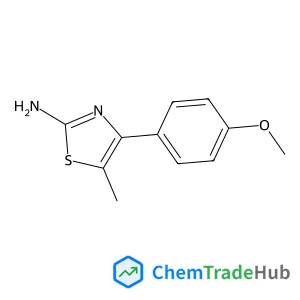
4-(4-Methoxyphenyl)-5-methyl-1,3-thiazol-2-amine
CAS Number:
105512-88-7
Molecular Formula:
C11H12N2OS
Recommended Suppliers






Disclaimer
This page provides academic journal information for reference and research purposes only. We are not affiliated with any journal publishers and do not handle publication submissions. For publication-related inquiries, please contact the respective journal publishers directly.
If you notice any inaccuracies in the information displayed, please contact us at support@chemtradehub.com. We will promptly review and address your concerns.