













Design of novel structured Au/g-C3N4 nanosheet/reduced graphene oxide nanocomposites for enhanced visible light photocatalytic activities
Literature Information
Publication Date
2020-05-25
DOI
10.1039/D0SE00248H
Impact Factor
6.367
Authors
View Original
Abstract
In order to surmount the intrinsic disadvantages of raw g-C3N4, we demonstrate simple thermal oxidation exfoliation and facile in situ photoreduction methods to fabricate Au/g-C3N4 nanosheet/reduced graphene oxide (Au/CNNS/rGO) photocatalysts. During the preparation, g-C3N4 was exfoliated to ultrathin nanosheets, and the deposition of Au and reduction of graphene oxide (GO) were accomplished simultaneously. Remarkably, the monodispersed Au nanoparticles were well anchored on the surface of the CNNSs and rGO was decorated on the opposite surface of the CNNSs. This novel structure bidirectionally promotes the transfer of photogenerated electrons. The H2 evolution rate of optimal Au/CNNS/rGO is 9.6 times higher and the methylene blue degradation rate is 6 times higher than those of pure g-C3N4 under visible light irradiation. The enhancement of photocatalytic activities could be attributed to the novel structure of the nanocomposite, the surface plasmon resonance effect of Au, the high electron mobility of rGO and the large surface area of CNNSs.
Recommended Journals
Related Literature
Syntheses and anti-cancer activity of CO-releasing molecules with targeting galactose receptors
Jili Li, Jinlong Zhang, Qiuping Zhang, Zhongjie Bai, Quanyi Zhao, Dian He, Zhen Wang, Yonglin Chen, Bin Liu
2018-10-09
Paper
DOI: 10.1039/C8OB01921E
Radicals derived from uric acid and its methyl derivatives in aqueous solution: an EPR spectroscopy and theoretical study
2002-12-23
Paper
DOI: 10.1039/B208827B
A new synthesis of porphobilinogen analogues, inhibitors of hydroxymethylbilane synthase
Raef Ahmed, Finian J. Leeper
2002-11-08
Communication
DOI: 10.1039/B209613G
Kinetic barriers and ordering of non-covalently bound states
Simon W. O'Brien, Hideyuki Shiozawa, Rosa Zerella, Dominic P. O'Brien, Dudley H. Williams
2003-01-07
Paper
DOI: 10.1039/B209162N
Molecular recognition in the gas phase ligand switching reactions of the proton bound dimer of sarcosine and glycylglycine.‡
Richard A. J. O'Hair, Ana K. Vrkic
2003-02-04
Paper
DOI: 10.1039/B209848B
A tetraphenylmethane based dendritic tolan–anthracene dyad: synthesis and energy transfer properties
Saumitra Sengupta, Pradipta Purkayastha
2002-12-09
Paper
DOI: 10.1039/B209186K
Cyclic arylopeptoid oligomers: synthesis and conformational propensities of peptide-mimetic aromatic macrocycles
Masahide Hayakawa, Ayaka Ohsawa, Kumi Takeda, Ryo Torii, Yoshiaki Kitamura, Hiroshi Katagiri
2018-09-10
Paper
DOI: 10.1039/C8OB01962B
First synthesis of 2′,3′-epimino-carbocyclic nucleosides
Minoru Ishikura, Atsushi Murakami, Nobuya Katagiri
2003-01-07
Communication
DOI: 10.1039/B210963H
Synthesis of 11C-amides using [11C]carbon monoxide and in situ activated amines by palladium-mediated carboxaminations
Farhad Karimi
2002-12-23
Paper
DOI: 10.1039/B209553J
You might also like
Compound Q&A
Is 4-Benzyl-2,2-dimethylmorpholine (CAS: 84761-04-6) safe?
4-Benzyl-2,2-dimethylmorpholine is generally considered safe when handled under ...
84761-04-64-Benzyl-2,2-dimethy...
Compound Q&A
What is (5,6-Dimethoxy-3-pyridinyl)boronic acid (CAS: 1346526-61-1)?
(5,6-Dimethoxy-3-pyridinyl)boronic acid is a chemical compound with the molecula...
1346526-61-1(5,6-Dimethoxy-3-pyr...
Compound Q&A
How is 1,1,3,3-Tetramethyl-1,3-bis(2-methyl-2-propanyl)disiloxane (CAS: 67875-55-2) typically synthesized?
1,1,3,3-Tetramethyl-1,3-bis(2-methyl-2-propanyl)disiloxane is synthesized throug...
67875-55-21,1,3,3-Tetramethyl-...
Compound Q&A
What are the main uses of (2R,4S)-1-Boc-4-methylpyrrolidine-2-carboxylic acid (CAS: 1018818-04-6)?
(2R,4S)-1-Boc-4-methylpyrrolidine-2-carboxylic acid is primarily used as a build...
1018818-04-6(2R,4S)-1-Boc-4-meth...
Compound Q&A
What precautions should be taken when handling 2,3-Dichloroacrylonitrile (CAS: 22410-58-8)?
When handling 2,3-Dichloroacrylonitrile, it is crucial to wear appropriate perso...
22410-58-82,3-Dichloroacryloni...
Compound Q&A
How should (S)-1-(o-Tolyl)ethanamine hydrochloride (CAS: 1332832-16-2) be stored?
(S)-1-(o-Tolyl)ethanamine hydrochloride should be stored in a cool, dry place to...
1332832-16-2(S)-1-(o-Tolyl)ethan...
Compound Q&A
What are the physical and chemical properties of Benzyl [1-(hydroxyamino)-1-imino-2-methyl-2-propanyl]carbamate (CAS: 518047-98-8)?
Benzyl [1-(hydroxyamino)-1-imino-2-methyl-2-propanyl]carbamate (CAS: 518047-98-8...
518047-98-8Benzyl [1-(hydroxyam...
Compound Q&A
What industries use 2-Methyloxazole-5-carbaldehyde (CAS: 885273-42-7)?
2-Methyloxazole-5-carbaldehyde is used in the pharmaceutical industry for the sy...
885273-42-72-Methyloxazole-5-ca...
Compound Q&A
What is the market or research trend for 2-Methyl-2-propanyl 4-[(1S)-1-hydroxyethyl]-1-piperidinecarboxylate (CAS: 389889-82-1)?
The market for 2-Methyl-2-propanyl 4-[(1S)-1-hydroxyethyl]-1-piperidinecarboxyla...
389889-82-12-Methyl-2-propanyl ...
Compound Q&A
Is 1-Butyl-3-methylpyridinium bromide (CAS: 26576-85-2) safe?
1-Butyl-3-methylpyridinium bromide is generally considered safe for laboratory u...
26576-85-21-Butyl-3-methylpyri...
Source Journal
Recommended Compounds
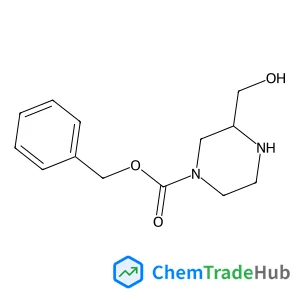
Benzyl 3-(hydroxymethyl)-1-piperazinecarboxylate
CAS Number:
191739-40-9
Molecular Formula:
C13H18N2O3
![1-{2-[(4-Chlorobenzyl)sulfanyl]-2-(2,4-dichlorophenyl)ethyl}-1H-imidazole structure](https://static.chemtradehub.com/structs/613/61318-90-9-6785.webp "1-{2-[(4-Chlorobenzyl)sulfanyl]-2-(2,4-dichlorophenyl)ethyl}-1H-imidazole structure")
1-{2-[(4-Chlorobenzyl)sulfanyl]-2-(2,4-dichlorophenyl)ethyl}-1H-imidazole
CAS Number:
61318-90-9
Molecular Formula:
C18H15Cl3N2S
Recommended Suppliers






Disclaimer
This page provides academic journal information for reference and research purposes only. We are not affiliated with any journal publishers and do not handle publication submissions. For publication-related inquiries, please contact the respective journal publishers directly.
If you notice any inaccuracies in the information displayed, please contact us at support@chemtradehub.com. We will promptly review and address your concerns.