













Back cover
Literature Information
Publication Date
DOI
10.1039/D0QO90076A
Impact Factor
5.281
Authors
View Original
Abstract
A graphical abstract is available for this content
Related Literature
In situ X-ray absorption near edge structure studies and charge transfer kinetics of Na6[V10O28] electrodes
Chun-Jern Pan, Ali Haider, Rami Al-Oweini, Ming-Hsien Lin, Ulrich Kortz
2017-01-16
Paper
DOI: 10.1039/C6CP05768C
Inorganically coated colloidal quantum dots in polar solvents using a microemulsion-assisted method
Facundo C. Herrera, Martín Mizrahi, Cristina Navío, Ramón Bernardo-Gavito, Daniel Granados, Félix G. Requejo
2016-12-08
Paper
DOI: 10.1039/C6CP06982G
The discrete nature of inhomogeneity: the initial stages and local configurations of TiOPc during bilayer growth on Ag(111)
Laura Fernandez, Sebastian Thussing, Alexander Mänz, Jörg Sundermeyer, Gregor Witte, Peter Jakob
2016-12-22
Paper
DOI: 10.1039/C6CP07922A
Gold-supported two-dimensional cobalt oxyhydroxide (CoOOH) and multilayer cobalt oxide islands
Jakob Fester, Alex Walton, Zheshen Li, Jeppe V. Lauritsen
2016-12-21
Paper
DOI: 10.1039/C6CP07901F
Doping the cage. Re@Au11Pt and Ta@Au11Hg, as novel 18-ve trimetallic superatoms displaying a doped icosahedral golden cage
2016-12-14
Paper
DOI: 10.1039/C6CP07519C
Structure and photoluminescence properties of a novel apatite green phosphor Ba5(PO4)2SiO4:Eu2+ excited by NUV light
Xin Ding, Yuhua Wang
2016-12-14
Paper
DOI: 10.1039/C6CP08300E
Structures of protonated hydrogen sulfide clusters, H+(H2S)n, highlighting the nature of sulfur-centered intermolecular interactions
Dandan Wang, Asuka Fujii
2016-12-15
Paper
DOI: 10.1039/C6CP07342E
Double electron–electron resonance with multiple non-selective chirp refocusing
Andrin Doll, Gunnar Jeschke
2016-12-08
Paper
DOI: 10.1039/C6CP07262C
Sizing and Eddy currents in magnetic core nanoparticles: an optical extinction approach
Luis J. Mendoza Herrera, Ignacio J. Bruvera
2016-12-19
Paper
DOI: 10.1039/C6CP08260B
A first-principles study of the preventive effects of Al and Mg doping on the degradation in LiNi0.8Co0.1Mn0.1O2 cathode materials
Kyoungmin Min, Seung-Woo Seo, You Young Song, Hyo Sug Lee, Eunseog Cho
2016-11-15
Paper
DOI: 10.1039/C6CP06270A
You might also like
Compound Q&A
Is 2-(2-chloroacetamido)-3-phenylpropanoic acid (CAS: 7765-11-9) safe?
2-(2-Chloroacetamido)-3-phenylpropanoic acid (CAS: 7765-11-9) is generally consi...
7765-11-92-(2-chloroacetamido...
Compound Q&A
Is 2-(Benzyloxy)-5-bromobenzoic acid (CAS: 62176-31-2) safe?
2-(Benzyloxy)-5-bromobenzoic acid can be handled safely if appropriate precautio...
62176-31-22-(Benzyloxy)-5-brom...
Compound Q&A
What is (4-Methyl-1,2,5-oxadiazol-3-yl)methanamine hydrochloride (CAS: 1159825-48-5)?
(4-Methyl-1,2,5-oxadiazol-3-yl)methanamine hydrochloride is a chemical compound ...
1159825-48-5(4-Methyl-1,2,5-oxad...
Compound Q&A
What is 2-(5-Hexylthiophen-2-yl)-4,4,5,5-tetramethyl-1,3,2-dioxaborolane (CAS: 917985-54-7)?
2-(5-Hexylthiophen-2-yl)-4,4,5,5-tetramethyl-1,3,2-dioxaborolane (CAS: 917985-54...
917985-54-72-(5-Hexylthiophen-2...
Compound Q&A
Are there alternatives to 4-(8-Methyl-9H-1,3-dioxolo[4,5-h][2,3]benzodiazepin-5-yl)benzenamine (CAS: 102771-26-6) in synthesis?
While 4-(8-Methyl-9H-1,3-dioxolo[4,5-h][2,3]benzodiazepin-5-yl)benzenamine (CAS:...
102771-26-64-(8-Methyl-9H-1,3-d...
Compound Q&A
What is the market or research trend for tert-butyl 3-hydroxy-4,5,7,8-tetrahydro-2H-pyrazolo[3,4-d]azepine-6-carboxylate (CAS: 851376-80-2)?
The market for tert-butyl 3-hydroxy-4,5,7,8-tetrahydro-2H-pyrazolo[3,4-d]azepine...
851376-80-2tert-butyl 3-hydroxy...
Compound Q&A
How should waste containing 3,5-Diamino-1H-pyrazole-4-carbonitrile (CAS: 6844-58-2) be handled?
Waste containing 3,5-Diamino-1H-pyrazole-4-carbonitrile (CAS: 6844-58-2) should ...
6844-58-23,5-Diamino-1H-pyraz...
Compound Q&A
How is (6-Fluoro-3-pyridinyl)boronic acid (CAS: 351019-18-6) typically synthesized?
(6-Fluoro-3-pyridinyl)boronic acid can be synthesized through the reaction of 6-...
351019-18-6(6-Fluoro-3-pyridiny...
Compound Q&A
What industries use Dibenzyl carbonimidoylbiscarbamate (CAS: 10065-79-9)?
Dibenzyl carbonimidoylbiscarbamate (CAS: 10065-79-9) finds applications in vario...
10065-79-9Dibenzyl carbonimido...
Compound Q&A
What is the market or research trend for (beta,beta,2,3,4,5,6-~2~H_7_)Phenylalanine (CAS: 74228-83-4)?
The market for (beta,beta,2,3,4,5,6-~2~H_7_)Phenylalanine (CAS: 74228-83-4) is g...
74228-83-4(beta,beta,2,3,4,5,6...
Source Journal
Organic Chemistry Frontiers

CiteScore:
7.8
Self-citation Rate:
8.7%
Articles per Year:
724
Organic Chemistry Frontiers publishes high-quality research from across organic chemistry. Emphases are placed on studies that make significant contributions to the field of organic chemistry by reporting either new or significantly improved protocols or methodologies. Topics include, but are not limited to the following: Organic synthesis Development of synthetic methodologies Catalysis Natural products Functional organic materials Supramolecular and macromolecular chemistry Physical and computational organic chemistry
Recommended Compounds
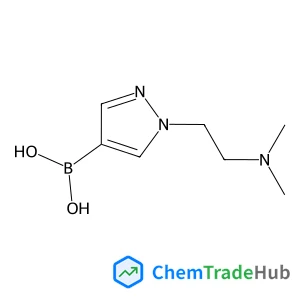
(1-(2-(Dimethylamino)ethyl)-1H-pyrazol-4-yl)boronic acid
CAS Number:
1086063-73-1
Molecular Formula:
C7H14BN3O2
Recommended Suppliers





Disclaimer
This page provides academic journal information for reference and research purposes only. We are not affiliated with any journal publishers and do not handle publication submissions. For publication-related inquiries, please contact the respective journal publishers directly.
If you notice any inaccuracies in the information displayed, please contact us at support@chemtradehub.com. We will promptly review and address your concerns.