












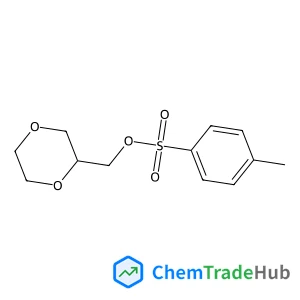
(S)-(1,4-Dioxan-2-yl)methyl 4-methylbenzenesulfonate
CAS Number:
917882-64-5
Molecular Formula:
C12H16O5S
Expanding the versatility of well defined clusters is a major concern in the design of building blocks towards functional nanostructures. W@Au12 is a prototypical binary bare superatomic cluster involving an icosahedral symmetry, which has been discussed in the literature, precluding the proposal of several endohedral d-block and f-block element structures within a golden cage. Here we pursue the construction of related trimetallic clusters, which has been explored to a lesser extent. Our results expose the great advantages of involving heterocages in the superatom approach, unraveling Re@Au11Pt and Ta@Au11Hg as novel trimetallic candidates. Re@Au11Pt exhibits an electron-deficient element in the cage, and an endohedral atom with an extra electron. In contrast, Ta@Au11Hg is conceived as having an icosahedral cage with an extra electron, and an electron-deficient endohedral element. These new clusters follow the eighteen valence electron principle, with similar characteristics to their W@Au12 parent. This leads to stable clusters with an electronic structure formally described by the 1s21p61d10 closing shell order, showing an interesting approach to design ternary superatoms, where the variation of valence electrons occurs in both cage and endohedral sites. Moreover, the cage doping appears as a useful approach to further evaluate the formation of magnetic superatoms, and also the construction of larger clusters by fusing different icosahedral structures.
Ryoya Kobayashi, Toshihiro Takashima, Satoshi Tanigawa, Shugo Takeuchi, Bunsho Ohtani
DOI: 10.1039/C6CP02903E
Ankur Solanki, Herlina Arianita Dewi, Tze Chien Sum
DOI: 10.1039/C6CP02640K
Mathew J. Boyer, Linas Vilčiauskas, Gyeong S. Hwang
DOI: 10.1039/C6CP05140E
S. Carlotto, M. Sambi, F. Sedona, A. Vittadini, J. Bartolomé, F. Bartolomé
DOI: 10.1039/C6CP04787D
F. A. Mackenzie-Rae, A. Karton, S. M. Saunders
DOI: 10.1039/C6CP04695A
Guanglin Kuang, Xu Wang, Christer Halldin, Agneta Nordberg, Bengt Långström, Hans Ågren, Yaoquan Tu
DOI: 10.1039/C6CP02278B
Kyeounghak Kim, Jeong Woo Han
DOI: 10.1039/C6CP04122A
Rafał Janicki, Andrzej Kędziorski, Anna Mondry
DOI: 10.1039/C6CP05284C
Bin Yang, Masoud Mahjouri-Samani, Christopher M. Rouleau, David B. Geohegan, Kai Xiao
DOI: 10.1039/C6CP02896A
Yipeng An, Mengjun Zhang, Dapeng Wu, Tianxing Wang, Zhaoyong Jiao, Congxin Xia, Kun Wang
DOI: 10.1039/C6CP05912K
2-(2-Chloroacetamido)-3-phenylpropanoic acid (CAS: 7765-11-9) is generally consi...
2-(Benzyloxy)-5-bromobenzoic acid can be handled safely if appropriate precautio...
(4-Methyl-1,2,5-oxadiazol-3-yl)methanamine hydrochloride is a chemical compound ...
2-(5-Hexylthiophen-2-yl)-4,4,5,5-tetramethyl-1,3,2-dioxaborolane (CAS: 917985-54...
While 4-(8-Methyl-9H-1,3-dioxolo[4,5-h][2,3]benzodiazepin-5-yl)benzenamine (CAS:...
The market for tert-butyl 3-hydroxy-4,5,7,8-tetrahydro-2H-pyrazolo[3,4-d]azepine...
Waste containing 3,5-Diamino-1H-pyrazole-4-carbonitrile (CAS: 6844-58-2) should ...
(6-Fluoro-3-pyridinyl)boronic acid can be synthesized through the reaction of 6-...
Dibenzyl carbonimidoylbiscarbamate (CAS: 10065-79-9) finds applications in vario...
The market for (beta,beta,2,3,4,5,6-~2~H_7_)Phenylalanine (CAS: 74228-83-4) is g...

Physical Chemistry Chemical Physics (PCCP) is an international journal co-owned by 19 physical chemistry and physics societies from around the world. This journal publishes original, cutting-edge research in physical chemistry, chemical physics and biophysical chemistry. To be suitable for publication in PCCP, articles must include significant innovation and/or insight into physical chemistry; this is the most important criterion that reviewers and Editors will judge against when evaluating submissions. The journal has a broad scope and welcomes contributions spanning experiment, theory, computation and data science. Topical coverage includes spectroscopy, dynamics, kinetics, statistical mechanics, thermodynamics, electrochemistry, catalysis, surface science, quantum mechanics, quantum computing and machine learning. Interdisciplinary research areas such as polymers and soft matter, materials, nanoscience, energy, surfaces/interfaces, and biophysical chemistry are welcomed if they demonstrate significant innovation and/or insight into physical chemistry. Joined experimental/theoretical studies are particularly appreciated when complementary and based on up-to-date approaches.
![{3-[Bis(4-hydroxyphenyl)methyl]-1-[2-(dimethylamino)ethyl]-1H-indol-2-yl}[4-(2-chlorophenyl)-1-piperazinyl]methanone structure](https://static.chemtradehub.com/structs/170/170365-25-0-e4d7.webp "{3-[Bis(4-hydroxyphenyl)methyl]-1-[2-(dimethylamino)ethyl]-1H-indol-2-yl}[4-(2-chlorophenyl)-1-piperazinyl]methanone structure")
![(1S)-1,5-Anhydro-2-O-alpha-L-arabinopyranosyl-1-[5-hydroxy-7-({6-O-[3-(4-hydroxy-3-methoxyphenyl)propanoyl]-beta-D-glucopyranosyl}oxy)-2-(4-hydroxyphenyl)-4-oxo-4H-chromen-6-yl]-D-glucitol structure](https://static.chemtradehub.com/structs/225/2252345-81-4-bcff.webp "(1S)-1,5-Anhydro-2-O-alpha-L-arabinopyranosyl-1-[5-hydroxy-7-({6-O-[3-(4-hydroxy-3-methoxyphenyl)propanoyl]-beta-D-glucopyranosyl}oxy)-2-(4-hydroxyphenyl)-4-oxo-4H-chromen-6-yl]-D-glucitol structure")
![2-[(E)-(2-Methoxyphenyl)diazenyl]-3-oxo-N-(2-oxo-2,3-dihydro-1H-benzimidazol-5-yl)butanamide structure](https://static.chemtradehub.com/structs/821/82199-12-0-f1d0.webp "2-[(E)-(2-Methoxyphenyl)diazenyl]-3-oxo-N-(2-oxo-2,3-dihydro-1H-benzimidazol-5-yl)butanamide structure")






