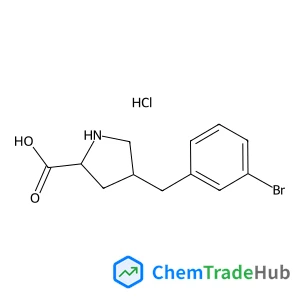
(2S,4R)-4-(3-Bromobenzyl)pyrrolidine-2-carboxylic acid hydrochloride
CAS Number:
1049734-10-2
Molecular Formula:
C12H15BrClNO2
Chun-Jern Pan, Ali Haider, Rami Al-Oweini, Ming-Hsien Lin, Ulrich Kortz
Polyoxometalates (POMs) have been reported as promising electrode materials for energy storage applications due to their ability to undergo fast redox reactions with multiple transferred electrons per polyanion. Here we employ a polyoxovanadate salt, Na6[V10O28], as an electrode material in a lithium-ion containing electrolyte and investigate the electron transfer properties of Na6[V10O28] on long and short timescales. Looking at equilibrated systems, in situ V K-edge X-ray absorption near edge structure (XANES) studies show that all 10 V5+ ions in Na6[V10O28] can be reversibly reduced to V4+ in a potential range of 4–1.75 V vs. Li/Li+. Focusing on the dynamic response of the electrode to potential pulses, the kinetics of Na6[V10O28] electrodes and the dependence of the fundamental electron transfer rate k0 on temperature are investigated. From these measurements we calculate the reorganization energy and compare it with theoretical predictions. The experimentally determined reorganization energy of λ = 184 meV is in line with the theoretical estimate and confirms the hypothesis of small values of λ for POMs due to electrostatic shielding of the redox center from the solvent.
J. Zhu, H. L. Zhan, X. Y. Miao, Y. Song, K. Zhao
DOI: 10.1039/C6CP05593A
Xiaofang Li, Changqian Wang, Bo Li, Yu Shao, Danzhen Li
DOI: 10.1039/C6CP04929J
Steffen Eusterwiemann, David R. Matuschek, Constantin G. Daniliuc, Oliver Janka, Rainer Pöttgen, Armido Studer
DOI: 10.1039/C6CP05875B
Bin Yang, Masoud Mahjouri-Samani, Christopher M. Rouleau, David B. Geohegan, Kai Xiao
DOI: 10.1039/C6CP02896A
Rafał Janicki, Andrzej Kędziorski, Anna Mondry
DOI: 10.1039/C6CP05284C
C. D. Rankine, J. P. F. Nunes, M. S. Robinson, P. D. Lane, D. A. Wann
DOI: 10.1039/C6CP05518D
S. Sanyal, A. Painelli, S. K. Pati, F. Terenziani, C. Sissa
DOI: 10.1039/C6CP05153G
Aurélien M. A. Leguy, Jarvist M. Frost, Jonathan Skelton, Federico Brivio, Xabier Rodríguez-Martínez, Oliver J. Weber, Anuradha Pallipurath, M. Isabel Alonso, Mariano Campoy-Quiles, Mark T. Weller, Aron Walsh, Piers R. F. Barnes
DOI: 10.1039/C6CP03474H
Piotr Piatkowski, Boiko Cohen, Samrana Kazim, Shahzada Ahmad, Abderrazzak Douhal
DOI: 10.1039/C6CP02682F
S. Carlotto, M. Sambi, F. Sedona, A. Vittadini, J. Bartolomé, F. Bartolomé
DOI: 10.1039/C6CP04787D
2-(2-Chloroacetamido)-3-phenylpropanoic acid (CAS: 7765-11-9) is generally consi...
2-(Benzyloxy)-5-bromobenzoic acid can be handled safely if appropriate precautio...
(4-Methyl-1,2,5-oxadiazol-3-yl)methanamine hydrochloride is a chemical compound ...
2-(5-Hexylthiophen-2-yl)-4,4,5,5-tetramethyl-1,3,2-dioxaborolane (CAS: 917985-54...
While 4-(8-Methyl-9H-1,3-dioxolo[4,5-h][2,3]benzodiazepin-5-yl)benzenamine (CAS:...
The market for tert-butyl 3-hydroxy-4,5,7,8-tetrahydro-2H-pyrazolo[3,4-d]azepine...
Waste containing 3,5-Diamino-1H-pyrazole-4-carbonitrile (CAS: 6844-58-2) should ...
(6-Fluoro-3-pyridinyl)boronic acid can be synthesized through the reaction of 6-...
Dibenzyl carbonimidoylbiscarbamate (CAS: 10065-79-9) finds applications in vario...
The market for (beta,beta,2,3,4,5,6-~2~H_7_)Phenylalanine (CAS: 74228-83-4) is g...

Physical Chemistry Chemical Physics (PCCP) is an international journal co-owned by 19 physical chemistry and physics societies from around the world. This journal publishes original, cutting-edge research in physical chemistry, chemical physics and biophysical chemistry. To be suitable for publication in PCCP, articles must include significant innovation and/or insight into physical chemistry; this is the most important criterion that reviewers and Editors will judge against when evaluating submissions. The journal has a broad scope and welcomes contributions spanning experiment, theory, computation and data science. Topical coverage includes spectroscopy, dynamics, kinetics, statistical mechanics, thermodynamics, electrochemistry, catalysis, surface science, quantum mechanics, quantum computing and machine learning. Interdisciplinary research areas such as polymers and soft matter, materials, nanoscience, energy, surfaces/interfaces, and biophysical chemistry are welcomed if they demonstrate significant innovation and/or insight into physical chemistry. Joined experimental/theoretical studies are particularly appreciated when complementary and based on up-to-date approaches.
![Heptadecanoic Acid 3-[2-[4-(6-Fluoro-1,2-benzisoxazol-3-yl)-1-piperidinyl]ethyl]-6,7,8,9-tetrahydro-2-methyl-4-oxo-4H-pyrido[1,2-a]pyrimidin-9-yl Ester structure](https://static.chemtradehub.com/structs/140/1404053-62-8-9da4.webp "Heptadecanoic Acid 3-[2-[4-(6-Fluoro-1,2-benzisoxazol-3-yl)-1-piperidinyl]ethyl]-6,7,8,9-tetrahydro-2-methyl-4-oxo-4H-pyrido[1,2-a]pyrimidin-9-yl Ester structure")