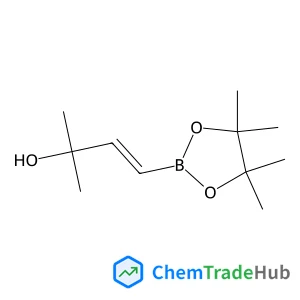
(E)-2-methyl-4-(4,4,5,5-tetramethyl-1,3,2-dioxaborolan-2-yl)but-3-en-2-ol
CAS Number:
581802-26-8
Molecular Formula:
C11H21BO3
Rui Sang, Yuya Hu, Rauf Razzaq, Ralf Jackstell, Matthias Beller
Palladium-catalyzed alkoxycarbonylation reactions allow for the efficient conversion of widely available unsaturated compounds, CO and alcohols into the corresponding carboxylic acid derivatives. A driving force for the development of new and improved catalytic methodologies is the design and synthesis of ligands, which fine-tune the properties of the metal center. In general, alternation of the ligand backbone and substituents adjusts the electronic and steric properties of the active catalyst species to control activity and selectivity of a given catalytic process. Therefore, our group has a long-standing interest in ligand developments. In the past decade, several classes of ligands have been developed by us for palladium-catalyzed carbonylation reactions, which are summarized in this article. As an example, mono- and bidentate phosphines with heteroaromatic backbones were prepared to overcome the limitations of known catalyst systems. The common feature of all these ligands is the function of the integrated base, which acts as a proton shuttle for the formation of the palladium hydride and the rate-determining N-assisted alcoholysis. On the other hand, the basic substituent improves the durability of the catalyst via hemilabile coordination to the palladium center in the catalytic cycle.
Anupam Bandyopadhyay, Neha Agrawal, Sachitanand M. Mali, Sandip V. Jadhav, Hosahudya N. Gopi
DOI: 10.1039/C0OB00199F
Cai-Feng Wang, Dong-Ping Li, Xin Chen, Xiao-Ming Li, Yi-Zhi Li, Jing-Lin Zuo, Xiao-Zeng You
DOI: 10.1039/B916637H
Volker M. Arlt, David H. Phillips, Jóhannes Reynisson
DOI: 10.1039/C1OB05570D
Priscila M. Lalli, Yuri E. Corilo, Patrícia V. Abdelnur, Marcos N. Eberlin
DOI: 10.1039/C001985B
Richard J. Hopkinson, Philippa S. Barlow, Christopher J. Schofield, Timothy D. W. Claridge
DOI: 10.1039/C0OB00208A
Christopher D. Gabbutt, B. Mark Heron, Colin Kilner, Suresh B. Kolla
DOI: 10.1039/C0OB00141D
Robert Ta, Alex X. Li, Filip Wojciechowski, Stephen H. Pasternak, Robert Bartha, Robert H. E. Hudson
DOI: 10.1039/B926639A
Fosca Conti, Enrico Negro, Vito Di Noto
DOI: 10.1039/B913870F
Binbin Zhou, Mark S. Denning, Thomas A. D. Chapman, John E. McGrady, Jose M. Goicoechea
DOI: 10.1039/B917185A
(1R,3S)-1,3-Cyclopentanediol finds applications in various industries. In the ph...
When handling N'-[4-(Dimethylamino)phenyl]-N,N-dimethyl-1,4-benzenediamine, it i...
There are several alternatives to 5-(2,4-Difluorophenyl)-2-methoxypyrimidine in ...
1-(3-Methoxyphenoxy)propan-2-ol (CAS: 382141-68-6) must comply with the Globally...
Tetrodotoxin Citrate is extremely dangerous and should be handled with extreme c...
2-Methyl-2-propanyl [(1R,3S)-3-hydroxycyclopentyl]carbamate (CAS: 225641-84-9) i...
Waste containing 4-(2-Hydroxyhexafluoroisopropyl)Benzoic Acid (CAS: 16261-80-6) ...
2-Methyl-2-proanyl {(2S)-1-[(benzyloxy)amino]-3-hydroxy-3-methyl-1-oxo-2-butanyl...
Benzeneethanamine, α-ethyl-, hydrochloride (1:1) is an organic compound with the...
In the synthesis of compounds similar to 3-{(E)-[4-(Dimethylamino)phenyl]diazeny...

Organic Chemistry Frontiers publishes high-quality research from across organic chemistry. Emphases are placed on studies that make significant contributions to the field of organic chemistry by reporting either new or significantly improved protocols or methodologies. Topics include, but are not limited to the following: Organic synthesis Development of synthetic methodologies Catalysis Natural products Functional organic materials Supramolecular and macromolecular chemistry Physical and computational organic chemistry