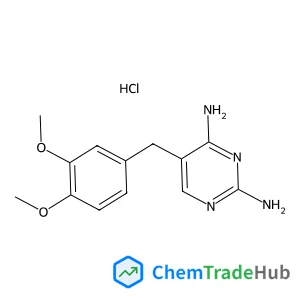
5-(3,4-Dimethoxybenzyl)-2,4-pyrimidinediamine hydrochloride (1:1)
CAS Number:
2507-23-5
Molecular Formula:
C13H17ClN4O2
Priscila M. Lalli, Yuri E. Corilo, Patrícia V. Abdelnur, Marcos N. Eberlin
The ion/molecule chemistry of four representative propagyl/allenyl cations 1–4 of the general formula R1CH+-CC-R (a) ↔ R1CHCC+-R (b), that is, the reactive C3H3+ ions of m/z 39 from EI of propargyl chloride (H2C+-CC–H, 1a), isomeric C4H5+ ions of m/z 53 from EI of 3-butyne-2-ol (2a, H2C+-CC-CH3) and 2-butyne-1-ol (CH3-CH+-CC–H, 3a), and Ph-C3H2+ ions of m/z 115 from 3-phenyl-2-propyn-1-ol (H2C+-CC-Ph, 4a) was studied via pentaquadrupole mass spectrometry. With pyridine, proton transfer was observed as the predominant process for 1 and the sole reaction channel for the isomeric 2 and 3, whereas 4 reacted preferentially by adduct formation. These outcomes were rationalized using DFT calculations from isodesmic proton transfer reactions. Similar reaction tendencies were observed with acetonitrile and acrylonitrile, with adduct formation appearing again as a minor pathway for 1, 2 and 3, and as a major reaction channel for 4. With 1,3-dioxolane, hydride abstraction was a dominant reaction, with proton transfer and adduct formation competing as side reactions. With 2,2-dimethyl-1,3-dioxolane, an interplay of reactions including methyl anion abstraction, proton transfer, hydride abstraction and adduct formation were observed depending on the ion structure, with 4 reacting again mainly by adduct formation. Proton transfer was also observed as a dominant process in reactions with ethanol for 1, 2 and 3, with 4 being nearly unreactive whereas no adduct formation was observed for any of the carbocations studied. Limited reactivity was exhibited by these ions in cycloaddition reaction with isoprene.

Science

Helvetica Chimica Acta

Organic Preparations and Procedures International

Planta Medica

Pharmacological Reviews

Proceedings of the National Academy of Sciences of the United States of America

European Journal of Wood and Wood Products

Pure and Applied Chemistry

Fibre Chemistry

Israel Journal of Chemistry
Weijuan Wang, Daming Chen, Hui Xu, Genxi Yu, Shangqi Sun, Wei Zhang, Jian Chen
DOI: 10.1039/D0SE00112K
Mingyan Chuai, Hongpeng Zhang, Yu Tong, Kewei Zhang, Mingzhe Zhang
DOI: 10.1039/D0SE00366B
Fernanda dos Santos Depoi, Tiago Charão de Oliveira, Diogo Pompéu de Moraes, Dirce Pozebon
DOI: 10.1039/C1AY05246B
Yibin Yang, Xun Cui, Di Gao, Huichao He, Yingqing Ou, Ming Zhou, Qingxin Lai, Xijun Wei, Peng Xiao, Yunhuai Zhang
DOI: 10.1039/D0SE00659A
Yamin Zhang, Biling Jiang, Chen Guo, Liping Liu, Jian Xu, Yujue Wang, Chen Shen, Jinjin Zhu, Guanxin Shen, Hao Jiang, Jintao Zhu, Juan Tao
DOI: 10.1039/D1BM00373A
Chandrasekaran Nithya, Gowtham Thiyagaraj
DOI: 10.1039/D0SE00469C
N. Queyriaux, K. Abel, J. Fize, J. Pécaut, M. Orio, L. Hammarström
DOI: 10.1039/D0SE00570C
(1R,3S)-1,3-Cyclopentanediol finds applications in various industries. In the ph...
When handling N'-[4-(Dimethylamino)phenyl]-N,N-dimethyl-1,4-benzenediamine, it i...
There are several alternatives to 5-(2,4-Difluorophenyl)-2-methoxypyrimidine in ...
1-(3-Methoxyphenoxy)propan-2-ol (CAS: 382141-68-6) must comply with the Globally...
Tetrodotoxin Citrate is extremely dangerous and should be handled with extreme c...
2-Methyl-2-propanyl [(1R,3S)-3-hydroxycyclopentyl]carbamate (CAS: 225641-84-9) i...
Waste containing 4-(2-Hydroxyhexafluoroisopropyl)Benzoic Acid (CAS: 16261-80-6) ...
2-Methyl-2-proanyl {(2S)-1-[(benzyloxy)amino]-3-hydroxy-3-methyl-1-oxo-2-butanyl...
Benzeneethanamine, α-ethyl-, hydrochloride (1:1) is an organic compound with the...
In the synthesis of compounds similar to 3-{(E)-[4-(Dimethylamino)phenyl]diazeny...

Organic & Biomolecular Chemistry (OBC) publishes original and high impact research and reviews in organic chemistry. We welcome research that shows new or significantly improved protocols or methodologies in total synthesis, synthetic methodology or physical and theoretical organic chemistry as well as research that shows a significant advance in the organic chemistry or molecular design aspects of chemical biology, catalysis, supramolecular and macromolecular chemistry, theoretical chemistry, mechanism-oriented physical organic chemistry, medicinal chemistry or natural products. Articles published in the journal should report new work which makes a highly-significant impact in the field. Routine and incremental work is generally not suitable for publication in the journal. More details about key areas of our scope are below. In all cases authors should include in their article clear rationale for why their research has been carried out.
![(2S)-2-{[(9H-Fluoren-9-ylmethoxy)carbonyl]amino}-4-(methylselanyl)butanoic acid structure](https://static.chemtradehub.com/structs/121/1217852-49-7-f252.webp "(2S)-2-{[(9H-Fluoren-9-ylmethoxy)carbonyl]amino}-4-(methylselanyl)butanoic acid structure")
![[4-(Isobutyrylamino)phenyl]boronic acid structure](https://static.chemtradehub.com/structs/874/874219-50-8-6ab5.webp "[4-(Isobutyrylamino)phenyl]boronic acid structure")