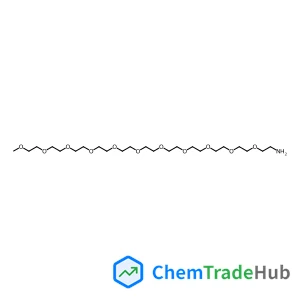
2,5,8,11,14,17,20,23,26,29,32-Undecaoxatetratriacontan-34-amine
CAS Number:
854601-60-8
Molecular Formula:
C23H49NO11
Antoine Tardy, Noémie Gil, Christopher M. Plummer, Chen Zhu, Didier Siri, Julien Nicolas, Didier Gigmes, Yohann Guillaneuf, Catherine Lefay
The radical ring-opening polymerization (rROP) of cyclic ketene acetals (CKAs) by free radical or controlled radical mechanisms attracts considerable research interest as it presents an alternative route for the synthesis of aliphatic polyesters. These monomers can undergo radical addition to their C=C double bonds which subsequently leads to propagation by ring opening. CKA/vinyl monomer copolymerization appears to be an elegant method to produce partially or fully degradable copolymers depending on the proportion of the ester functionality incorporated into the copolymer backbone. Although this approach seems promising, some important limitations still remain. Owing to DFT calculations, we are now able to understand the reactivity of CKAs and common vinyl monomers. Indeed, the calculations confirm that cross-addition is not a key parameter for the copolymerization and the reactivity ratios are linked to the homopolymerization rate coefficients of the comonomer pair. In particular, it was demonstrated that trifluoromethyl vinyl acetate (CF3VAc) should provide alternating copolymers. These structures were confirmed experimentally with reactivity ratios close to 0 for the MDO/CF3VAc system (MDO = 2-methylene-1,3-dioxepane). A solid understanding of the reactivity of CKA monomers which allows for the tunable incorporation of main-chain functionalities into copolymers would open up exciting prospects in the field of degradable materials.
A. S. Dobrota, L. D. Rafailović
DOI: 10.1039/C8CP00992A
Aimal Khan, Shuhua Zou, Ting Wang, Jerosha Ifthikar, Ali Jawad, Zhuwei Liao, Ajmal Shahzad, Audrey Ngambia, Zhuqi Chen
DOI: 10.1039/C8CP02080A
Ya-Ya Wang, Jia-Jun Deng, Xin Wang, Jian-Tao Che, Xun-Lei Ding
DOI: 10.1039/C7CP07914A
DOI: 10.1039/C8CP00350E
Dipankar Sukul, Aparesh Pal, Sanjoy Satpati, Utpal Adhikari
DOI: 10.1039/C7CP06848D
Zhe Sheng, Shujing Wu, Xianying Dai, Tianlong Zhao, Yue Hao
DOI: 10.1039/C8CP00722E
Xuemin Wang, Rui Wang, Li Shen, Zhaofeng Tang, Congying Wen, Bin Dong, Heyuan Liu, Chunfeng Zhang, Xiyou Li
DOI: 10.1039/C7CP07841B
Yu Tang, Jian Dou, Christopher M. Andolina, Yuting Li, Hongbin Ma, Stephen D. House, Xiaoyan Zhang, Judith Yang, Franklin (Feng) Tao
DOI: 10.1039/C7CP07407G
Licheng Miao, Luojia Liu, Zhenfeng Shang, Yixin Li, Yong Lu, Fangyi Cheng, Jun Chen
DOI: 10.1039/C8CP00597D
Alexey Koltsov, Jean-Michel Mataigne
DOI: 10.1039/C7CP08636A
3-Fluoro-2-methylbenzylamine is an organic compound with the CAS number 771573-3...
Tert-butyl 2-(oxetan-3-ylidene)acetate is considered safe for its intended uses ...
Proper personal protective equipment (PPE) such as gloves, goggles, and a lab co...
2-Ethyl-4-methyl-1,3-thiazole is commonly synthesized via the reaction of thiour...
This compound should be stored in a cool, dry place away from direct sunlight an...
L-Lysine Acetate Salt (CAS: 52315-92-1) is subject to various regulatory guideli...
6-Fluoro-3-hydroxy-2-pyrazinecarboxamide (CAS: 259793-96-9) is generally conside...
1,1'-Sulfonylbis(1H-imidazole) is a crystalline solid with a molecular weight of...
4-Methyl-7-nitro-1H-indole-3-carbonitrile (CAS: 289483-82-5) is primarily used i...
Waste containing 5-Bromo-3-indolyl-beta-galactoside (CAS: 97753-82-7) should be ...

Polymer Chemistry welcomes submissions in all areas of polymer science that have a strong focus on macromolecular chemistry. Manuscripts may cover a broad range of fields, yet no direct application focus is required.