













Small stoichiometric (MoS2)n clusters with the 1T phase
Literature Information
Publication Date
2018-01-30
DOI
10.1039/C7CP07914A
Impact Factor
3.676
Authors
Ya-Ya Wang, Jia-Jun Deng, Xin Wang, Jian-Tao Che, Xun-Lei Ding
View Original
Abstract
Stoichiometric (MoS2)n clusters (n = 1–6) were systematically studied by density functional theory calculations with hybrid B3LYP and pure GGA PW91 functionals. The most stable structures of these clusters were obtained by global optimizations with a genetic algorithm. A triangle of Mo3 capped with a S atom was found to be a favourite building block, which can construct the most stable structures (or at least candidates) for n = 3–6 clusters. These types of structures can be viewed as fragments of MoS2 monolayer with the 1T phase, which is an important phase that has unique reactivity and conductivity properties. Electronic structures were analyzed by means of density of states and frontier molecular orbitals (FMOs), which suggest that both Mo and S contribute to the FMOs below the Fermi energy while Mo atoms contribute more toward the unoccupied FMOs.
Related Literature
Correlating high temperature thin film ionomer electrode binder properties to hydrogen pump polarization
Gokul Venugopalan, Deepra Bhattacharya, Subarna Kole, Cameron Ysidron, Polyxeni P. Angelopoulou, Georgios Sakellariou, Christopher G. Arges
2021-05-13
Communication
DOI: 10.1039/D1MA00208B
“Comment on analysis of Fe isotopes in sulfides and iron meteorites by laser ablation high-mass resolution multi-collector ICP mass spectrometry”—a reply
Paul Sylvester
2005-12-22
Comment
DOI: 10.1039/B512647A
Synthesis of transition metal isocyanide compounds from carbonyl complexes via reaction with Li[Me3SiNR]‡
Wesley Sattler, Gerard Parkin
2009-11-12
Communication
DOI: 10.1039/B917156H
Transfer hydrogenation of levulinic acid under hydrothermal conditions catalyzed by sulfate as a temperature-switchable base
Daniel Kopetzki, Markus Antonietti
2010-02-16
Paper
DOI: 10.1039/B924648G
Computational determination of coordination structure impact on adsorption and acidity of pristine and sulfated MOF-808
Bo Yang, Joshua I. Wheeler, Brett Sorensen, Robert Steagall, Taylor Nielson, Jianhua Yao, Jose Mendez-Arroyo, Daniel H. Ess
2021-04-27
Paper
DOI: 10.1039/D1MA00330E
Novel 3D-networked melamine–naphthalene–polyamic acid nanofillers doped in vinyl ester resin for higher flame retardancy
Ravi Kumar Cheedarala, M. N. Prabhakar, Beom Gon Cho, Young Bin Park, Jung Il Song
2021-05-11
Paper
DOI: 10.1039/D1MA00048A
Tailored porous carbons enabled by persistent micelles with glassy cores
Eric R. Williams, Paige L. McMahon, Joseph E. Reynolds, III, Jonathan L. Snider, Vitalie Stavila, Mark D. Allendorf, Morgan Stefik
2021-06-01
Paper
DOI: 10.1039/D1MA00146A
Effects of acidity and immiscibility of lactam-based Brønsted-acidic ionic liquids on their catalytic performance for esterification
Hancheng Zhou, Jing Yang, Linmin Ye, Haiqiang Lin, Youzhu Yuan
2010-02-19
Paper
DOI: 10.1039/B921081D
Nontoxic photoluminescent tin oxide nanoparticles for cell imaging: deep eutectic solvent mediated synthesis, tuning and mechanism
Linmariya Devassy Koonathan, Suman Neogy, Anil K. Debnath, Soumyakanti Adhikari
2021-05-10
Paper
DOI: 10.1039/D1MA00042J
You might also like
Compound Q&A
What precautions should be taken when handling 4-Methyl-6-(trifluoromethyl)quinoline (CAS: 40716-16-3)?
When handling 4-Methyl-6-(trifluoromethyl)quinoline (CAS: 40716-16-3), safety go...
40716-16-34-Methyl-6-(trifluor...
Compound Q&A
What is 4-(3,5-Difluorophenyl)aniline (CAS: 405058-00-6)?
4-(3,5-Difluorophenyl)aniline is an aromatic organic compound with the CAS numbe...
405058-00-64-(3,5-Difluoropheny...
Compound Q&A
How is 5-{[4-(Trifluoromethyl)phenyl]sulfanyl}-1,2,3-thiadiazole-4-carboxylic acid (CAS: 338982-07-3) typically synthesized?
5-{[4-(Trifluoromethyl)phenyl]sulfanyl}-1,2,3-thiadiazole-4-carboxylic acid can ...
338982-07-35-{[4-(Trifluorometh...
Compound Q&A
What is the market or research trend for 4-Benzylaniline hydrochloride (CAS: 6317-57-3)?
The market for 4-Benzylaniline hydrochloride (CAS: 6317-57-3) is steadily growin...
6317-57-34-Benzylaniline hydr...
Compound Q&A
Is [3-(Diethylsulfamoyl)phenyl]boronic acid (CAS: 871329-58-7) safe?
[3-(Diethylsulfamoyl)phenyl]boronic acid is generally considered safe when handl...
871329-58-7[3-(Diethylsulfamoyl...
Compound Q&A
What are the main uses of 3-Bromo-2,5-dimethoxyaniline (CAS: 115929-62-9)?
3-Bromo-2,5-dimethoxyaniline is mainly used in the pharmaceutical and chemical i...
115929-62-93-Bromo-2,5-dimethox...
Compound Q&A
What regulatory guidelines apply to N-Methyl-1-(5-methyl-1H-indol-3-yl)methanamine (CAS: 915922-67-7)?
N-Methyl-1-(5-methyl-1H-indol-3-yl)methanamine (CAS: 915922-67-7) is subject to ...
915922-67-7N-Methyl-1-(5-methyl...
Compound Q&A
What industries use Carbamic acid, N-[(5S)-5,6-diamino-6-oxohexyl]-, 1,1-dimethylethyl ester (CAS: 24828-96-4)?
This compound is primarily used in the pharmaceutical industry for the synthesis...
24828-96-4Carbamic acid, N-[(5...
Compound Q&A
How should 2-Methyl-2-propanyl [(1S,3R)-3-aminocyclohexyl]carbamate (CAS: 1298101-47-9) be stored?
2-Methyl-2-propanyl [(1S,3R)-3-aminocyclohexyl]carbamate (CAS: 1298101-47-9) sho...
1298101-47-92-Methyl-2-propanyl ...
Compound Q&A
What industries use Ethyl 2-bromo-4,4,4-trifluorobutanoate (CAS: 367-33-9)?
Ethyl 2-bromo-4,4,4-trifluorobutanoate (CAS: 367-33-9) is utilized in the pharma...
367-33-9Ethyl 2-bromo-4,4,4-...
Source Journal
Physical Chemistry Chemical Physics

CiteScore:
5.5
Self-citation Rate:
10.3%
Articles per Year:
3036
Physical Chemistry Chemical Physics (PCCP) is an international journal co-owned by 19 physical chemistry and physics societies from around the world. This journal publishes original, cutting-edge research in physical chemistry, chemical physics and biophysical chemistry. To be suitable for publication in PCCP, articles must include significant innovation and/or insight into physical chemistry; this is the most important criterion that reviewers and Editors will judge against when evaluating submissions. The journal has a broad scope and welcomes contributions spanning experiment, theory, computation and data science. Topical coverage includes spectroscopy, dynamics, kinetics, statistical mechanics, thermodynamics, electrochemistry, catalysis, surface science, quantum mechanics, quantum computing and machine learning. Interdisciplinary research areas such as polymers and soft matter, materials, nanoscience, energy, surfaces/interfaces, and biophysical chemistry are welcomed if they demonstrate significant innovation and/or insight into physical chemistry. Joined experimental/theoretical studies are particularly appreciated when complementary and based on up-to-date approaches.
Recommended Compounds
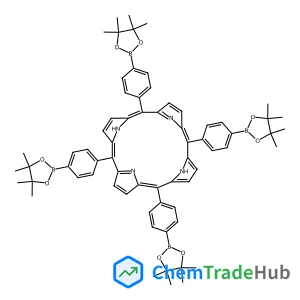
5,10,15,20-tetrakis(4-boronic acid pinacol ester phenyl) porphyrin
CAS Number:
1332748-00-1
Molecular Formula:
C68H74B4N4O8
Recommended Suppliers






Disclaimer
This page provides academic journal information for reference and research purposes only. We are not affiliated with any journal publishers and do not handle publication submissions. For publication-related inquiries, please contact the respective journal publishers directly.
If you notice any inaccuracies in the information displayed, please contact us at support@chemtradehub.com. We will promptly review and address your concerns.