












Structural, electronic and adhesion characteristics of zinc/silica interfaces: ab initio study on zinc/β-cristobalite
Literature Information
Publication Date
2018-01-29
DOI
10.1039/C7CP08636A
Impact Factor
3.676
Authors
Alexey Koltsov, Jean-Michel Mataigne
View Original
Abstract
The weak interaction between zinc and silica is responsible for a poor performance of anti-corrosive galvanic zinc coatings on modern advanced high strength steels. With the goal of identifying its microscopic origin, we report an extensive ab initio study on the structural, electronic, and adhesion characteristics of a variety of model zinc/β-cristobalite interfaces, representative for different oxidation conditions. We show that the weakness of the zinc–silica interaction at non polar interfaces is driven by the presence of surface siloxane rings. These latter are drastically detrimental to interface adhesion when intact and their breaking is impeded by a large energy barrier. Conversely, the characteristics of polar interfaces are principally driven by the capacity of zinc to screen the surface compensating charges and to form O–Zn bonds. This screening is especially efficient in an oxygen-rich environment where the substrate-induced partial oxidation of the zinc deposit produces a considerable enhancement of interface adhesion. The identified microscopic mechanisms of interface interactions furnish precious guidelines towards practical attempts to improve adhesion. In particular, processes which enable breaking the surface siloxane rings are expected to noticeably reinforce the interaction at non-polar interfaces.
Related Literature
A binary PMMA/PVDF blend film modified substrate enables a superior lithium metal anode for lithium batteries
Xiaosong Xiong, Ruoyu Zhi, Qi Zhou, Wenqi Yan, Yusong Zhu, Yuhui Chen, Lijun Fu, Nengfei Yu, Yuping Wu
2021-05-11
Communication
DOI: 10.1039/D1MA00121C
Azobenzene isomerization in condensed matter: lessons for the design of efficient light-responsive soft-matter systems
Luke W. Giles, Charl F. J. Faul, Rico F. Tabor
2021-06-03
Review Article
DOI: 10.1039/D1MA00340B
History and recent developments in divergent electrolytes towards high-efficiency lithium–sulfur batteries – a review
Srikanth Ponnada, Maryam Sadat Kiai, Demudu Babu Gorle, Annapurna Nowduri
2021-06-16
Review Article
DOI: 10.1039/D1MA00332A
Optimization of LC-DRC-ICP-MS for the speciation of selenotrisulfides with simultaneous detection of sulfur and selenium as oxides combined with determination of elemental and isotope ratios
Stefan Stürup, Lars Bendahl, Bente Gammelgaard
2005-12-16
Technical Note
DOI: 10.1039/B514633J
Molecular gate effects observed in fluoroalkylsilane self-assembled monolayers grafted on LiNi0.5Mn1.5O4 cathodes: an application to efficient ion-exchange reactions
Youn Charles-Blin, Hitomi Todoki
2021-06-22
Paper
DOI: 10.1039/D1MA00426C
Novel 3D-networked melamine–naphthalene–polyamic acid nanofillers doped in vinyl ester resin for higher flame retardancy
Ravi Kumar Cheedarala, M. N. Prabhakar, Beom Gon Cho, Young Bin Park, Jung Il Song
2021-05-11
Paper
DOI: 10.1039/D1MA00048A
Green chemistry synthesis of nanostructured poly(2,5-dimethoxyaniline)
Sujit Jain, Sumedh P. Surwade, Srikanth Rao Agnihotra, Vineet Dua, Pamela A. Eliason, Gregory J. Morose, Sanjeev K. Manohar
2010-02-19
Communication
DOI: 10.1039/B923400D
Selective hydration of dihydromyrcene in ionic liquids
Paul N. Davey, Martyn J. Earle, Jennifer T. Hamill, Suhas P. Katdare, David W. Rooney, Kenneth R. Seddon
2010-02-08
Paper
DOI: 10.1039/B915131A
You might also like
Compound Q&A
What precautions should be taken when handling 4-Methyl-6-(trifluoromethyl)quinoline (CAS: 40716-16-3)?
When handling 4-Methyl-6-(trifluoromethyl)quinoline (CAS: 40716-16-3), safety go...
40716-16-34-Methyl-6-(trifluor...
Compound Q&A
What is 4-(3,5-Difluorophenyl)aniline (CAS: 405058-00-6)?
4-(3,5-Difluorophenyl)aniline is an aromatic organic compound with the CAS numbe...
405058-00-64-(3,5-Difluoropheny...
Compound Q&A
How is 5-{[4-(Trifluoromethyl)phenyl]sulfanyl}-1,2,3-thiadiazole-4-carboxylic acid (CAS: 338982-07-3) typically synthesized?
5-{[4-(Trifluoromethyl)phenyl]sulfanyl}-1,2,3-thiadiazole-4-carboxylic acid can ...
338982-07-35-{[4-(Trifluorometh...
Compound Q&A
What is the market or research trend for 4-Benzylaniline hydrochloride (CAS: 6317-57-3)?
The market for 4-Benzylaniline hydrochloride (CAS: 6317-57-3) is steadily growin...
6317-57-34-Benzylaniline hydr...
Compound Q&A
Is [3-(Diethylsulfamoyl)phenyl]boronic acid (CAS: 871329-58-7) safe?
[3-(Diethylsulfamoyl)phenyl]boronic acid is generally considered safe when handl...
871329-58-7[3-(Diethylsulfamoyl...
Compound Q&A
What are the main uses of 3-Bromo-2,5-dimethoxyaniline (CAS: 115929-62-9)?
3-Bromo-2,5-dimethoxyaniline is mainly used in the pharmaceutical and chemical i...
115929-62-93-Bromo-2,5-dimethox...
Compound Q&A
What regulatory guidelines apply to N-Methyl-1-(5-methyl-1H-indol-3-yl)methanamine (CAS: 915922-67-7)?
N-Methyl-1-(5-methyl-1H-indol-3-yl)methanamine (CAS: 915922-67-7) is subject to ...
915922-67-7N-Methyl-1-(5-methyl...
Compound Q&A
What industries use Carbamic acid, N-[(5S)-5,6-diamino-6-oxohexyl]-, 1,1-dimethylethyl ester (CAS: 24828-96-4)?
This compound is primarily used in the pharmaceutical industry for the synthesis...
24828-96-4Carbamic acid, N-[(5...
Compound Q&A
How should 2-Methyl-2-propanyl [(1S,3R)-3-aminocyclohexyl]carbamate (CAS: 1298101-47-9) be stored?
2-Methyl-2-propanyl [(1S,3R)-3-aminocyclohexyl]carbamate (CAS: 1298101-47-9) sho...
1298101-47-92-Methyl-2-propanyl ...
Compound Q&A
What industries use Ethyl 2-bromo-4,4,4-trifluorobutanoate (CAS: 367-33-9)?
Ethyl 2-bromo-4,4,4-trifluorobutanoate (CAS: 367-33-9) is utilized in the pharma...
367-33-9Ethyl 2-bromo-4,4,4-...
Source Journal
Physical Chemistry Chemical Physics

CiteScore:
5.5
Self-citation Rate:
10.3%
Articles per Year:
3036
Physical Chemistry Chemical Physics (PCCP) is an international journal co-owned by 19 physical chemistry and physics societies from around the world. This journal publishes original, cutting-edge research in physical chemistry, chemical physics and biophysical chemistry. To be suitable for publication in PCCP, articles must include significant innovation and/or insight into physical chemistry; this is the most important criterion that reviewers and Editors will judge against when evaluating submissions. The journal has a broad scope and welcomes contributions spanning experiment, theory, computation and data science. Topical coverage includes spectroscopy, dynamics, kinetics, statistical mechanics, thermodynamics, electrochemistry, catalysis, surface science, quantum mechanics, quantum computing and machine learning. Interdisciplinary research areas such as polymers and soft matter, materials, nanoscience, energy, surfaces/interfaces, and biophysical chemistry are welcomed if they demonstrate significant innovation and/or insight into physical chemistry. Joined experimental/theoretical studies are particularly appreciated when complementary and based on up-to-date approaches.
Recommended Compounds
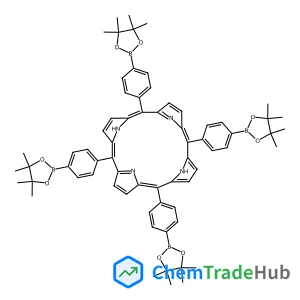
5,10,15,20-tetrakis(4-boronic acid pinacol ester phenyl) porphyrin
CAS Number:
1332748-00-1
Molecular Formula:
C68H74B4N4O8
![6,7-Dihydro-5H-pyrrolo[1,2-a]imidazole-6-carboxylic acid structure](https://static.chemtradehub.com/structs/136/1369160-12-2-6524.webp "6,7-Dihydro-5H-pyrrolo[1,2-a]imidazole-6-carboxylic acid structure")
6,7-Dihydro-5H-pyrrolo[1,2-a]imidazole-6-carboxylic acid
CAS Number:
1369160-12-2
Molecular Formula:
C7H8N2O2
Recommended Suppliers




Disclaimer
This page provides academic journal information for reference and research purposes only. We are not affiliated with any journal publishers and do not handle publication submissions. For publication-related inquiries, please contact the respective journal publishers directly.
If you notice any inaccuracies in the information displayed, please contact us at support@chemtradehub.com. We will promptly review and address your concerns.