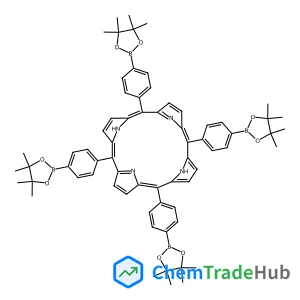
5,10,15,20-tetrakis(4-boronic acid pinacol ester phenyl) porphyrin
CAS Number:
1332748-00-1
Molecular Formula:
C68H74B4N4O8
A. S. Dobrota, L. D. Rafailović
New electrode materials for alkaline-ion batteries are a timely topic. Among many promising candidates, V2O5 is one of the most interesting cathode materials. While having very high theoretical capacity, in practice, its performance is hindered by its low stability and poor conductivity. As regards the theoretical descriptions of V2O5, common DFT–GGA calculations fail to reproduce both the electronic and crystal structures. While the band gap is underestimated, the interlayer spacing is overestimated as weak dispersion interactions are not properly described within GGA. Here we show that the combination of the DFT+U method and semi-empirical D2 correction can compensate for the drawbacks of the GGA when it comes to the modelling of V2O5. When compared to common PBE calculations, with a modest increase in the computational cost, PBE+U+D2 fully reproduced the experimental band gap of V2O5, while the errors in the lattice parameters are only a few percent. Using the proposed PBE+U+D2 methodology we studied the doping of V2O5 with 3d elements (from Sc to Zn). We show that both the structural and electronic parameters are affected by doping. Most importantly, a significant increase in conductivity is expected upon doping, which is of great importance for the application of V2O5 in metal-ion batteries.
Zhifeng Xiao, Shaik Waseem Vali, Wenmiao Chen, Qi Wang, Yutao Huang, Tian-Hao Yan, Jason E. Kuszynski, Paul A. Lindahl, Matthew R. Ryder
DOI: 10.1039/D1MA00163A
Marija Petkovic, Jamie L. Ferguson, H. Q. Nimal Gunaratne, Rui Ferreira, Maria C. Leitão, Luís Paulo N. Rebelo
DOI: 10.1039/B922247B
Jason P. Hallett, Tom Welton
DOI: 10.1039/B918787A
Marius Grundmann, Tillmann Stralka, Michael Lorenz, Susanne Selle, Christian Patzig, Thomas Höche
DOI: 10.1039/D1MA00204J
Jutta Frank, Michael Krachler, William Shotyk
DOI: 10.1039/B514268G
Andy Scheffer, Rolf Brandt, Carsten Engelhard, Stephan Evers, Norbert Jakubowski, Wolfgang Buscher
DOI: 10.1039/B510779B
Stefan Stürup, Lars Bendahl, Bente Gammelgaard
DOI: 10.1039/B514633J
Srikanth Mandava, Ranita Basu, B. Khasimsaheb, Sai Muthukumar V., Ajay Singh, S. Neeleshwar
DOI: 10.1039/D1MA00155H
When handling 4-Methyl-6-(trifluoromethyl)quinoline (CAS: 40716-16-3), safety go...
4-(3,5-Difluorophenyl)aniline is an aromatic organic compound with the CAS numbe...
5-{[4-(Trifluoromethyl)phenyl]sulfanyl}-1,2,3-thiadiazole-4-carboxylic acid can ...
The market for 4-Benzylaniline hydrochloride (CAS: 6317-57-3) is steadily growin...
[3-(Diethylsulfamoyl)phenyl]boronic acid is generally considered safe when handl...
3-Bromo-2,5-dimethoxyaniline is mainly used in the pharmaceutical and chemical i...
N-Methyl-1-(5-methyl-1H-indol-3-yl)methanamine (CAS: 915922-67-7) is subject to ...
This compound is primarily used in the pharmaceutical industry for the synthesis...
2-Methyl-2-propanyl [(1S,3R)-3-aminocyclohexyl]carbamate (CAS: 1298101-47-9) sho...
Ethyl 2-bromo-4,4,4-trifluorobutanoate (CAS: 367-33-9) is utilized in the pharma...

Physical Chemistry Chemical Physics (PCCP) is an international journal co-owned by 19 physical chemistry and physics societies from around the world. This journal publishes original, cutting-edge research in physical chemistry, chemical physics and biophysical chemistry. To be suitable for publication in PCCP, articles must include significant innovation and/or insight into physical chemistry; this is the most important criterion that reviewers and Editors will judge against when evaluating submissions. The journal has a broad scope and welcomes contributions spanning experiment, theory, computation and data science. Topical coverage includes spectroscopy, dynamics, kinetics, statistical mechanics, thermodynamics, electrochemistry, catalysis, surface science, quantum mechanics, quantum computing and machine learning. Interdisciplinary research areas such as polymers and soft matter, materials, nanoscience, energy, surfaces/interfaces, and biophysical chemistry are welcomed if they demonstrate significant innovation and/or insight into physical chemistry. Joined experimental/theoretical studies are particularly appreciated when complementary and based on up-to-date approaches.

![6-Bromo-3-ethyl-3H-imidazo[4,5-b]pyridine structure](https://static.chemtradehub.com/structs/103/1033202-59-3-2a8f.webp "6-Bromo-3-ethyl-3H-imidazo[4,5-b]pyridine structure")