












Polyarylene polyimides with hydrocarbon and semi-fluorinated backbones: synthesis, characterization, and properties
Literature Information
Publication Date
2020-09-01
DOI
10.1039/D0PY00814A
Impact Factor
5.582
Authors
Stephen M. Budy, Jamie Dore Hall, David Y. Son
View Original
Abstract
A series of six new polyarylene polyimides (PAPI) was prepared from a highly phenylated phenylenediamine synthesized via a Diels–Alder reaction. The diamine was reacted with a variety of dianhydrides using a one-step microwave-assisted step-growth polycondensation reaction to give the PAPI. The polymerizations were complete in 10 to 30 minutes using isoquinoline as catalyst. Yields as high as 99% were achieved using nitrobenzene as the solvent. A semi-fluorinated dianhydride was included to compare polyimide properties to the hydrocarbon materials. Full characterization was carried out via1H and 19F nuclear magnetic resonance spectroscopy and attenuated total reflectance Fourier transform infrared spectroscopy. Thermal properties were characterized via thermal gravimetric analysis and differential scanning calorimetry. The onset of thermal degradation was approximately 550 °C in nitrogen and air atmospheres while the char yields at 1000 °C in nitrogen were almost 70%. The semi-fluorinated polyarylene polyimide exhibited the highest char yield. Glass transition temperatures were in the range of 355 to 387 °C, with the semi-fluorinated material possessing the highest Tg and the most rigid material affording the lowest Tg. Optical transparency was good in all the materials, with the semi-fluorinated material having the largest optical window in the UV-Vis region. The polymers were colorless or pale yellow solids. Solubility was excellent in chloroform, tetrahydrofuran, toluene, and cyclohexanone. We are currently interested in these materials and precursors for fuel cell and gas separation membranes, coatings, fibers, adhesives, and composite applications.
Related Literature
Persistent homology analysis of ion aggregations and hydrogen-bonding networks
2018-04-27
Paper
DOI: 10.1039/C8CP01552J
Excitation spectra of retinal by multiconfiguration pair-density functional theory
Sijia S. Dong, Laura Gagliardi, Donald G. Truhlar
2018-02-08
Paper
DOI: 10.1039/C7CP07275A
Solvation-controlled lithium-ion complexes in a nonflammable solvent containing ethylene carbonate: structural and electrochemical aspects
Michiru Sogawa, Hikaru Kawanoue, Yanko Marinov Todorov, Daisuke Hirayama, Hideyuki Mimura, Nobuko Yoshimoto, Masayuki Morita, Kenta Fujii
2018-02-09
Paper
DOI: 10.1039/C7CP08511G
Structural and electronic properties of V2O5 and their tuning by doping with 3d elements – modelling using the DFT+U method and dispersion correction
A. S. Dobrota, L. D. Rafailović
2018-04-18
Paper
DOI: 10.1039/C8CP00992A
The effect of different organic solvents on sodium ion storage in carbon nanopores
Sharif Khan, Tomonori Ohba, Qiong Cai
2018-02-05
Paper
DOI: 10.1039/C7CP04878E
Imaging the ordering of a weakly adsorbed two-dimensional condensate: ambient-pressure microscopy and spectroscopy of CO2 molecules on rutile TiO2(110)
Mausumi Mahapatra, David C. Grinter, Fang Xu, Si Luo, Robert M. Palomino, Shyam Kattel, Iradwikanari Waluyo, Ping Liu, Dario J. Stacchiola, Sanjaya D. Senanayake
2018-05-01
Communication
DOI: 10.1039/C8CP01614C
Theoretical insights into the reactivity of Fe-based catalysts for water oxidation: the role of electron-withdrawing groups
Penglin Xu, Shaojin Hu, Hou-Dao Zhang, Xiao Zheng
2018-04-30
Paper
DOI: 10.1039/C8CP00687C
Ammonolysis of ketene as a potential source of acetamide in the troposphere: a quantum chemical investigation
Saptarshi Sarkar, Subhasish Mallick, Pradeep Kumar, Biman Bandyopadhyay
2018-04-25
Paper
DOI: 10.1039/C8CP01650J
Magnetic field effects dynamics of ethylammonium nitrate ionic liquid confined between glass plates
2018-01-31
Paper
DOI: 10.1039/C7CP06554J
Associative detachment (AD) paths for H and CN− in the gas-phase: astrophysical implications
Stanka V. Jerosimić, Franco A. Gianturco, Roland Wester
2017-10-17
Paper
DOI: 10.1039/C7CP05573K
You might also like
Compound Q&A
What is 3-Fluoro-2-methylbenzylamine (CAS: 771573-36-5)?
3-Fluoro-2-methylbenzylamine is an organic compound with the CAS number 771573-3...
771573-36-53-Fluoro-2-methylben...
Compound Q&A
Is Tert-butyl 2-(oxetan-3-ylidene)acetate (CAS: 1207175-03-8) safe?
Tert-butyl 2-(oxetan-3-ylidene)acetate is considered safe for its intended uses ...
1207175-03-8Tert-butyl 2-(oxetan...
Compound Q&A
What precautions should be taken when handling 4-Acetyl-2-fluorobenzonitrile (CAS: 214760-18-6)?
Proper personal protective equipment (PPE) such as gloves, goggles, and a lab co...
214760-18-64-Acetyl-2-fluoroben...
Compound Q&A
How is 2-Ethyl-4-methyl-1,3-thiazole (CAS: 15679-12-6) typically synthesized?
2-Ethyl-4-methyl-1,3-thiazole is commonly synthesized via the reaction of thiour...
15679-12-62-Ethyl-4-methyl-1,3...
Compound Q&A
How should 5',5''-([2,2'-Bithiophene]-5,5'-diyl)bis(([1,1':3',1''-terphenyl]-4,4''-dicarboxylic acid)) (CAS: 1227780-71-3) be stored?
This compound should be stored in a cool, dry place away from direct sunlight an...
1227780-71-35',5''''-([2,2'-Bith...
Compound Q&A
What regulatory guidelines apply to L-Lysine Acetate Salt (CAS: 52315-92-1)?
L-Lysine Acetate Salt (CAS: 52315-92-1) is subject to various regulatory guideli...
52315-92-1L-LYSINE ACETATE SAL...
Compound Q&A
Is 6-Fluoro-3-hydroxy-2-pyrazinecarboxamide (CAS: 259793-96-9) safe?
6-Fluoro-3-hydroxy-2-pyrazinecarboxamide (CAS: 259793-96-9) is generally conside...
259793-96-96-Fluoro-3-hydroxy-2...
Compound Q&A
What are the physical and chemical properties of 1,1'-Sulfonylbis(1H-imidazole) (CAS: 7189-69-7)?
1,1'-Sulfonylbis(1H-imidazole) is a crystalline solid with a molecular weight of...
7189-69-71,1'-Sulfonylbis(1H-...
Compound Q&A
What industries use 4-methyl-7-nitro-1H-indole-3-carbonitrile (CAS: 289483-82-5)?
4-Methyl-7-nitro-1H-indole-3-carbonitrile (CAS: 289483-82-5) is primarily used i...
289483-82-54-methyl-7-nitro-1H-...
Compound Q&A
How should waste containing 5-Bromo-3-indolyl-beta-galactoside (CAS: 97753-82-7) be handled?
Waste containing 5-Bromo-3-indolyl-beta-galactoside (CAS: 97753-82-7) should be ...
97753-82-75-Bromo-3-indolyl-be...
Source Journal
Polymer Chemistry

CiteScore:
8.6
Self-citation Rate:
7.3%
Articles per Year:
457
Polymer Chemistry welcomes submissions in all areas of polymer science that have a strong focus on macromolecular chemistry. Manuscripts may cover a broad range of fields, yet no direct application focus is required.
Recommended Compounds
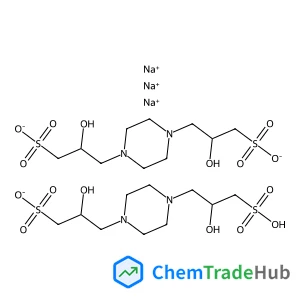
3,3'-(Piperazine-1,4-diyl)bis(2-hydroxypropane-1-sulfonic acid) Sodium Salt
CAS Number:
108321-08-0
Molecular Formula:
C20H41N4Na3O16S4
Recommended Suppliers






Disclaimer
This page provides academic journal information for reference and research purposes only. We are not affiliated with any journal publishers and do not handle publication submissions. For publication-related inquiries, please contact the respective journal publishers directly.
If you notice any inaccuracies in the information displayed, please contact us at support@chemtradehub.com. We will promptly review and address your concerns.