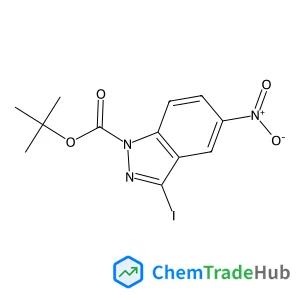
Tert-butyl 3-iodo-5-nitro-1H-indazole-1-carboxylate
CAS Number:
459133-69-8
Molecular Formula:
C12H12IN3O4
Sijia S. Dong, Laura Gagliardi, Donald G. Truhlar
Retinal is the chromophore in proteins responsible for vision. The absorption maximum of retinal is sensitive to mutations of the protein. However, it is not easy to predict the absorption spectrum of retinal accurately, and questions remain even after intensive investigation. Retinal poses a challenge for Kohn–Sham density functional theory (KS-DFT) because of the charge transfer character in its excitations, and it poses a challenge for wave function theory because the large size of the molecule makes multiconfigurational perturbation theory methods expensive. In this study, we demonstrate that multiconfiguration pair-density functional theory (MC-PDFT) provides an efficient way to predict the vertical excitation energies of 11-Z retinal, and it reproduces the experimentally determined absorption band widths and peak positions better than complete active space second-order perturbation theory (CASPT2). The consistency between complete active space self-consistent field (CASSCF) and KS-DFT dipole moments is demonstrated to be a useful criterion in selecting the active space. We also found that the nature of the terminal groups and the conformations of retinal play a significant role in the absorption spectrum. By considering a thermal distribution of conformations, we predict an absorption spectrum of retinal that is consistent with the experimental gas-phase spectrum. The location of the absorption peak and the spectral broadening based on MC-PDFT calculations agree better with experiments than those of CASPT2.
Qunzhou Bian, Carmen C. Garcia, Joachim Koch, Kay Niemax
DOI: 10.1039/B513690C
Qingchun Zhang, Weiping Ren, Xiang Yi, Zubin Zhou, Xiaochun Peng, Meidong Lang
DOI: 10.1039/C3TB20261E
Savarimuthu Philip Anthony, Sunil Varughese, Sylvia M. Draper
DOI: 10.1039/B914027A
Stefan Stürup, Lars Bendahl, Bente Gammelgaard
DOI: 10.1039/B514633J
Luke W. Giles, Charl F. J. Faul, Rico F. Tabor
DOI: 10.1039/D1MA00340B
Daniel Goitom, Erik Björn
DOI: 10.1039/B514503A
Sungjemmenla, Chhail Bihari Soni, S. K. Vineeth, Vipin Kumar
DOI: 10.1039/D1MA00247C
Gokul Venugopalan, Deepra Bhattacharya, Subarna Kole, Cameron Ysidron, Polyxeni P. Angelopoulou, Georgios Sakellariou, Christopher G. Arges
DOI: 10.1039/D1MA00208B
When handling 4-Methyl-6-(trifluoromethyl)quinoline (CAS: 40716-16-3), safety go...
4-(3,5-Difluorophenyl)aniline is an aromatic organic compound with the CAS numbe...
5-{[4-(Trifluoromethyl)phenyl]sulfanyl}-1,2,3-thiadiazole-4-carboxylic acid can ...
The market for 4-Benzylaniline hydrochloride (CAS: 6317-57-3) is steadily growin...
[3-(Diethylsulfamoyl)phenyl]boronic acid is generally considered safe when handl...
3-Bromo-2,5-dimethoxyaniline is mainly used in the pharmaceutical and chemical i...
N-Methyl-1-(5-methyl-1H-indol-3-yl)methanamine (CAS: 915922-67-7) is subject to ...
This compound is primarily used in the pharmaceutical industry for the synthesis...
2-Methyl-2-propanyl [(1S,3R)-3-aminocyclohexyl]carbamate (CAS: 1298101-47-9) sho...
Ethyl 2-bromo-4,4,4-trifluorobutanoate (CAS: 367-33-9) is utilized in the pharma...

Physical Chemistry Chemical Physics (PCCP) is an international journal co-owned by 19 physical chemistry and physics societies from around the world. This journal publishes original, cutting-edge research in physical chemistry, chemical physics and biophysical chemistry. To be suitable for publication in PCCP, articles must include significant innovation and/or insight into physical chemistry; this is the most important criterion that reviewers and Editors will judge against when evaluating submissions. The journal has a broad scope and welcomes contributions spanning experiment, theory, computation and data science. Topical coverage includes spectroscopy, dynamics, kinetics, statistical mechanics, thermodynamics, electrochemistry, catalysis, surface science, quantum mechanics, quantum computing and machine learning. Interdisciplinary research areas such as polymers and soft matter, materials, nanoscience, energy, surfaces/interfaces, and biophysical chemistry are welcomed if they demonstrate significant innovation and/or insight into physical chemistry. Joined experimental/theoretical studies are particularly appreciated when complementary and based on up-to-date approaches.
![Imidazo[1,2-c]pyrimidine structure](https://static.chemtradehub.com/structs/274/274-78-2-8b4c.webp "Imidazo[1,2-c]pyrimidine structure")